
Auction listings surge, but sales disappoint? What is the biggest obstacle to house price growth in 2024? This week’s key developments for property investors
Residential property auction numbers surged last week, with 437 properties going under the hammer nationwide, a substantial increase from 364 the previous week,

Auction numbers surged last week, but sales stalled
Residential property auction numbers surged last week, with 437 properties going under the hammer nationwide, a substantial increase from 364 the previous week. However, this remained well below the peak selling period in February and March this year, when more than 500 properties were auctioned each week. Notably, despite the increase in sales numbers, the auction clearance rate remained largely unchanged, with only 31% (136 properties) selling under the hammer. Over the past six weeks, auction clearance rates have hovered at a low 28% to 31%. This reflects a buyer’s market awash with properties for sale, in which buyers appear to have become more cautious and selective.
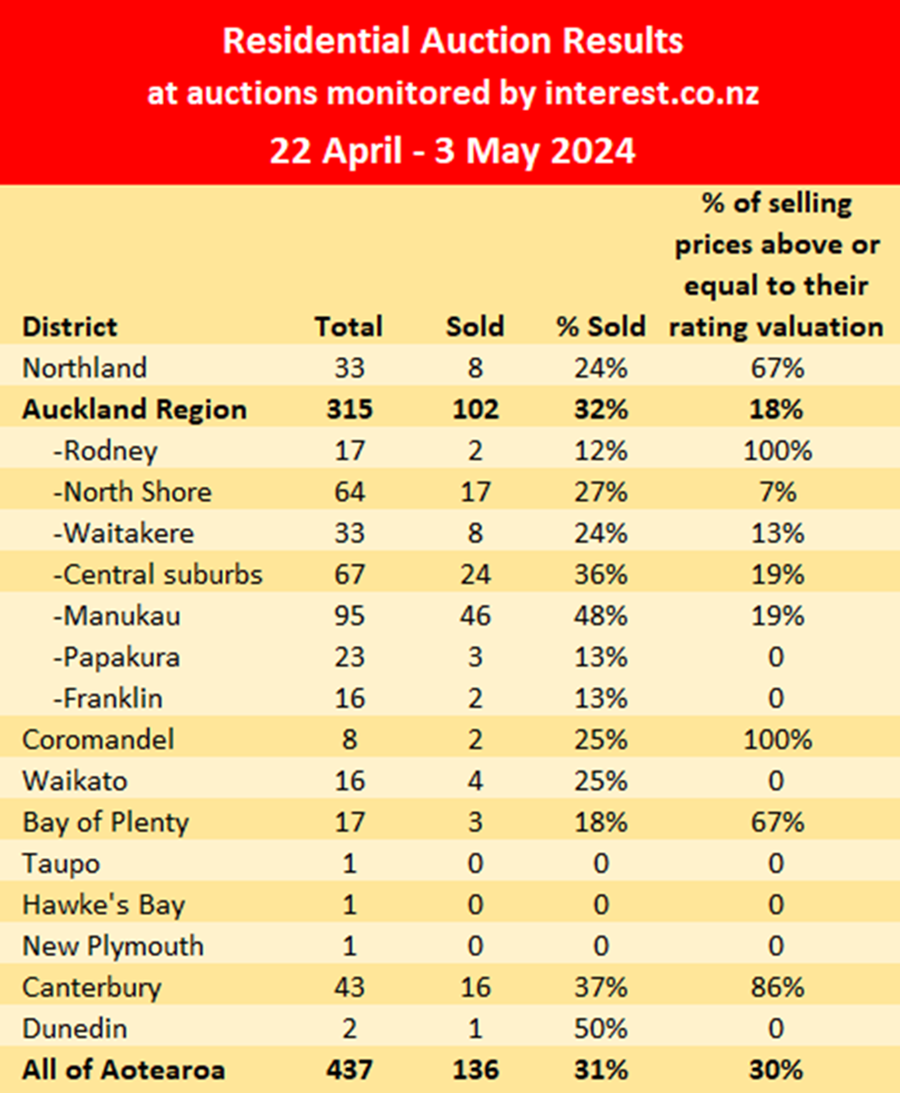
Property auction figures across New Zealand last week (Source: interest.co.nz)
02
The Reserve Bank has yet to announce the details of debt-to-income restrictions
The latest Financial Stability Report released by the Reserve Bank of New Zealand last week seemed ‘somewhat reserved’, merely noting that New Zealand’s financial system remained reasonably resilient and banks were well capitalised, while identifying risks requiring attention, such as insurance availability and costs. On the housing market, the report noted that mortgage repricing had largely been completed smoothly, with only around 10% of outstanding lending still carrying interest rates below 4%. Debt-to-income caps remained under consideration, but the Reserve Bank had yet to announce any substantive policy changes.
03
Will unemployment be the biggest obstacle to house price growth in 2024?
Stats NZ also released closely watched labour market figures last week. These showed unemployment rising from 4% in the final quarter of last year to 4.3% in the first quarter of this year, broadly in line with expectations. Worryingly, however, the increase was driven by outright job losses rather than more available workers entering the market. This was somewhat surprising, as filled job numbers had still been trending upwards from month 1 through March this year.
CoreLogic chief property economist Kelvin Davidson noted that these figures were volatile and that unemployment remained low by historical standards. However, further job losses were certain, including public sector redundancies, while mortgage rates would remain elevated for some time. House prices therefore still faced clear headwinds. He considered a surge in home sales or prices this year unlikely.
04
House prices flat: is the housing market still struggling?
The latest CoreLogic House Price Index showed that average house prices across New Zealand edged down 0.1% in April, remaining essentially unchanged from the previous month. Notably, prices rose towards the end of 2023, but the improvement was short-lived. Persistently high mortgage rates and an increase in listings gave buyers some pricing power, preventing sustained price growth. Moreover, although prices were around 11% below their peak two years earlier, affordability remained stretched.
05
Building consent applications continue to fall sharply?
The number of new homes approved in March was 2931, down a substantial 26% from a year earlier and marking the 18th consecutive monthly decline. Clearly, the residential construction industry faces a very difficult situation, with an even weaker pipeline ahead. However, more than 35,000 building consents were approved over the past 12 months, still well above levels following the global financial crisis of 2008 (only around 13,000 applications were approved in the 12 months around mid-2011). This suggests that the current risks of housing shortages and sharply rising house prices are very low.
06
Are first-home buyers still the most active
buyer group in the property market?
Looking ahead, this Tuesday the Reserve Bank of New Zealand will release the latest figures for March on borrowers’ choice of fixed mortgage terms. In February this year, the proportion of borrowers fixing for less than a year reached a record high. The forthcoming March figures appear likely to continue this trend, as people seek to avoid fixing for too long and missing out on falling mortgage rates. Meanwhile, CoreLogic’s April buyer classification figures will be released later this week. Are first-home buyers still the most active buyer group in the property market? We will wait and see.