
Economists warn: The damage from the Reserve Bank of New Zealand’s ‘brutal’ rate hikes is far worse than we imagine!
Kiwibank chief economist Jarrod Kerr recently warned borrowers that greater mortgage pressure lies ahead

Kiwibank chief economist Jarrod Kerr recently warned borrowers that greater mortgage pressure lies ahead. The Reserve Bank of New Zealand’s ‘brutal’ monetary policy has driven the economy into a second recession, inflicting far more damage on New Zealand borrowers’ finances than economic figures suggest.
Kerr said New Zealanders are right to worry about rising unemployment, continuing economic uncertainty and record net migration losses of citizens. These concerns reflect the harsh reality of the Reserve Bank of New Zealand’s drive to control inflation. Rising bad mortgage debt at banks, higher unemployment, people cutting spending and falling business confidence… These are all damaging consequences of the central bank’s ‘brutal’ interest rate hikes over recent years.
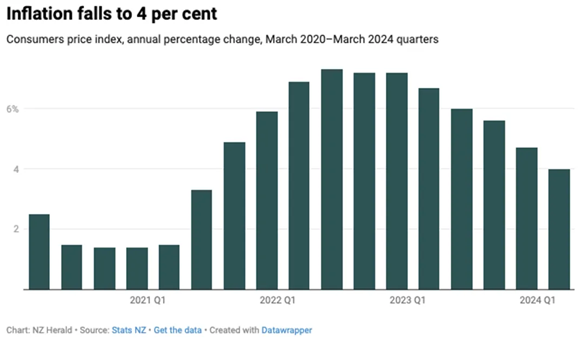
The latest consumer price index (CPI) figures released in April show annual inflation has fallen to 4%, its lowest level since peaking at 7.3% in June 2022. However, it remains above the central bank’s target range of 1%–3%. This means the battle to bring down high inflation is not over.
After first entering recession in the final quarter of 2022, New Zealand’s economy rebounded in the middle of 2023, only to decline again in the second half of 2023. Kerr explained that nominal GDP figures suggest the recession is shallow, but examining its impact on individual New Zealanders reveals a much more severe downturn. GDP per capita has shrunk by 3%, which is worse than we might imagine. We can see this in retail sales figures: the economic decline is much greater than the headline statistics suggest.
Record net migration inflows have undeniably brought benefits, but the central bank’s repeated rate hikes have pushed mortgage rates to levels that are seriously affecting the finances of borrowing households and businesses. Clearly, record numbers of new migrants have not been enough to prevent the economy from continuing to deteriorate.
Kerr warned that New Zealanders will feel greater pain from high interest rates in the period ahead.
He expects mortgage default rates to keep rising alongside unemployment, and says we are now at the critical stage where businesses are being forced to cut staff. He explained that there is a very close relationship between rising unemployment and people being forced to fall behind on their mortgages.
Although New Zealand recorded annual net migration growth of 126,000 people in December 2023—the largest increase since the record net migration gain of 134,400 in October 2023—Stats NZ figures show that record numbers of New Zealanders are still leaving, many of them moving to Australia.
In the year to February 2024, migration by New Zealand citizens set two annual records. Departures reached 74,900, surpassing the previous record of 72,400 set in February 2012. The net migration loss reached 47,700, exceeding the previous high of 44,400 in February 2012.
In Kerr’s view, Australia offers a more attractive living environment. Its central bank has been less aggressive in raising interest rates, and although mortgage repayment pressure remains considerable, it is not as unaffordable as in New Zealand. He believes that, despite the central bank’s tough measures, New Zealand’s housing market still faces a serious imbalance between supply and demand, with no sign of relief. Persistent regulatory barriers and inadequate infrastructure have further aggravated the problem.
Kerr is not alone. Prominent independent New Zealand economist Tony Alexander has also recently criticised the Reserve Bank of New Zealand publicly. He said the current situation stems from the Reserve Bank of New Zealand raising interest rates to fight inflation, ultimately placing unprecedented repayment pressure on borrowers and causing them to cut spending, particularly on big-ticket purchases such as housing, cars and furniture. We have indeed seen some declines in CPI, but the recent continuing falls in consumer spending and confidence also suggest that this pain may be precisely what the central bank wants.
Prominent independent New Zealand economist Tony Alexander
He stressed that making borrowing households suffer is only a means to an end and should not be the goal itself. The central bank needs businesses to become concerned about the economic outlook and abandon plans to raise their selling prices. This may force businesses to accept squeezed margins and the staff cuts we are currently facing.
But have businesses really lost interest in raising prices? Alexander thinks not. What we are seeing is weak consumer spending, deteriorating business conditions, redundancies and plans to cut costs. Yet businesses remain stubbornly intent on raising prices. Until that changes, the central bank will not ease monetary policy, and the property market will not recover.
Hope for the future? The timing of rate cuts is key
Kerr remains hopeful that economic conditions will turn around by the end of 2024. He expects the central bank to cut interest rates before November this year to ease households’ financial burdens. Mortgage rates are expected to fall by 100 basis points next year, helping to create a more stable market environment.
Kerr predicts that such rate cuts would give the market sufficient confidence. He believes this would lift house prices by 5% to 7% this year, with a similar increase possible next year. He acknowledged that these would be tangible gains, without the excesses seen in the past. When people see the central bank cutting interest rates, every borrowing household in New Zealand will breathe a sigh of relief.
So, do you agree with the Reserve Bank of New Zealand’s approach to raising interest rates over the past two years? Share your views in the comments below.