
Major banks make substantial cuts to fixed mortgage rates! Is the current housing market a paradise for first-home buyers?
Following earlier cuts to fixed mortgage rates by ANZ and ASB, Westpac and Kiwibank have also announced reductions to some of their fixed home loan rates, effective today

1
Major banks make substantial cuts to some fixed mortgage rates
Following earlier cuts to fixed mortgage rates by ANZ and ASB, Westpac and Kiwibank have also announced reductions to some of their fixed home loan rates, effective today—with the one-year fixed rate cut by 27 basis points to 6.99%. Kiwibank’s move can be considered the most significant cut by a major New Zealand bank in the past 10 months. The other three banks cut their one-year fixed rates by 10 basis points to around 7.15%. In fact, the last time a major bank offered a one-year fixed rate below 7% was in mid-July 2023, when Kiwibank’s rate was 6.89% and Westpac’s was 6.99%.
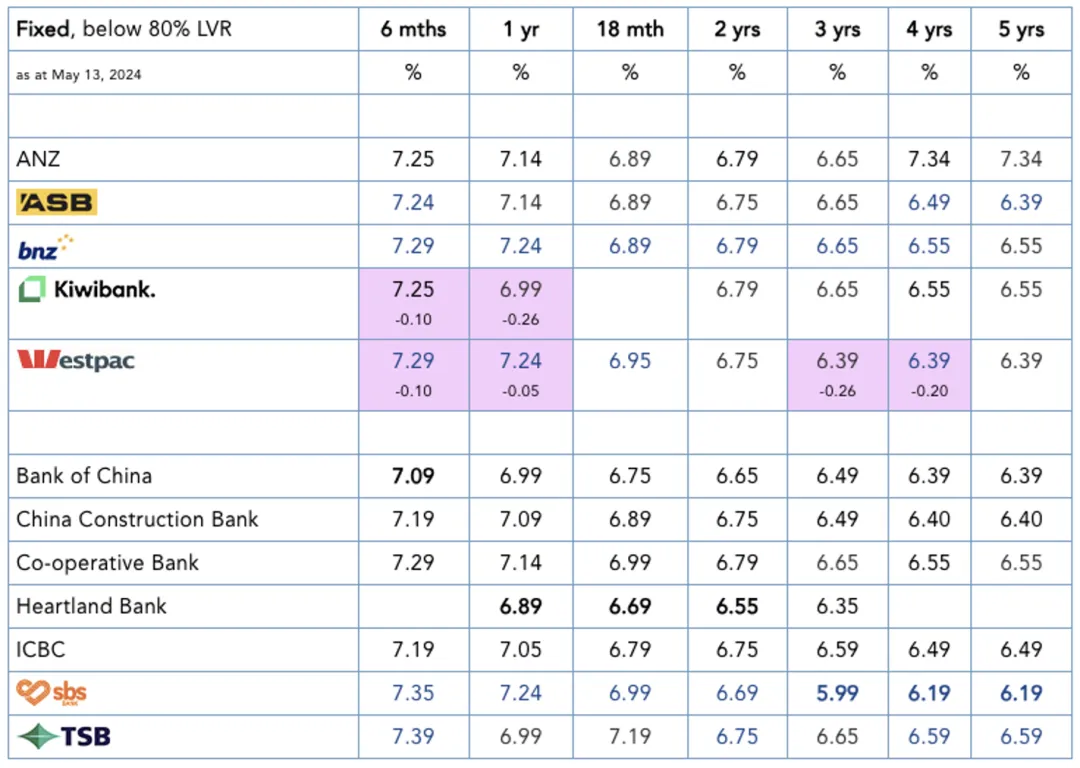
As at 13 May: Fixed mortgage rates across commercial banks (Source: Interest.co.nz)
2
Are brighter days here for first-home buyers?
CoreLogic Chief Property Economist Kelvin Davidson recently examined the state of New Zealand’s first-home buyer market and concluded that first-home buyers can now get more property for less money. Data shows that the median price paid by first-home buyers in the first quarter of 2024 was NZ$695,000, still a substantial sum for many. However, this was down from NZ$715,000 to NZ$720,000 around 12 to 18 months earlier. The proportion of first-home buyers purchasing standalone houses has also risen from 70% in 2023 to nearly 75% now. This means first-home buyers are purchasing larger properties at lower prices.
3
Are borrowers choosing shorter fixed mortgage terms?
Reserve Bank of New Zealand data for March shows that 57% of new lending for home purchases, refinancing and top-ups was fixed for no more than one year, exceeding the record of 56% set a month earlier. Although these short-term fixed rates remain higher than longer-term rates for 2–3 years, the potential benefit is that borrowers could save money when refixing if market rates fall. However, nobody knows when mortgage rates will fall or how quickly.
4
Have rent growth and migration growth passed their peaks?
This week, Stats NZ is due to release rental price data for April this year, while net migration figures for March will be released on Tuesday. Rents have risen strongly in recent months, largely because of a substantial influx of migrants to New Zealand and a tight supply of rental properties. Even so, recent data releases have shown signs that both indicators are approaching a turning point.
5
High debt-to-income lending may face limits
The Reserve Bank of New Zealand will release the relevant lending data for 1–March this Wednesday. Debt-to-income limits are widely expected to be 7 for investors and 6 for owner-occupiers. With mortgage rates remaining high, growth in high debt-to-income lending is naturally constrained, so the upcoming data release itself is unlikely to attract much attention. Nevertheless, DTI remains a focus as formal restrictions approach. In the long term, this signals a significant change in the lending environment: the new rules will tie house prices more closely to incomes and slow the growth of investors’ portfolios.