
Prime Minister announces major reforms! KiwiBuild to be scrapped too. Will the Reserve Bank cut rates this week? A roundup of key property developments for investors
A new review of New Zealand social housing agency Kāinga Ora has found that it is performing poorly financially and will struggle to sustain its operations without significant savings and changes to funding and financing.

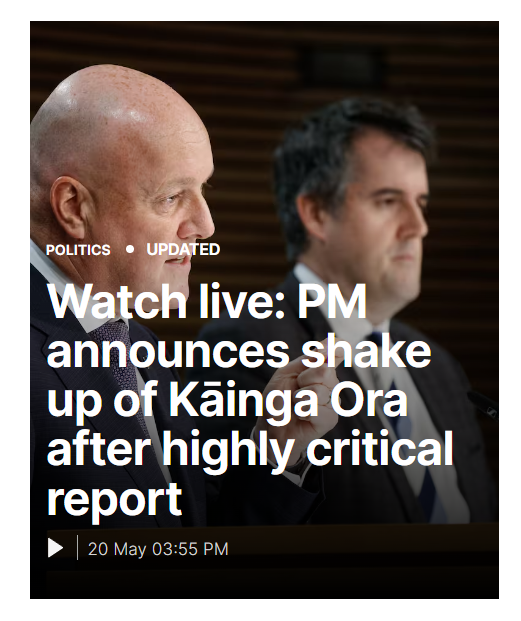
At this afternoon’s post-Cabinet press conference on Monday, Prime Minister Christopher Luxon and Housing Minister Chris Bishop announced the findings of an independent review of Kāinga Ora – Homes and Communities, along with plans to reform the agency.
A new review of New Zealand social housing agency Kāinga Ora has found that it is performing poorly financially and will struggle to sustain its operations without significant savings and changes to funding and financing. Led by former prime minister Bill English, the review found that Kāinga Ora had been able to access debt too easily while paying insufficient attention to fiscal discipline. This had led to growing annual losses, with debt forecast to rise to NZ$23,000,000,000. Housing Minister Chris Bishop said the review found no clear separation between the board’s governance role and operational management, with weak accountability contributing to the deterioration in its finances.
To address these problems, Cabinet has agreed to four key recommendations to improve Kāinga Ora’s financial performance: align its contractual arrangements with those of community housing providers, restructure its board, issue it with simplified directions, and develop a detailed plan to eliminate losses.
Simon Moutter has been appointed Kāinga Ora’s new chair, with a new board expected to be in place in July. Its first priority will be to submit a turnaround plan by the end of the year, focusing on restoring Kāinga Ora’s financial sustainability.
Housing Minister Bishop said Kāinga Ora’s homes cost more to build, on average, than those in the wider housing sector. Bishop confirmed that the previous government’s affordable housing programme, KiwiBuild, would be formally scrapped, with a date yet to be decided.

Last week, CoreLogic released its latest Pain & Gain property report for the first quarter of 2024. With buyers currently holding the upper hand in negotiations, overall property sales remained relatively subdued last quarter. In Auckland, 10.5% of properties resold during the first three months of this year fetched less than their sellers originally paid, up from 9.2% in the fourth quarter of 2023. In Hamilton, 9.4% of properties sold for less than their purchase price, higher than Tauranga’s 6.0% and Christchurch’s 4.4%.
The survey data showed that, among New Zealand’s main centres, the largest median house price gains in the first quarter of 2024 were in Tauranga ($417,000), Wellington ($405,000) and Auckland ($388,000). Resale profits in Hamilton, Christchurch and Dunedin remained between $275,000 and $300,0000.
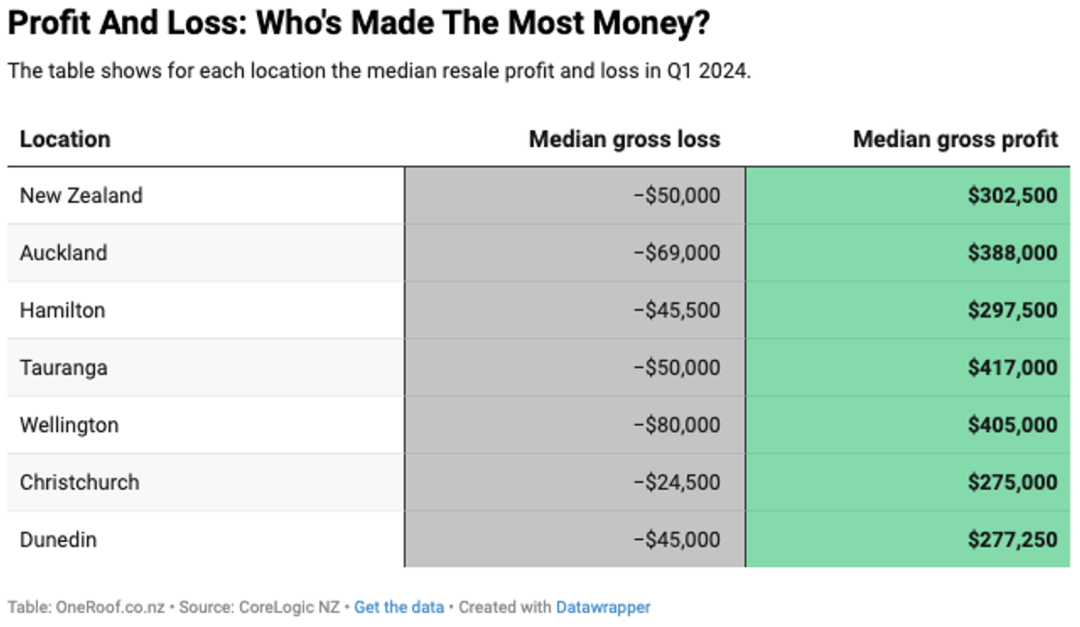
Comparison of median profits on properties sold across New Zealand cities in the first quarter of 2024 (Source: CoreLogic; also applies below)
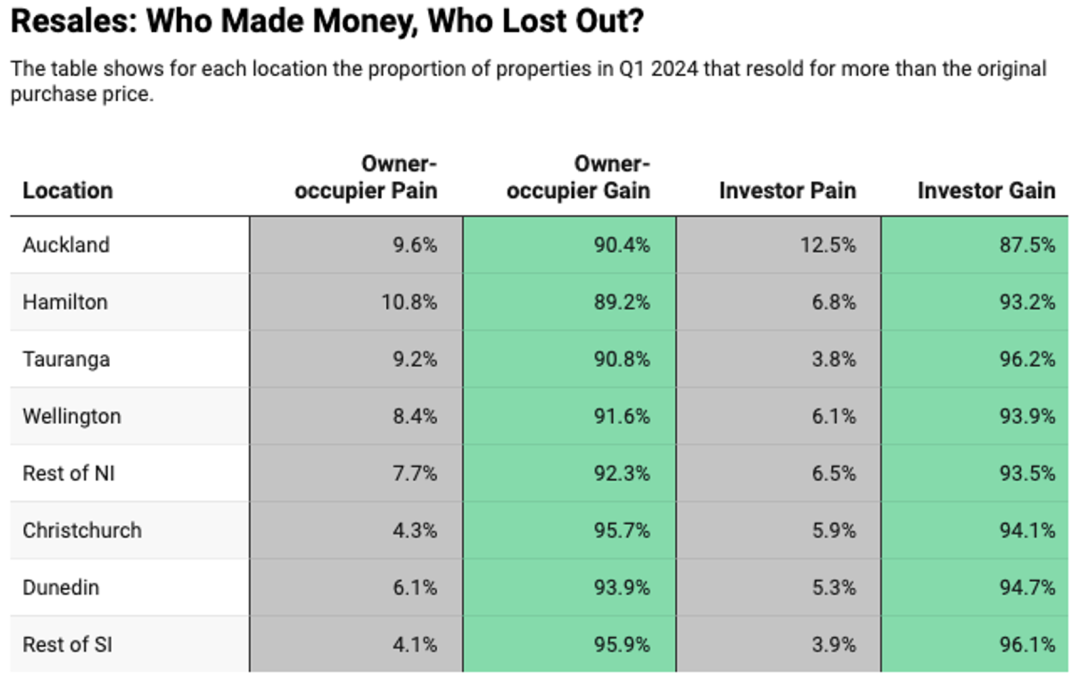
Comparison of the proportion of profitable property sales by owner-occupiers and investors across New Zealand cities in the first quarter of 2024

The latest rental price flow measure for new tenancies published by Stats NZ showed that rents rose 4.2% in the year to April. This was around 1% above the long-term average, but still well below the peak of 7% at the end of 2023. It now appears that rental growth has indeed peaked, while net migration has also fallen noticeably.
Net migration was around 111,000 people in the year to March, down as more New Zealand residents departed, compared with a peak of about 139,000 in October last year. These changes are somewhat encouraging for the inflation outlook, but offer little comfort to tenants: housing demand has already been boosted, and rents remain high relative to household incomes.

Property sales in April rose 15% compared with the same month last year. This was the 12th consecutive month of growth, indicating that transaction volumes are increasing, albeit from a low base. This may reflect the increase in listings, giving buyers a better chance of finding a home they really want. House price growth has also levelled off in recent months, suggesting sellers are responding to market conditions while buyers have gained more negotiating power.

While we await the Reserve Bank of New Zealand’s final decision on the timing and structure of debt-to-income (DTI) restrictions, actual lending at high DTI ratios remains relatively low. This is because current high mortgage rates limit how much debt applicants can obtain or service relative to their income. During the first three months of this year, only around 5% of first-home buyers had a DTI above 6, while around 7% of investors had a DTI above 7.

The Reserve Bank will release its latest Monetary Policy Statement this Wednesday. Many economists currently expect the OCR to remain at 5.5%. The Reserve Bank of New Zealand has delivered a consistent message over the past year: inflation, although falling, remains too high, and rates will not be cut until it returns to the target range. Nothing over the past 4–6 weeks has changed enough to shake that view.