
The two-year bright-line test for existing homes is almost here! Will new builds face a price-cutting sell-off to maintain sales?
Davidson noted that restoring interest relief for investment properties and shortening the bright-line test for a second investment property from ten years to two would remove any tax advantage new builds hold over existing homes.
Are new builds losing their market appeal?
The latest research from property information company CoreLogic finds that although the median price of new builds remains 6% higher than that of existing homes, the gap is narrowing. CoreLogic chief economist Kelvin Davidson said higher interest rates, economic uncertainty and changes to investor rules were challenging the new-build market, and profit margins on new homes could shrink further.
The research shows developers have been offering noticeably more discounts recently. Davidson believes this pricing strategy has become necessary to secure sales, highlighting uncertainty in the market. To some extent, it suggests the price gap between new and existing homes is not the key consideration in a purchase. For developers, profits depend more on construction costs and selling prices. Davidson said developers’ margins were being squeezed by rising construction costs, interest rates and financing costs. New homes generally cost more than ‘old’ ones because buyers are getting better specifications and fittings.
The chart below shows that new-build premiums have varied over the past 20 years, from a high of 15% to a low of -2% (the -2% occurred after the global financial crisis, when the construction industry was struggling and developers offered steep discounts to secure presales and sell homes).
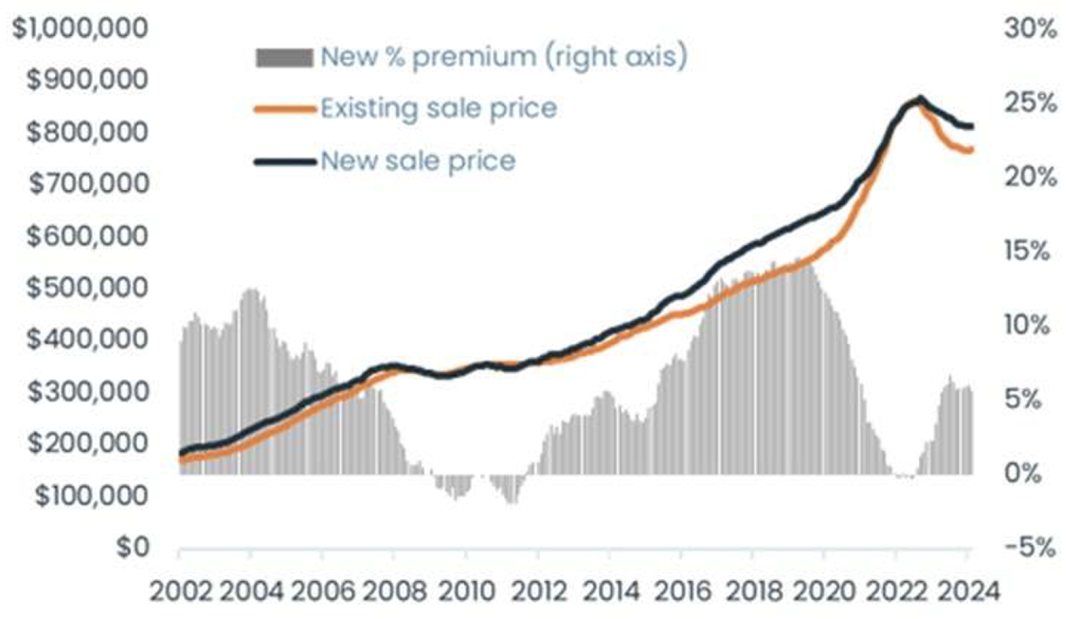
Changes in median prices for new and existing properties since 2002 (source: CoreLogic)
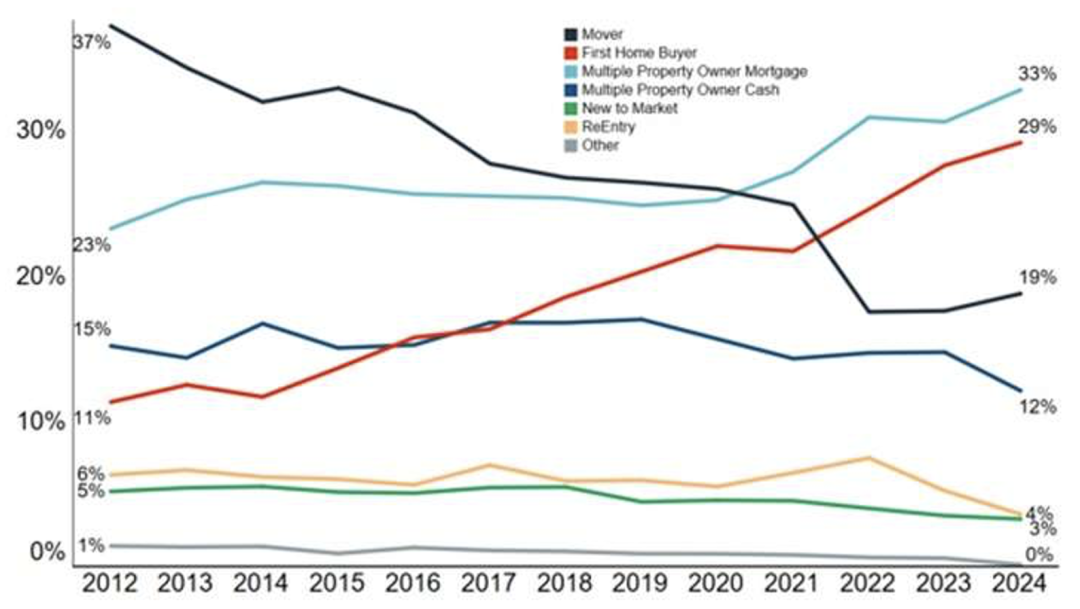
Changes in the share of purchases by different buyer groups in New Zealand’s new-build market since 2012 (source: CoreLogic)
Davidson noted that restoring interest relief for investment properties and shortening the bright-line test for a second investment property from ten years to two would remove any tax advantage new builds hold over existing homes. However, LVR rules have consistently favoured new-build sales, potentially offsetting some of the decline in demand over the longer term. Another ‘positive’ for the industry is that the continuing decline in building consent approvals points to substantially fewer new homes coming onto the market over the next few years. Most builders are currently still busy constructing already-approved residential projects. This reflects the inevitable lag between approvals and actual construction, as well as the substantial backlogs many builders had accumulated.
The new-build market is not as bad as it may seem
Davidson believes there are still positive factors shaping the future of the new-build market for developers. For example, persistently high net migration could boost demand, although not immediately. He explained that new arrivals are currently having more of an impact on rents than house prices. As migrants spend longer in New Zealand, however, that demand will gradually translate into home purchases. He said that while construction activity was slowing, the population continued to grow, inevitably creating a need for more homes. Unfortunately, the market was not building enough, meaning housing shortages would still emerge in the near future.
Encouragingly, CoreLogic’s research also found that construction cost growth in New Zealand had fallen below its long-term average. CoreLogic’s latest Corndell Construction Cost Index (CCCI) rose just 0.5% in the first quarter of this year, less than half the long-term quarterly average of 1.1%.
During 2022, construction costs soared because of Covid -related supply chain problems and a booming construction sector. In May 2022, building consent approvals peaked at 51,000 homes. The data shows that the current annual price index change of 2.3% is well below the peak of 10.4% recorded in the fourth quarter of 2022, and is the lowest in almost eight years.
The report also said building material supply chains had largely returned to normal. Fewer residential construction projects had eased capacity pressures to some extent, slowing construction cost increases. Slower cost growth benefits both property investors and builders. More stable construction costs allow builders to price projects more accurately and give property investors greater confidence that their final costs will not soar by the time construction is complete.
For today’s discussion, we also spoke to experienced New Zealand construction industry figures Jacky Li, director of Treasure Homes, and An Na, head of Indelible Homes, to hear their views.
YIJU: With the two-year bright-line test for existing homes about to take effect, do you think the new-build market will see a price-cutting sell-off to maintain sales? What do you make of the gradually narrowing price gap between existing homes and new builds?

Treasure Homes Jacky: The first consideration is the location of the new build, which is crucial. The next is whether its floor plan and layout suit that location. In my view, homes in suitable locations with sensible interior layouts will not face steeply discounted sell-offs. More innovative interior design and high-quality workmanship will also help a home stand out in a crowded market.
Many people say existing home prices are gradually approaching those of new builds. Personally, I think this is mainly down to land area and development potential. Prices for existing homes without development potential remain quite reasonable. Falling new-build prices reflect lower construction costs and oversupply, but this also makes it a good time for buyers who prefer high-quality new homes to purchase. Overall, this comes down entirely to market preferences. Existing homes on large sections with development potential have relatively stable prices. New builds in less desirable locations, or areas with oversupply, can experience sluggish sales, which broadly follows normal market patterns.

Indelible Homes An Na:A narrowing price gap between new and existing homes is not necessarily bad for the market, as it gives buyers more choice and bargaining power. There was a time when limited stocks of existing homes for sale pushed prices higher, leaving most buyers disappointed at auctions. Buying a new build became a good option, particularly for first-home buyers. Following the upheaval of the pandemic, new-build prices rose alongside construction costs, widening the gap between ‘new’ and ‘old’ homes. Now, as construction costs decline, that gap is narrowing reasonably. I am not worried that new builds will eventually attract no interest and have to be sold at clearance prices.
I am very confident about the future of the new-build market. As members of Master Builders, we can offer a 10-year guarantee on the homes we build, with lower maintenance costs and higher construction standards, making new builds warmer, drier, quieter and healthier. We also use the most advanced building materials available, including insulation and insulating glass that provide effective thermal protection. Compared with existing homes, new builds have lower running costs and are more environmentally friendly.