
New listings surge as more sellers cut prices! First-home buyers are the biggest winners, and now could be the best time to buy!
Property sales data for the past 6 months shows that more than twenty thousand homes nationwide sold for less than NZ$1,000,000, more than twice the number sold for over NZ$1,000,000.

New property listings surge
The latest property sales data released by OneRoof shows that New Zealand’s average house price rose by just 0.8%, or NZ$8000, over the past 6 months to NZ$975,000. In stark contrast, new listings surged by 25% over the same period.
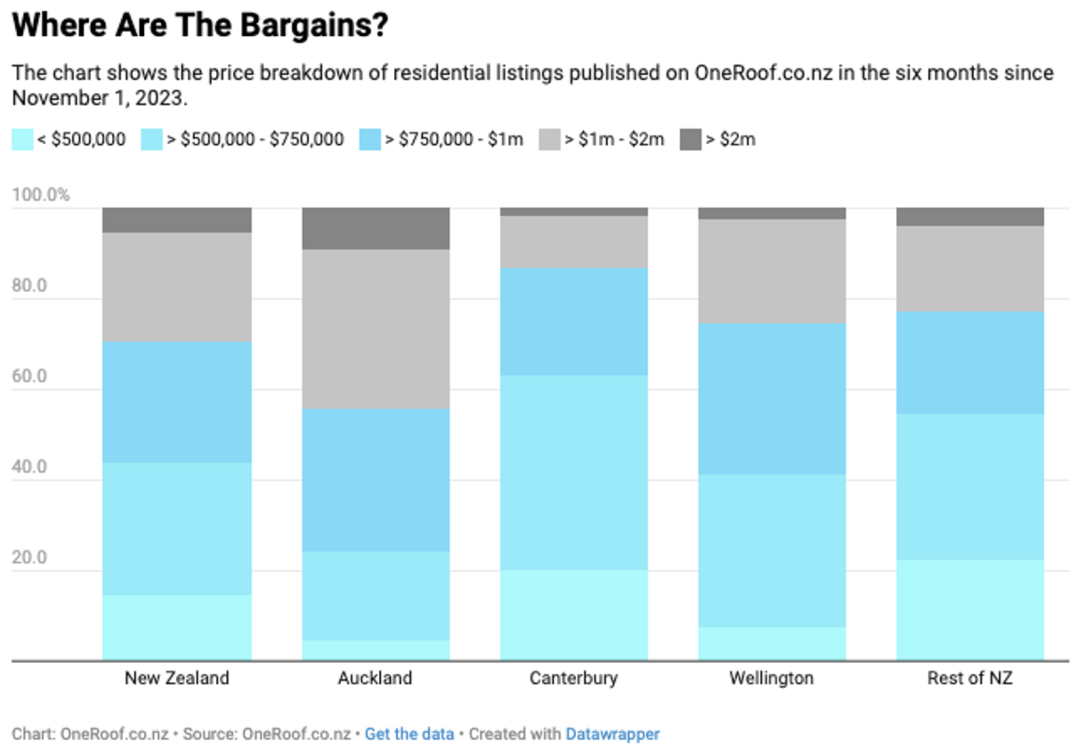
This means buyers have more properties to choose from, with entry-level buyers benefiting the most. The data shows that properties listed for less than NZ$1,000,000 account for as many as 7 in ten listings.
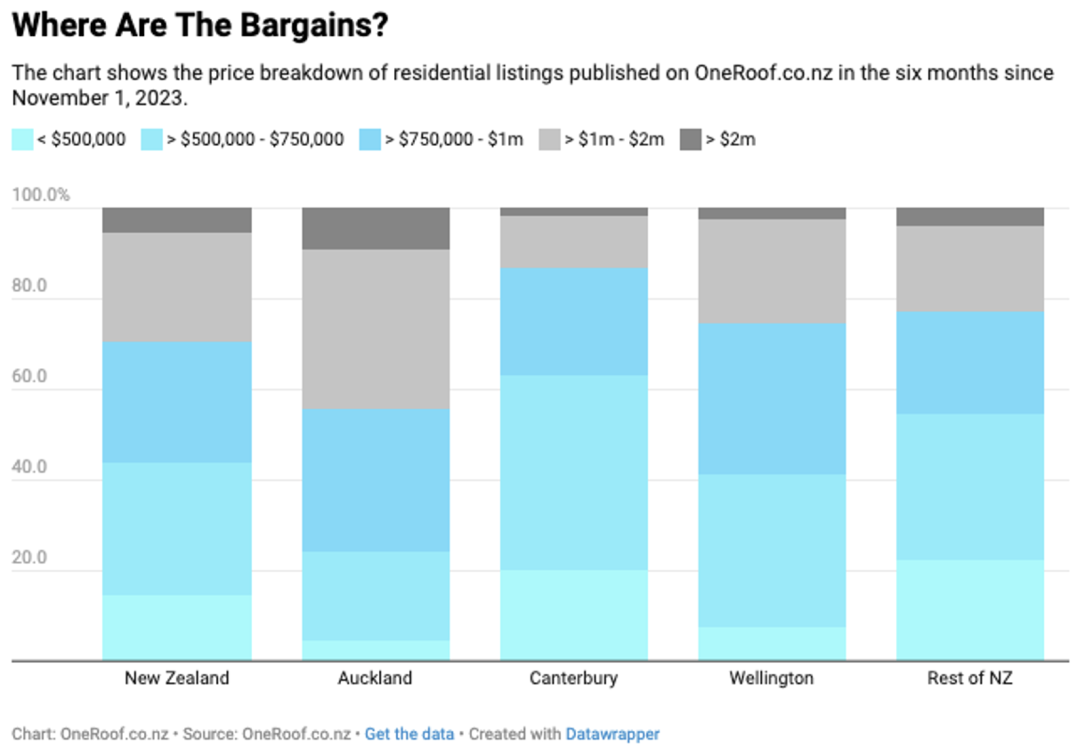
Distribution of new OneRoof listings by price bracket over the past 6 months (Source: OneRoof)
Property sales data for the past 6 months shows that more than twenty thousand homes nationwide sold for less than NZ$1,000,000, more than twice the number sold for over NZ$1,000,000.
More sellers cut prices to secure a sale
Over the past 6 months, increasing numbers of sellers have cut their prices to secure a sale. The data shows that at least one seller in every 10 new listings lowered their initial asking price to meet the market, with an average reduction of NZ$74,000. Some sellers even cut their asking prices by as much as NZ$1,000,000. For many buyers, this means they can consider neighbourhoods they previously thought were too expensive.
Notably, most properties with price adjustments—60%—were outside Auckland and priced below NZ$1,000,000. This means entry-level buyers in these areas can ultimately benefit from average discounts ranging from NZ$23,000 to NZ$64,000.
Comparison of listing numbers and average price reductions across New Zealand price brackets over the past 6 months (Source: OneRoof)
Strong competition in the entry-level property market benefits first-home buyers most
Since November 2023, more than half of Auckland’s listed properties have been priced below NZ$1,000,000. Fewer than 1/4 were priced below NZ$750,000, while properties listed below NZ$500,000 accounted for less than 5%. By comparison, Canterbury had the country’s largest number of properties listed below NZ$500,000, at 1800, reflecting the region’s generally lower house prices.
OneRoof property editor Owen Vaughan said several factors in the current housing market favour first-home buyers who have pre-approval: weak house price growth, sellers cutting prices and greater choice. A large influx of new listings early in the year means properties for sale now outnumber buyers in the market.
Vaughan added that the Reserve Bank of New Zealand’s announcement before the Budget that it would ease loan-to-value ratio(LVR) restrictions would make it easier to obtain approval for low-deposit loans. Of course, this does not mean plain sailing for the property market ahead. The Bank has said interest rates will remain restrictive for longer, debt-to-income (DTI) rules taking effect next month will limit New Zealanders’ borrowing capacity, and the Government recently scrapped the First Home Grant scheme, which helped many New Zealanders realise their dream of home ownership.
Despite the removal of the First Home Grant scheme, first-home buyers can still access a range of government home-buying assistance measures.
Assistance for first-home buyers

1
Shared ownership
Shared ownership allows prospective homeowners to obtain a mortgage in partnership with a third party, such as the Government, a local council or an iwi. With a conventional mortgage, the buyer pays a deposit and a lender provides the rest. Under shared ownership, a third party, or co-owner, can contribute funds in return for a corresponding share of the property. The buyer can then purchase that share within an agreed timeframe. If the property is sold beforehand, the homeowner must pay the co-owner a proportion of the sale proceeds equivalent to their ownership share.
2
Family equity loans
A family equity loan is another option if a buyer has family members or relatives who own property and are keen to help them buy a home. This arrangement involves two loans. The first, which funds the deposit, is taken out jointly by the buyer and their family member, with both sharing liability. It has a shorter term so it can be repaid quickly, releasing the family member from any liability. The second loan, covering the remaining 80%, is solely in the buyer’s name and usually has a term of 30 years.
3
Kāinga Ora First Home Loan
The First Home Loan is another government scheme helping first-home buyers complete a purchase and should not be confused with the grant that has now been scrapped. These loans are underwritten by Kāinga Ora, allowing banks greater lending flexibility. To qualify, buyers must be first-home buyers and have a 5% deposit.
4
KiwiSaver withdrawals
Buyers who have been saving through the Government’s KiwiSaver scheme for at least three years may be able to use some of their savings to purchase their first home.
Buyers can withdraw almost all their KiwiSaver savings, including employer contributions, their own contributions, government contributions and any interest earned in the account, provided they leave NZ$1000 in it. Even second-home buyers who have previously owned a home remain eligible to withdraw their KiwiSaver savings for a purchase, as long as they have not previously used KiwiSaver to buy a property.
As the market gradually becomes a buyer’s market, first-home buyers are facing a golden opportunity, with greater negotiating power and more properties to choose from. However, mortgage interest rates remain challenging. First-home buyers are advised to assess their household finances thoroughly and prepare before making a purchase.