
Latest May house price report released: national prices rise sharply year on year! This week’s key developments for property investors
Auckland’s average house price has fallen by 1.1% over the past three months

1. Major mortgage rule changes from 1 July
Last week, the Reserve Bank of New Zealand announced that new debt-to-income (DTI) lending restrictions would officially take effect on 1 July. The DTI multiple will be 6 for owner-occupiers and 7 for investors. Although buyers of new builds and those using non-bank lenders are exempt, the rules will still affect mortgage applications from around 80% of bank borrowers.
As many reports have noted, the new DTI rules will not have a major immediate impact on the lending market, because high mortgage interest rates already constrain borrowing to some extent. Nevertheless, their introduction marks a significant shift in the future lending landscape. As mortgage rates fall, DTI restrictions will become more apparent, tying house prices more closely to incomes over the medium term and slowing, to some extent, the pace at which investors expand their property portfolios.
Meanwhile, the Bank also announced that it would ease loan-to-value ratio (LVR) restrictions. From 1 July, 20% of bank mortgage lending may go to owner-occupiers with deposits below 20%, while no more than 5% of bank lending may go to investors with deposits below 30%. CoreLogic chief economist Kelvin Davidson said property investors would benefit most from the change, as current LVR settings have hit this group hardest. Even with lower deposit requirements, however, investors still face numerous obstacles when buying property. In a high-interest-rate environment, for example, investment properties’rental yields fall well short of their monthly mortgage repayments.
2. First-home buyers’ market share slips slightly
The Bank released its latest mortgage data last week. Although lending increased further, it remained low overall. Notably, first-home buyers remain a major force in the market. Despite the removal of the First Home Grant, they still account for around 80% of the low-LVR lending market.
The easing of loan-to-value ratio (LVR) rules is good news for first-home buyers, as banks will be permitted to issue more low-deposit loans. At the same time, the market faces challenges. The Reserve Bank of New Zealand has also warned that interest rates will remain high for longer than previously expected. In a sense, this may benefit first-home buyers: keeping interest rates high for an extended period will delay the next rise in house prices and further reduce competition in the market.

Research data from Valocity shows that first-home buyers’ market share has slipped slightly. In the first quarter of 2024, first-home buyers accounted for 42.8% of all mortgage registrations for property purchases, down from 43.9% in the previous quarter. Second-quarter data so far shows their share has fallen again, to 42.4%, although it remains above the longer-term average levels seen in 2020 and 2021.
The data also shows that property investors have begun returning to the market, with their share of new mortgage registrations rising from 21.5% before the general election to 24.2% in the first quarter of 2024. Although this figure slipped slightly in the second quarter, the Government’s changes to the bright-line test from 1 July are likely to encourage more investor purchases and a surge in investment property listings.
3. Will the Government’s Budget have a major impact on the housing market?
The Budget released last Thursday contained no direct assistance measures for the property market. The key question is whether personal income tax cuts will push up inflation, keeping interest rates higher for longer. Davidson believes only time may tell, but noted that the Government appears to have been very careful to offset the impact of tax cuts by reducing spending elsewhere. He acknowledged that, with New Zealand’s economy in recession, a Budget without any impact on the property market may be a sensible decision.

4. Is the continuing economic downturn a reason for caution in the property market?
New Zealand economic data released by authoritative bodies over the past week was subdued. Job numbers rose by just 0.1% in April, with annual growth slowing to 1.4%, its lowest level since March 2021. Meanwhile, ANZ’s business outlook survey shows that businesses remain pessimistic about the economic outlook for the coming months. We therefore have reason to believe expectations for the property market will also remain subdued.
5. New Zealand house prices rise sharply year on year
The latest OneRoof-Valocity House Value Index report shows that New Zealand’s average house price rose by 3.33% year on year last month to NZ$975,000. However, the national average fell by 0.2% over the past three months. Slower house price growth may not be a bad thing for buyers eager to own a home.
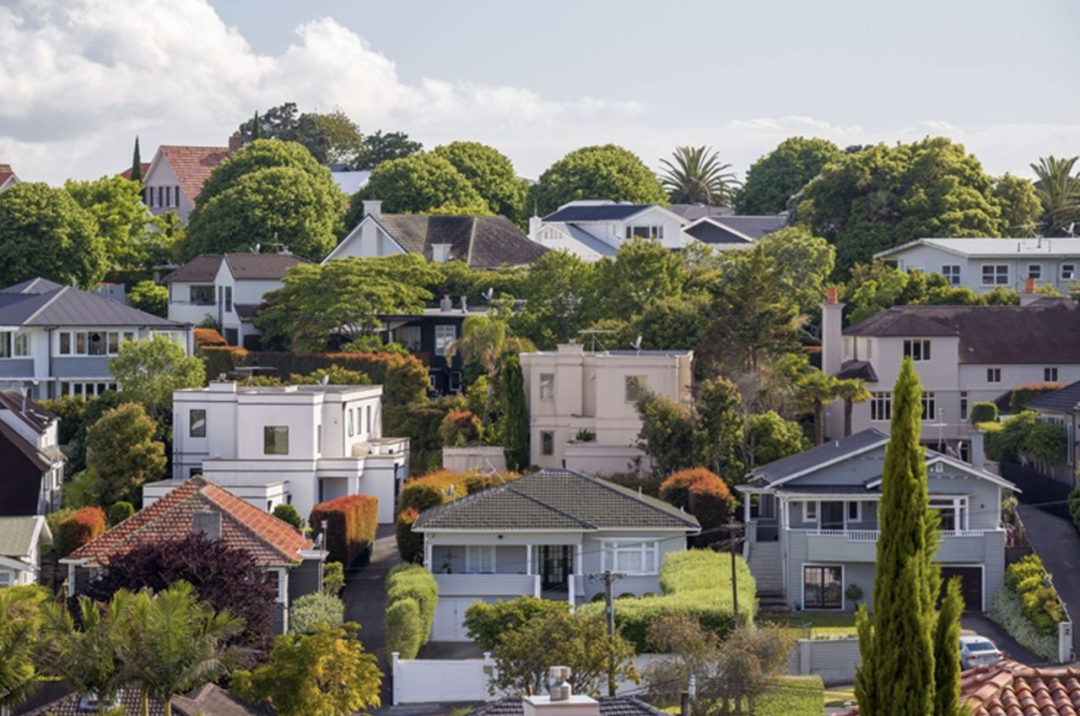
Auckland’s average house price has fallen by 1.1% over the past three months
The latest data shows that average house prices in Auckland, Bay of Plenty and Gisborne fell compared with the previous quarter, while eight other regions recorded only slight increases.
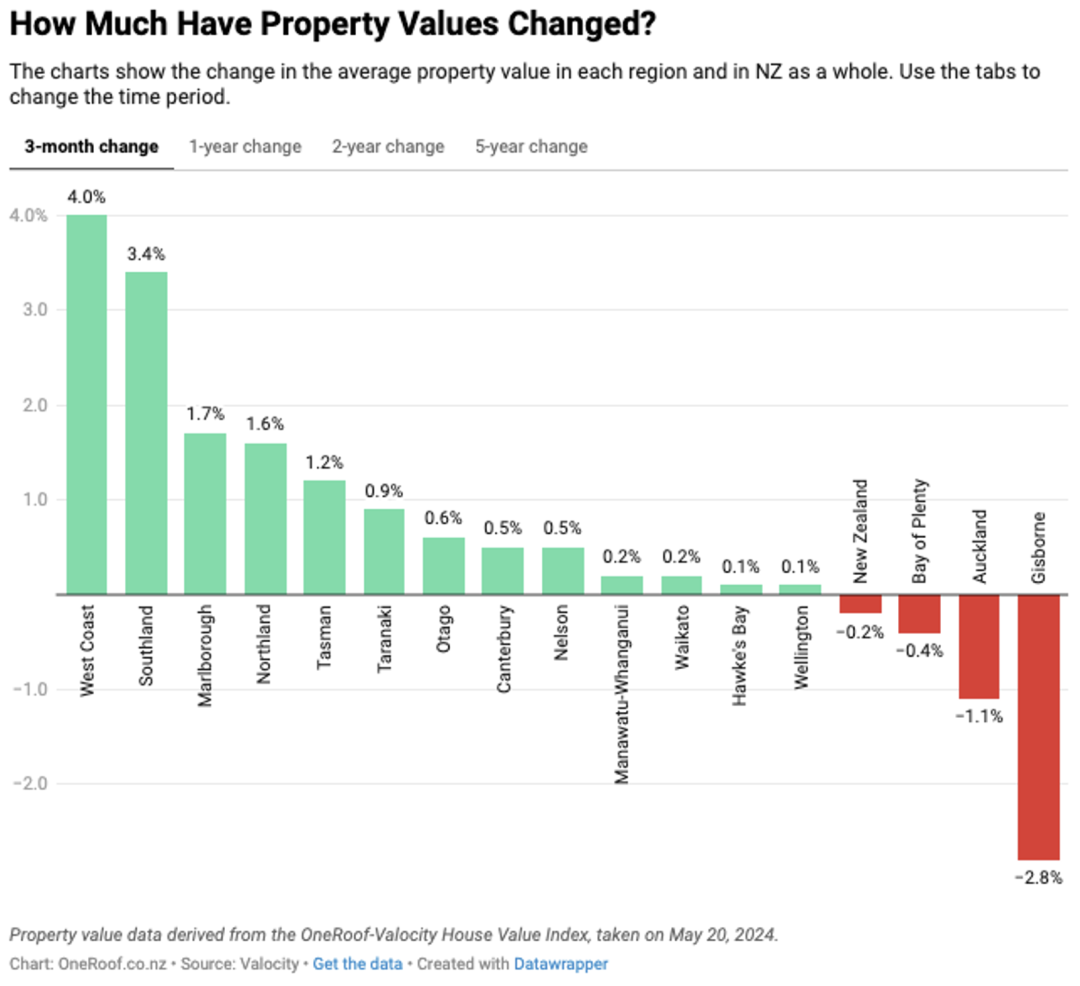
Changes in average house prices across New Zealand regions over the three months to the end of May (Source: Valocity)
Notably, the regions with the strongest house price growth nationwide remain those with the lowest average prices, where first-home buyers dominate the market. Over the three months to the end of May, the West Coast’s average house price rose by 4%, or NZ$18,000, to NZ$468,000. Southland was not far behind, with its average rising by 3.4% to NZ$551,000.
Christchurch and Dunedin were the only main centres to record house price increases over the past three months, up 0.5% and 1.8% respectively. Their relatively low average prices, and the fact that many homes for sale target first-home buyers, have eased selling pressure to some extent. As buyers withdraw from the middle of the market, prices in main centres with higher starting values are coming under pressure.
Listing numbers have climbed to high levels compared with a year ago, giving buyers more choice and negotiating power. At the end of May, the total number of homes for sale on OneRoof.co.nz was 19% higher than a year earlier, but down 3.89% from April. This shows that although new listing numbers fell over the past month, they remained substantially higher year on year, with Auckland’s market up nearly 45.4%.