
Auction activity weakens as listings surge: how far must interest rates fall to revive the housing market?
How low interest rates ultimately fall will depend not only on a recovery in market demand, but also on when market confidence can truly be rebuilt.

New Zealand’s property market is facing unprecedented difficulties. Recent data shows persistently subdued auction activity and low sales rates, while the stock of properties available for sale has reached its highest level in a decade. Together, these trends reflect weak demand and widespread falls in house prices.
Against this market backdrop, falling mortgage rates have brought a question into sharp focus: How far must interest rates fall to breathe new life into the market?

First, conditions in the auction market clearly reflect the wider weakness. Reportedly, between 10 August and 16, just 222 residential properties went to auction nationwide, with only 81 selling, leaving the success rate at 36%. More concerningly, about three-quarters sold below their assessed values, suggesting a clear shortage of demand and continued downward pressure on prices. These concerns extend beyond auctions to online property listings.
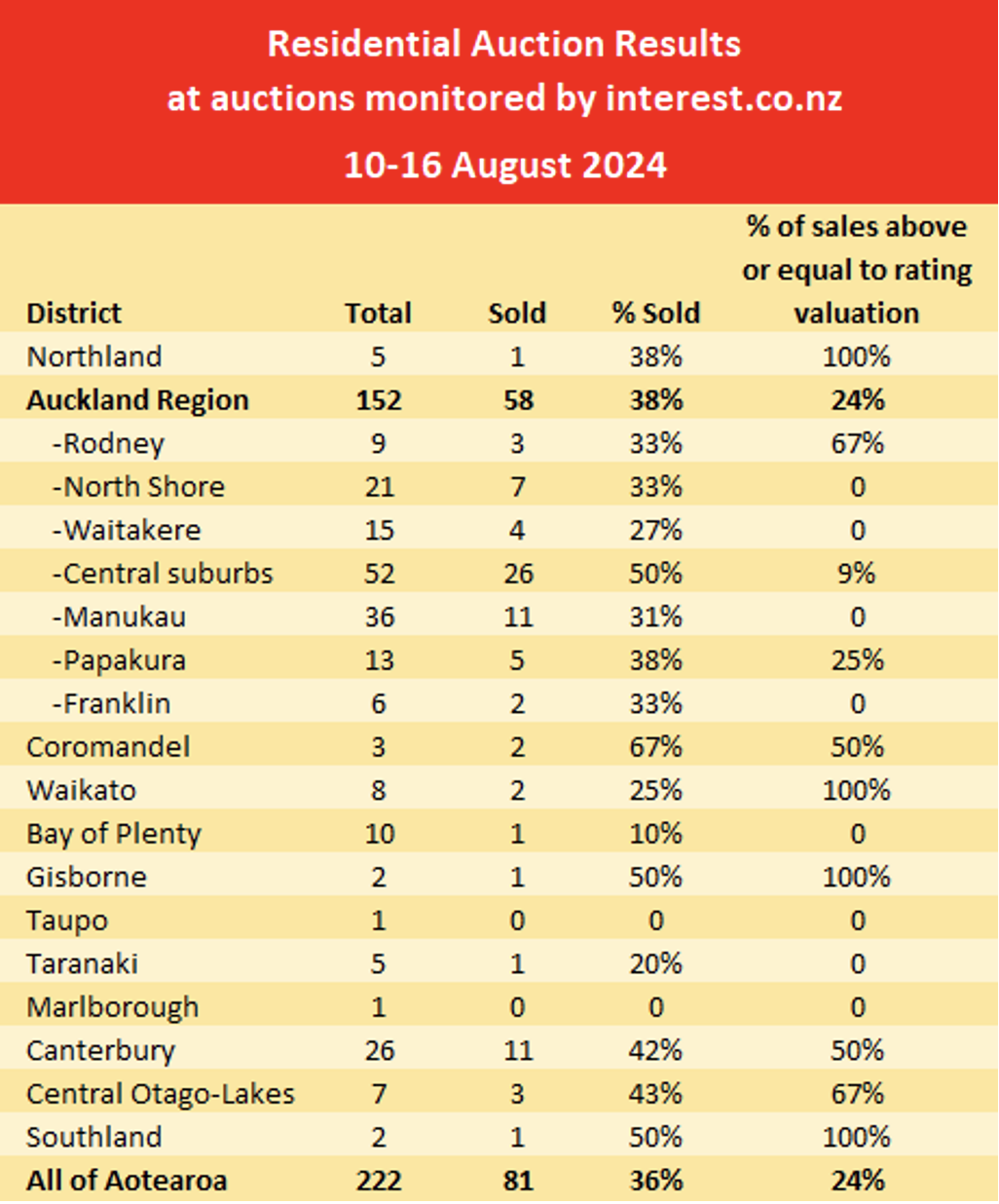
Nationwide property market rankings for 10–16 August (Source: interest.co.nz)
The latest Trade Me Property data shows that listings on the platform reached 42,440 in May 2024, a decade high. Meanwhile, the average asking price fell by NZ$50,000 from the start of the year to its lowest level in three years. Behind these figures lies a surge in supply, increasingly cautious buyers and a growing number of unsold properties. Listings in the NZ$600,000 to NZ$799,000 price bracket rose 29% year on year, indicating particularly pronounced pressure on properties in the lower and middle price ranges.

In such a subdued market, the direction of interest rates has become a focus of attention. The Reserve Bank of New Zealand recently cut the Official Cash Rate (OCR) and expects it to fall further over the coming years, potentially reaching 3% or lower in 2027. However, the market’s response to this outlook has been far from optimistic. Although a lower OCR usually means lower borrowing costs, whether this will be enough to reverse the market’s current difficulties remains an open question.
Infometrics forecasts, for example, suggest that even if the OCR falls to 3% in early 2025, one-year mortgage rates are expected to fall only to 4.9%, while two-year and three-year fixed rates could be 5% and 6% respectively. This reflects pressure on banks’ margins. Margins on retail mortgage rates are currently low, potentially reflecting weak borrowing demand that is forcing banks to offer more competitive rates to attract customers. Falls in longer-term fixed rates may also be limited, particularly if long-term official government interest rates remain relatively stable.
Kiwibank economist Sabrina Delgado also predicts that the OCR could fall further to 2.5% by mid-2027. Even so, she notes that mortgage rates will ultimately also be influenced by term deposit rates and other funding costs. Whether mortgage rates can fall significantly therefore remains uncertain, even if the OCR continues to decline. She expects future mortgage rates may stay close to 5%, with substantial cuts unlikely.
Taken together, the challenges facing New Zealand’s property market extend beyond interest rates to an imbalance between supply and demand and a lack of market confidence. Although OCR cuts may bring some short-term benefits, a genuine turnaround will require more time and policy support. In the current market, buyers have more choice and greater bargaining power, while sellers must make more compromises on price and selling timeframes. For prospective buyers, lower interest rates may offer an opportunity to purchase, but caution remains sensible amid wider market weakness.
With the market subdued, its future direction remains highly uncertain. How low interest rates ultimately fall will depend not only on a recovery in demand, but also on when market confidence can truly be rebuilt. Until then, all market participants need to prepare for prolonged volatility and find the most appropriate strategies for navigating uncertainty.