
When will the Reserve Bank of New Zealand make its first interest rate cut? Five major banks give their forecasts
When will the Reserve Bank of New Zealand make its first interest rate cut? Five major banks give their forecasts

For more than a year, the Reserve Bank of New Zealand has kept the Official Cash Rate (OCR) at the high level of 5.5%. While this demonstrates its determination to tackle high inflation, it has also caused considerable hardship for countless New Zealand borrowers. We cannot help asking: when will the Reserve Bank make its first interest rate cut?
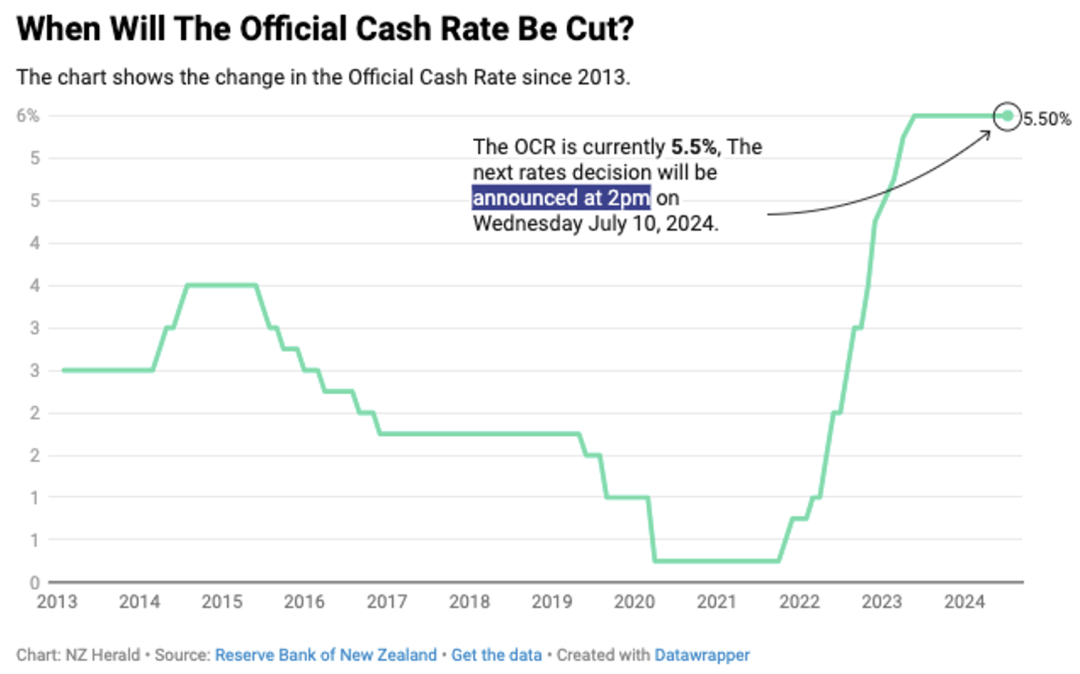
Graph of OCR changes from 2013 to 2024 (Source: Reserve Bank of New Zealand)
The Reserve Bank will make its next Official Cash Rate decision on 10 July, a week before inflation figures for the second quarter of 2024 are released. First-quarter inflation of 4% was less than ideal, remaining above the Reserve Bank's target range of 1% to 3%. Following its May OCR announcement, the Reserve Bank warned that interest rates might need to remain high for longer than previously forecast, citing stubborn domestic inflation.
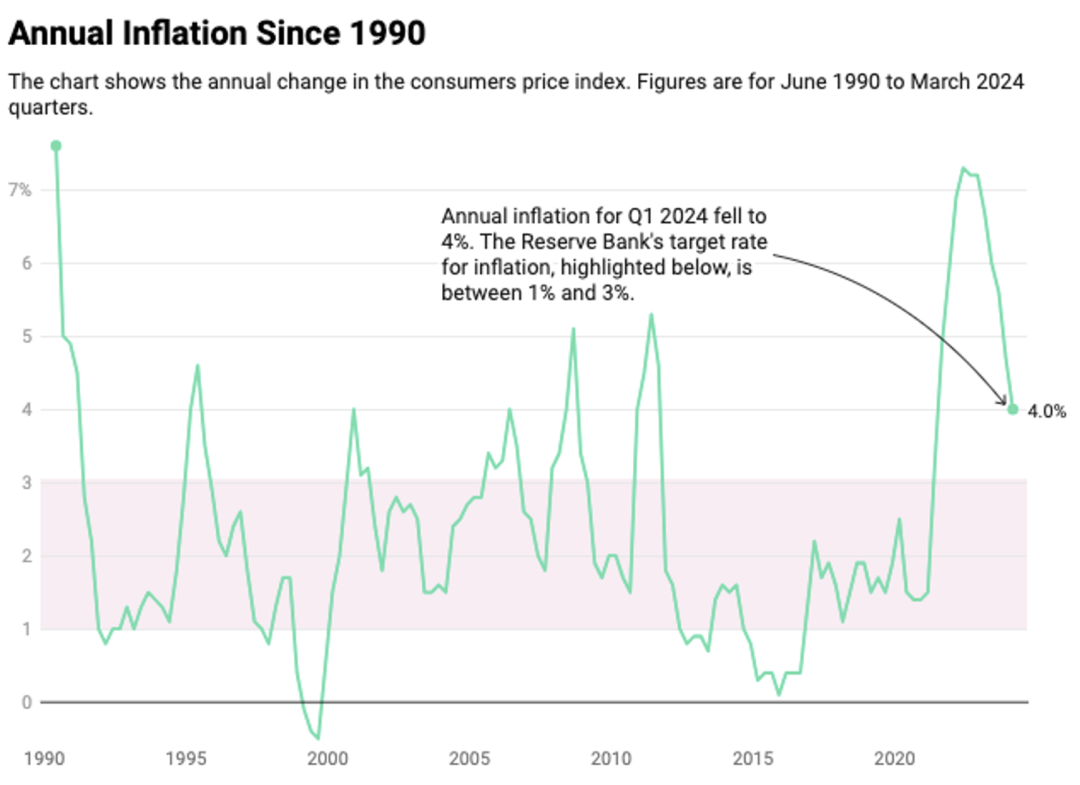
Graph of changes in New Zealand's annual inflation rate from 1990 to the present (Source: Stats NZ)
Meanwhile, other central banks around the world face mixed circumstances. The Reserve Bank of Australia has held its cash rate at 4.35%, but stressed that the path to low inflation has narrowed. Australia's current inflation rate of 3.6% is above its target range, prompting the central bank to warn that recent data “reinforced the need to remain vigilant to upside risks to inflation”.
In the United Kingdom, inflation has fallen to 2.3%, but core inflation remains high, dashing hopes of a rapid interest rate cut. Better-than-expected inflation figures in the United States, meanwhile, have bolstered hopes of rate cuts.
Next, we look at when New Zealand's major banks expect the first interest rate cut.
Kiwibank's forecast: November 2024
Among the major banks, Kiwibank has the most optimistic forecast. Its team believes the Reserve Bank will make its first OCR cut in November 2024. Senior economist Mary Jo Vergara said November could mark the start of the rate-cutting cycle, as inflation should be back within the target range by then and would hopefully reach 2%.

Kiwibank senior economist Mary Jo Vergara
She predicted that New Zealand's economy would be weaker by then, continuing to drive domestic inflation down. This would also be crucial to whether overall inflation could return to 2%. Unemployment would also rise, with the rate expected to reach 5% to 5.5%. In these economic conditions, the Reserve Bank of New Zealand would inevitably move to lower the OCR.
ANZ's forecast: February 2025
ANZ economists said the Reserve Bank of New Zealand's concern about higher-than-expected domestic inflation was understandable. ANZ expects the first interest rate cut in February next year. However, they also stressed that before cutting the OCR, the Reserve Bank of New Zealand needed confirmation not only that inflation was heading towards 2%, but also that expected inflation would remain within the 1% to 3% target range over the long term. They expected the real economy to be exceptionally weak, with inflation reaching 2.6% and unemployment rising to 5% by February next year.
ASB's forecast: February 2025
Although ASB economists lean towards a Reserve Bank interest rate cut in February next year, they also see a strong possibility of action in November. Senior economist Kim Mundy said: “Some of the recent data have shown signs that conditions favour an earlier rate cut, so it could well happen towards the end of this year.”
Like economists at other banks, Mundy said overseas influences were also important, pointing to the persistence of UK inflation. “The Bank of England expects inflation to pick up again in the second half of this year, which is also why there is reluctance to start cutting rates.”
Mundy believed New Zealand's economic conditions would be suitable for interest rate cuts to begin by February 2025. If anything prompted the Reserve Bank to act earlier, it would be a faster deterioration in the economy. Mundy also said that one of the easiest ways for businesses to return to profitability was to cut labour costs. Laying off staff would help reduce consumer demand, bringing the economy to a point where earlier rate cuts would be appropriate.
BNZ's forecast: February 2025
BNZ chief economist Michael Jones believes the Reserve Bank will act at its first Monetary Policy Statement meeting of 2025, although a rate cut in November cannot be ruled out. On one hand, economic indicators continue to deteriorate. At the same time, inflation is too high. Some persistent factors remain, and there are now additional risks from oil prices and freight costs. This therefore offers a way to bring inflation back to target without prolonging pressure on the domestic economy.

BNZ chief economist Michael Jones
Asked what would prompt the Reserve Bank to act earlier, Jones said it did not necessarily need confirmation that inflation would remain within the target range. That was its main objective, and we were not there yet, but he did believe conditions across the board were moving in that direction.
Westpac's forecast: February 2025
Westpac chief economist Kelly Eckhold said the Reserve Bank would not have enough data to make a judgement on inflation and interest rates until February next year. He said: “If our Consumer Price Index falls, perhaps over the next few quarters, then an earlier move clearly becomes more likely.
Eckhold believed New Zealand, like the United Kingdom and the United States, had persistently high core inflation. “If you compare our core inflation with its long-term average, you will see that New Zealand's inflation has remained relatively high compared with countries such as Sweden and Canada.” He believed Reserve Bank of New Zealand Governor Adrian Orr had taken the right approach all along. They needed to keep interest rates at their current level until they saw inflation beginning to fall, particularly in the services sector. The weak economic figures we were seeing should give the Reserve Bank confidence that it would see those signs at some point. However, some of the lags in the post-pandemic period were more uncertain than usual.