
Mortgage stress risk surges for more than 24,000 Kiwi households?! New Zealand's top locations for first-home buyers revealed
The latest survey data shows that more than 24,000 New Zealand households face significant mortgage stress, with rising interest rates increasing their weekly repayments by an average of almost NZ$250. Some of these households may even be in “negative equity”, where their home is worth less than their outstanding mortgage.

Since the pandemic, rising interest rates have affected all households with mortgages, but borrowers who took out loans between May 2020 and August 2021 have been hardest hit. At the time, two-year fixed mortgage rates at New Zealand's major banks were as low as 2.52% to 2.88%. Meanwhile, to stimulate the economy, the Reserve Bank of New Zealand temporarily removed loan-to-value ratio (LVR) restrictions from 1 May 2020 to 1 March 2021, making mortgage lending rules unusually relaxed. Reserve Bank of New Zealand data shows that 397,564 mortgages were approved during this period. Around 24,244 were low-equity loans used to buy homes with deposits below 20%, with an average loan amount of NZ$490,000.
Rising interest rates have placed particularly significant pressure on these low-equity borrowers. Between May 2020 and August 2021, first-home buyers accounted for 65.4% of all low-equity loans. They bought at an average two-year fixed rate of 2.58%, with weekly repayments of around NZ$526. However, as rates rose to 6% in August 2024, weekly repayments surged to NZ$769, an increase of NZ$243. These first-home buyers therefore need to find additional income to cover the expense.
Although statistics show substantial wage growth over the same period, the actual increase in after-tax income may have been offset by higher mortgage repayments. According to Stats NZ, between June 2020 and June 2023, median weekly wages for a couple rose from NZ$2136 to NZ$2540, a pre-tax increase of NZ$404. Households may therefore face greater financial pressure from other living costs, including rising council rates, insurance, food, transport and home maintenance expenses.
More seriously, many buyers with low-equity loans may face falling home values. Data from the Real Estate Institute of New Zealand (REINZ) shows that between May 2020 and August 2021, the average price of properties in the cheapest 25% of New Zealand's housing market rose from NZ$446,000 to NZ$619,000. However, by August 2024, this figure had fallen to NZ$577,500, its lowest level since March 2021. Median house prices followed a similar trend, rising from NZ$620,000 in May 2020 to NZ$850,000 in August 2021, before falling to just NZ$765,000 in August this year.
These figures suggest that around a third of low-equity borrowers who bought during the buying boom when interest rates were below 3% have seen their homes fall below their purchase value, leaving them in negative equity. Although individual circumstances and financial pressures vary, most low-equity borrowers who took out loans when rates were at their lowest may now face substantial financial stress. Further interest rate rises have also brought the total number of households affected by mortgage stress to nearly 29,000. For these households, rising interest rates, surging mortgage pressure and continually increasing living costs are creating major challenges in their daily lives.
Falling house prices draw first-home buyers into the market
As house prices and interest rates fall, first-home buyers remain a major force in New Zealand's property market. The latest analysis from OneRoof and Valocity identifies Waitakere and Lower Hutt as the country's most popular areas for first-home buyers, accounting for the largest shares of first-home purchases. The data shows that in 2024, first-home buyers' overall market share rose from the 25% recorded in 2021 to 31%, while their median purchase price fell from NZ$747,000 to NZ$685,000. The analysis suggests that falling house prices and interest rates have significantly strengthened first-home buyers' purchasing power, enabling them to secure a greater share of a competitive market.
Waitakere and Lower Hutt lead the first-home buyer market
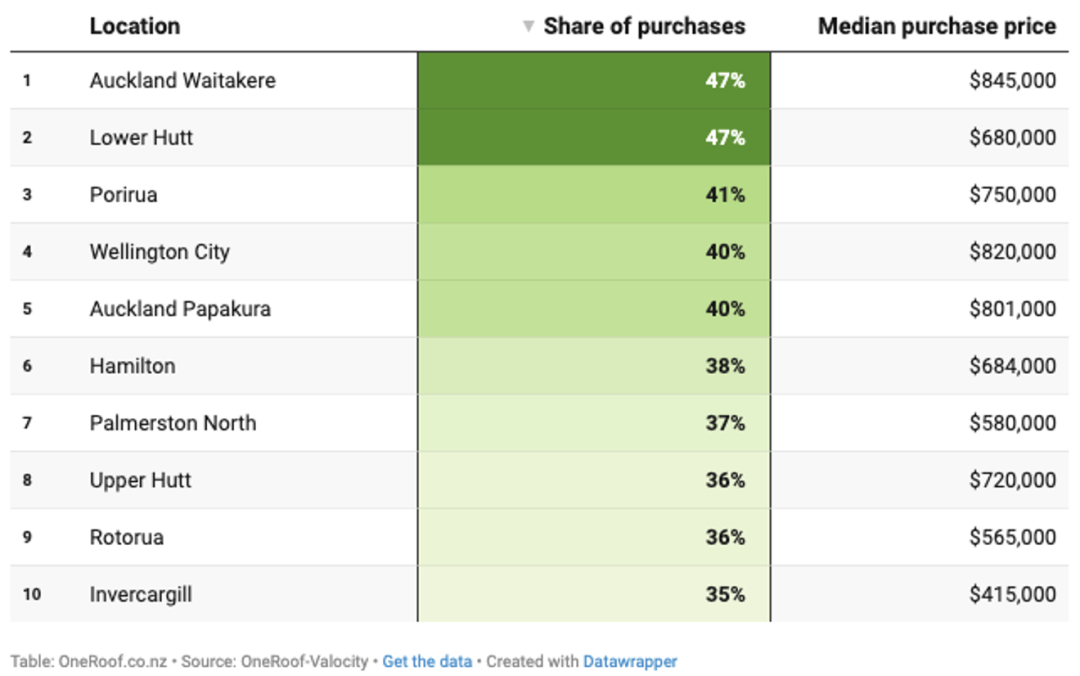
Table of New Zealand's ten most popular cities or districts for first-home buyers (Source: OneRoof-Valocity)
Do US interest rate cuts mean the Reserve Bank of New Zealand (RBNZ) will also be forced to follow suit in October? Will this affect the value of the New Zealand dollar? These questions are becoming a focus of market discussion.
So far this year, first-home buyers have accounted for 47% of mortgage registrations in Auckland's Waitakere area, a significant increase from 34% in 2021. Although the area's median purchase price remains high at NZ$845,000, it is NZ$100,000 below its market peak. Papakura, on Auckland's southern fringe, is also a popular choice, with first-home buyers' share of mortgage registrations in 2024 reaching 40%.
In the Wellington region, Lower Hutt leads, with first-home buyers accounting for 47% of all purchases financed by mortgages. Nearby Porirua and Upper Hutt have first-home buyer shares of 41% and 36% respectively. However, because higher interest rates have offset the benefits of falling house prices, first-home buyer numbers across Wellington remain below their long-term average.
High barriers for first-home buyers on the North Shore and in Queenstown
Despite falling house prices, first-home buyers still face challenges in some expensive areas. Auckland's North Shore has the same first-home buyer share as Christchurch, at 33%, but its median purchase price is almost NZ$400,000 higher. This suggests that the increased market share of first-home buyers on the North Shore is primarily due to the absence of investors and owner-occupier buyers, rather than improved affordability.
In New Zealand's most expensive district, Queenstown-Lakes, first-home buyers account for just 16% of the market. Their median purchase price is as high as NZ$1,137,000, which is NZ$184,000 above the market peak. High prices and a shortage of suitable homes make Queenstown the hardest market for first-home buyers to enter.

Market changes create opportunities for first-home buyers
Valocity senior research analyst Wayne Shum said areas such as Waitakere, Papakura and Takanini in South Auckland offered relatively affordable options for first-home buyers. The progress of numerous new housing developments was also creating more opportunities. In areas such as Waitakere in particular, many new homes were being sold at fixed prices, making them more accessible to first-home buyers unfamiliar with auctions.
“Waitakere and Lower Hutt have traditionally been first-home buyer hubs,” Shum said. “But at the market peak, investors flooded into these areas, forcing first-home buyers out. Over the past two years, fewer investors have allowed first-home buyers to return.” Meanwhile, continually rising house prices in Wellington have encouraged more first-home buyers to consider Lower Hutt. Compared with the capital, Lower Hutt offers more affordable homes and convenient transport links, making commuting to central Wellington easy. Overall, although the difficulty of buying varies by area, first-home buyers are actively taking advantage of favourable conditions to enter the market. As interest rates and house prices change further in the period ahead, first-home buyers are expected to maintain a strong market presence.