
Latest property report released! House prices in this New Zealand area soar by NZ$150,000 in three months! As construction liquidations surge, is the industry's outlook cause for concern?
In the four weeks to the end of September, the national average house price rose for the first time since the first quarter.
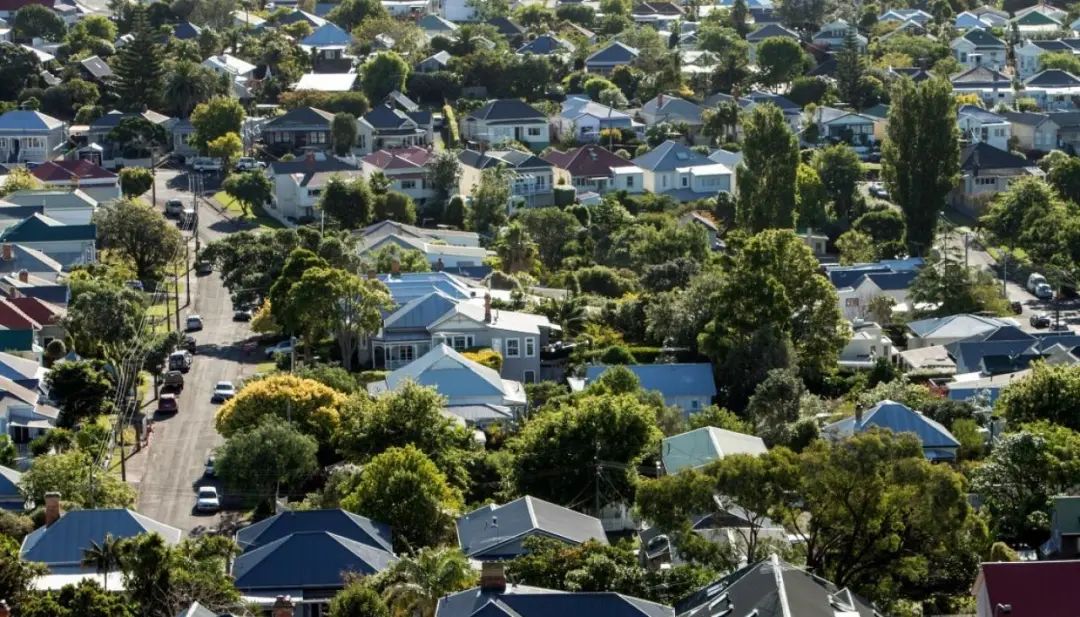
Although New Zealand's housing market has remained subdued for six consecutive months, sharply lower mortgage rates and improving buyer sentiment suggest the market is likely to improve before the end of the year. Research shows homeowners in New Zealand's wealthiest areas gained as much as NZ$150,000 in property value over the past three months, although the wider market's performance was somewhat subdued.
At the end of September, the national average house price was NZ$957,000, down 1.1% from the NZ$968,000 recorded at the end of June. This shows the property market is still being affected by the wider economic recession and the increase in listings earlier in the year. Although New Zealand's annual house price growth slowed to 0.1%, weekly data from the OneRoof-Valocity House Value Index shows the market has begun to stabilise. In the four weeks to the end of September, the national average house price rose for the first time since the first quarter.
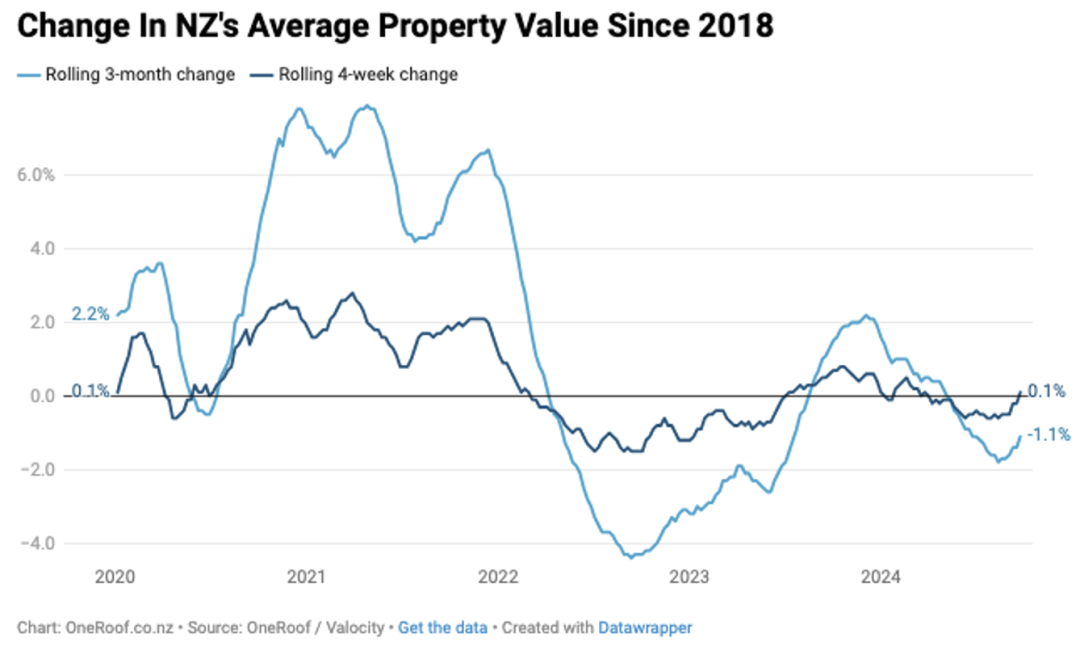
Changes in New Zealand's average property value from 2020 to the present (Source: OneRoof; also applies below)
While it is too early to tell whether these figures signal a house price recovery, other market indicators appear to offer homeowners hope. Economists are broadly confident that the Reserve Bank of New Zealand will cut the official cash rate further, with financial markets expecting at least one 50-basis-point cut before the end of the year. A OneRoof consumer survey conducted after the official cash rate fell to 5.25% in August found New Zealanders had become more confident about the property market.
The survey of 1000 OneRoof users revealed the following positive signs:
-
40% believed the economy would improve over the next 12 months;
-
41% believed housing affordability would improve slightly over the next year;
-
54% said falling interest rates had a significant or moderate impact on them; and
-
21% said they would make a major property decision because of rate cuts.
However, the latest OneRoof-Valocity House Value Index data also reveals weaknesses in the market. Auckland's average house price fell 1.1% (NZ$22,000) in the three months to the end of September, to NZ$1,276,000, down 2.4% (NZ$32,000) from a year earlier. The region's rate of decline slowed from 3% at the end of July, and weekly data showed a small increase in September. However, Northland, down 2.7% to NZ$816,000, and Wellington, down 2.7% to NZ$866,000, continued to decline. Manawatū-Whanganui, down 2% to NZ$601,000, and Hawke's Bay, down 1.6% to NZ$780,000, were also under pressure. Otago, Tasman and the West Coast each recorded quarterly house price growth of 0.9%, although low sales volumes in these areas suggest considerable volatility in the figures.
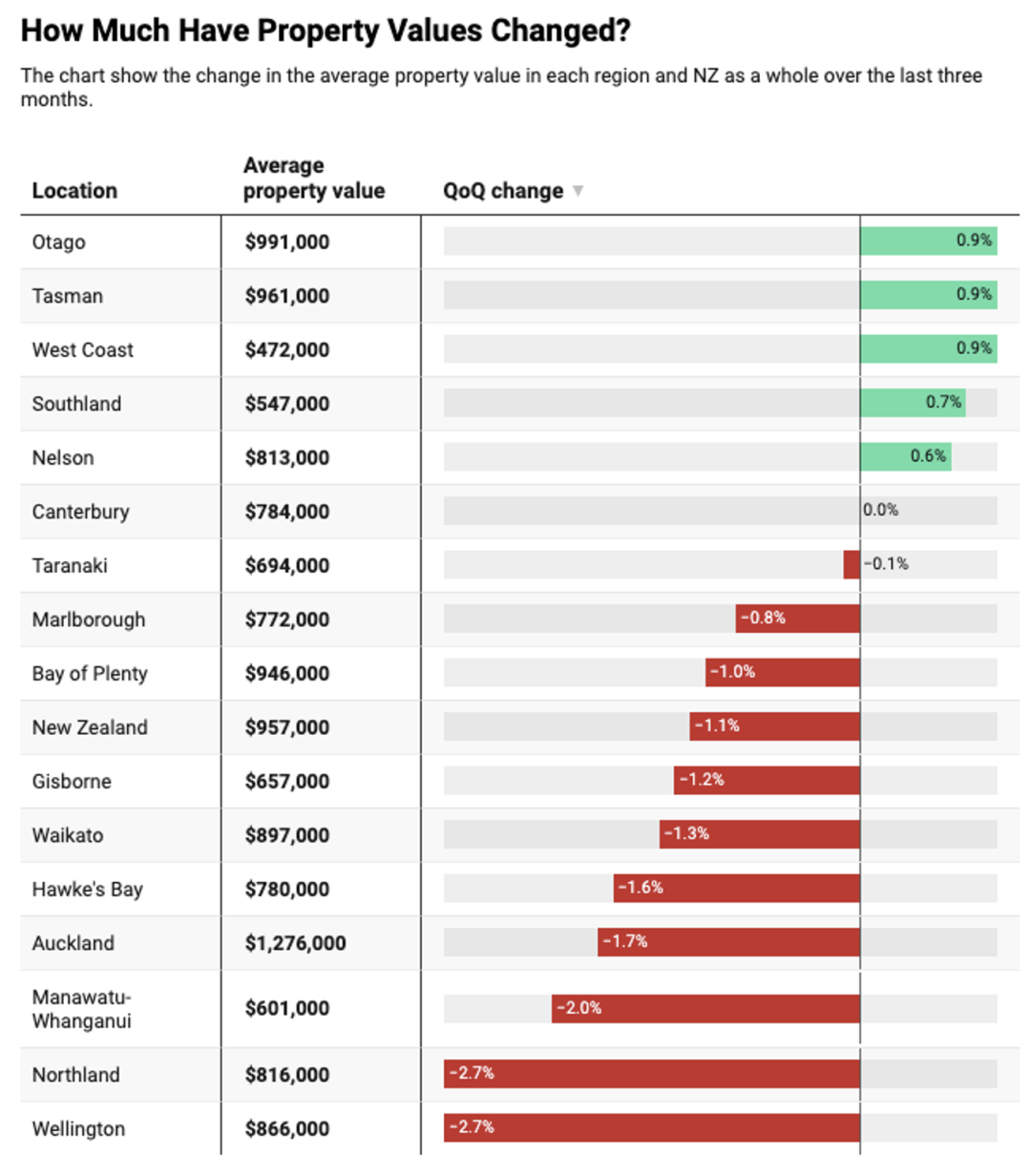
Changes in average property values across New Zealand's regions over the past three months
Only two major urban areas nationwide recorded quarterly house price growth: Queenstown-Lakes and Dunedin.
Queenstown-Lakes, the country's most expensive housing area, saw its average house price rise 1.5% (NZ$31,000) over the quarter to NZ$2,050,000. A large number of newly built luxury homes coming onto the market, along with demand for luxury homes from wealthy expatriates and Aucklanders, has put upward pressure on Queenstown-Lakes prices. Prices are now an extraordinary NZ$688,000 higher than five years ago.
Dunedin benefited from its lower house prices, with its average rising 0.1% (NZ$1000) to NZ$681,000. Although Christchurch prices fell 0.1% (NZ$1000) over the quarter, they have remained flat over the past six months. Hamilton and Tauranga prices fell 1% and 1.5% respectively, while Wellington city's average house price dropped 2.8% (NZ$28,000) to NZ$975,000, its lowest level in a year. The city has been grappling with rising unemployment and a sluggish economy, while recent reports of numerous local shops, eateries and retailers closing have added to market uncertainty.
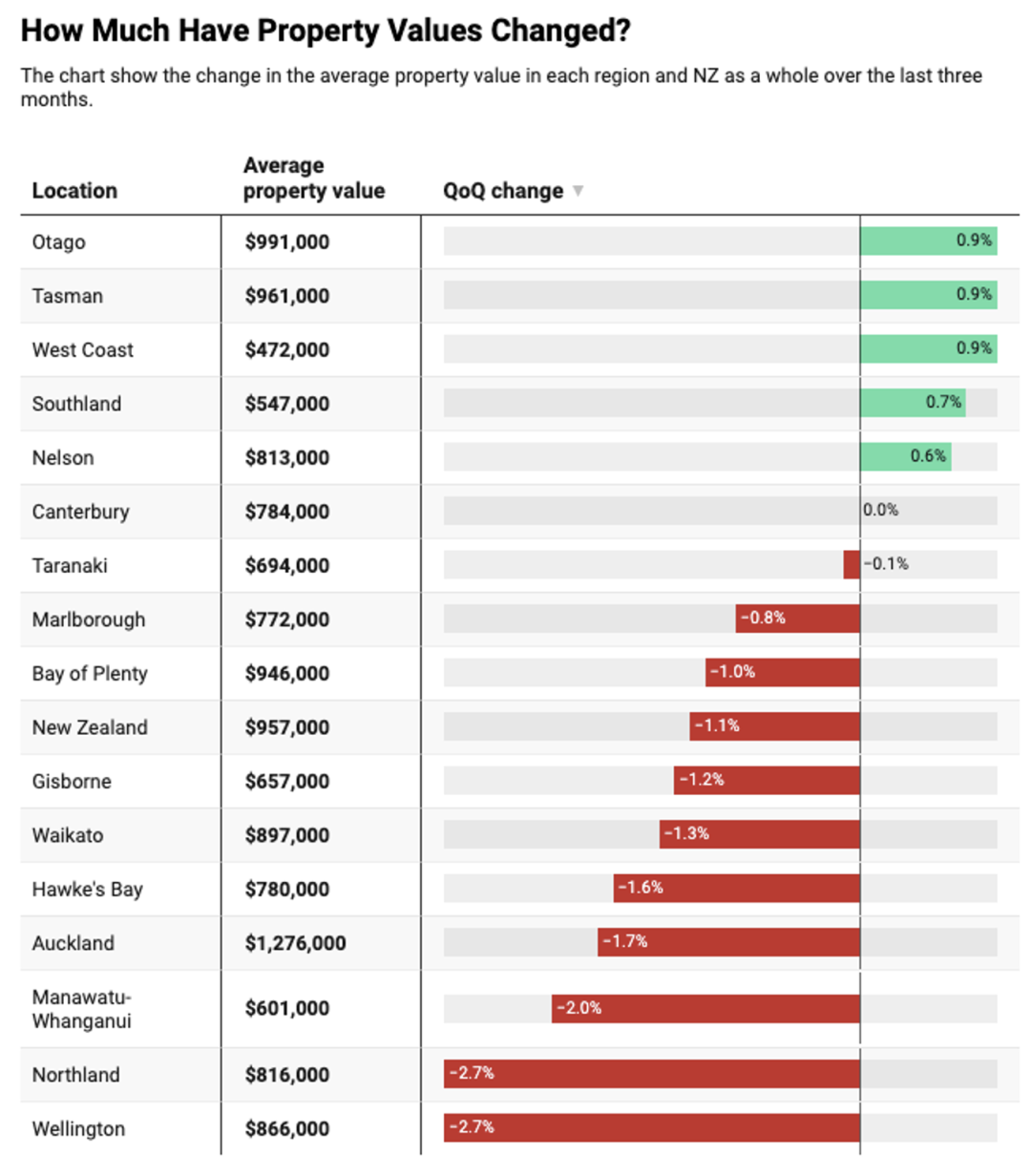
Quarterly changes in average property values in New Zealand's major cities
OneRoof-Valocity research shows house prices in some areas rose significantly over the past three months, while others suffered substantial losses. Nationwide, fewer than 1/4 of suburbs recorded quarterly price growth. The suburbs with the largest increases were in Queenstown-Lakes. Arrowtown's average house price jumped 5.7% (NZ$150,000) to NZ$2,780,000, while Lake Hayes rose 4.7% (NZ$125,000) to NZ$2,791,000. The largest quarterly falls were in the Far North, with 12 suburbs in Northland recording declines of more than 5%. The Karikari Peninsula was hardest hit, falling 12.4% (NZ$97,000) to NZ$686,000, followed by Paihia, down 10.1%, and Russell and Kaikohe, both down 8.5%.
OneRoof editor Owen Vaughan said that despite the increasingly positive interest rate outlook, the market still faced numerous challenges. Sales volumes remained low, he noted, and although new listings had recently declined, stock levels were still high.
“Overall, the economic picture is not encouraging. Non-performing mortgages have reached their highest level in a decade; GDP fell 0.2% in the second quarter; unemployment is currently 4.6% and is expected to rise to 5% in 2025; and net migration is also falling. While house prices are expected to recover, the return to a healthy market will be very slow.”
Vaughan also noted that OneRoof's consumer survey showed market pessimism was fading. “Although rate cuts have yet to have a direct impact on house prices, they have had an immediate effect on New Zealanders' perceptions of the market. Lower mortgage repayments and smaller living expenses bills at the end of the month are giving people more confidence to buy and sell property. This also provides a solid foundation for house price increases towards the end of the year and in 2025.
Construction liquidations surge
Concerns over the industry's outlook
Meanwhile, New Zealand's construction industry is experiencing a wave of liquidations and business failures. Credit bureau Centrix says construction companies currently account for a quarter of businesses entering liquidation, with 546 construction companies liquidated nationwide over the past 12 months.
Centrix's latest monthly Credit Indicator report shows business credit defaults across all industries rose 5%. Transport and construction were particularly hard hit, with business credit defaults surging 25% and 22% respectively year on year. “Non-residential construction companies experienced the largest annual increase in liquidations, up 78% on last year,” said Centrix managing director Keith McLaughlin. Construction companies account for 12% of all registered companies in New Zealand, or 84,000 businesses, but 26% of liquidations across all industries. Centrix says construction companies are more than twice as likely to fail as the average New Zealand business. As construction is an important part of New Zealand's economy, its difficulties further intensify the pressure on the wider economy's ability to grow.