
Another bank cuts floating mortgage rates! With rapid Reserve Bank cuts raising hopes that house prices will stop falling, is this buyers' chance to buy at the bottom?
Retail NZ chief executive Carolyn Young described the rate cut as an “early Christmas present” for retailers, hoping it would boost consumer confidence. “

After the Reserve Bank of New Zealand cut the Official Cash Rate (OCR) to 4.75%, ANZ became the latest major bank to lower its floating mortgage rates. ANZ cut rates by 50 basis points, taking its floating mortgage rate to 7.89% and its flexible mortgage rate to 8%. ANZ New Zealand managing director of personal banking Grant Knuckey said homeowners with floating-rate loans would be among the first to feel the benefits of the OCR cut. He stressed: “We are passing on the full 50-basis-point reduction to customers, meaning homeowners with some or all of their mortgage on a floating rate will benefit immediately.” He added that the bank would continue monitoring international and local market developments and adjust rates as appropriate.
Meanwhile, other banks also responded quickly. Today, Rabobank cut its floating base rate for rural lending by 0.50%. BNZ also cut its floating mortgage rate following the OCR announcement, lowering the annual rate from 8.44% to 7.94%. ASB reduced its floating mortgage rate from 8.39% to 7.89% and also cut the rate on its Orbit product. Westpac followed closely, announcing a 0.5% cut to floating mortgage rates within an hour, taking its Choices Floating and Offset rates to 7.89% and its Choices Everyday rate to 7.99%.
These bank rate adjustments reflect the market's rapid response to the OCR change and have raised expectations of lower financing costs. Even before the OCR cut, ANZ quietly lowered its one-year mortgage rate to 5.59% for customers with a deposit of at least 20%, further demonstrating the banking sector's positive response to the falling-rate environment.
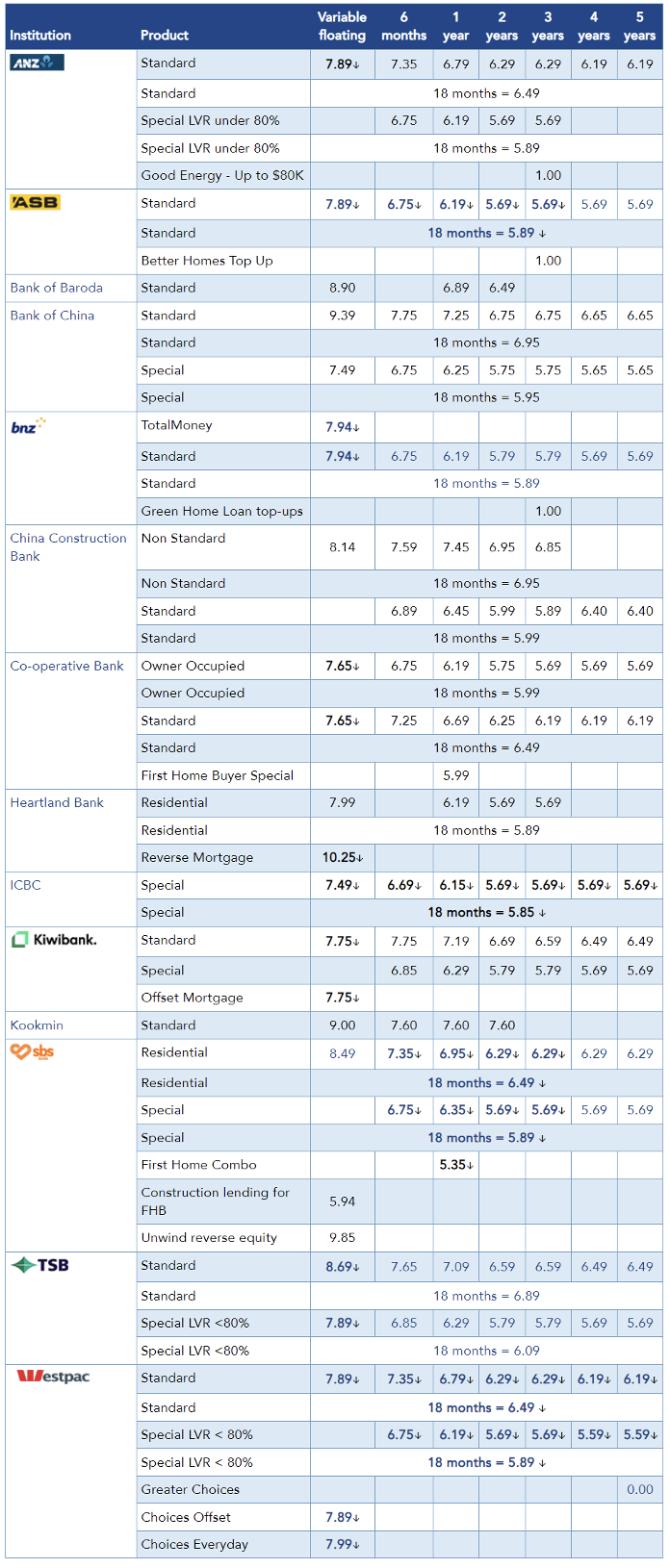
Latest mortgage rates across New Zealand banks (Source: www.interest.co.nz/borrowing)
Expert views: why did the Reserve Bank choose a substantial rate cut?
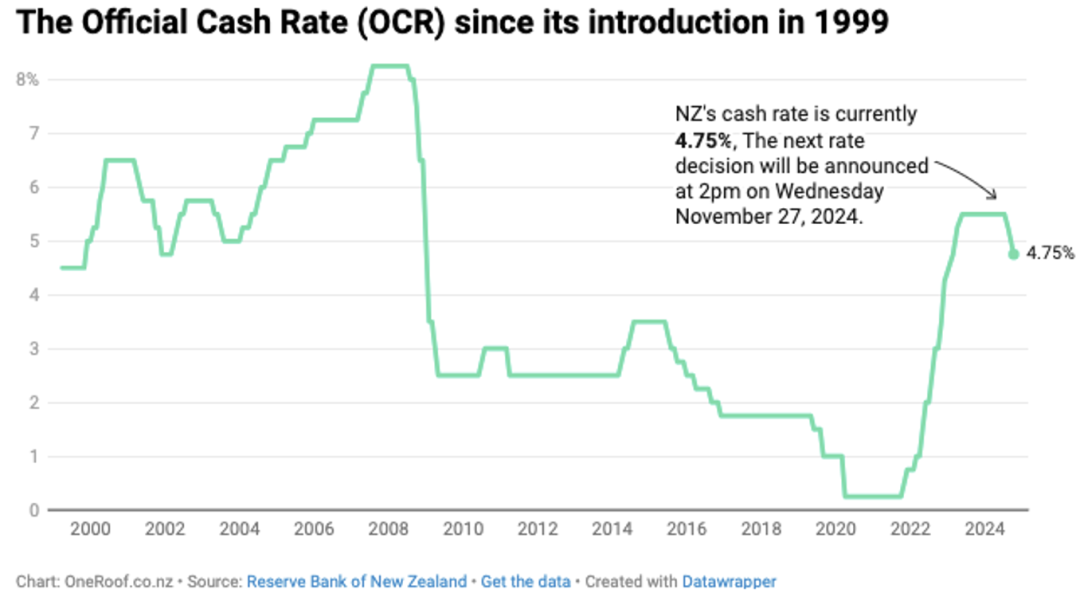
Chart of New Zealand's OCR from 1999 to the present (Source: RBNZ)
Infometrics chief economist Brad Olsen said the Reserve Bank's rate cut was no surprise. “They chose a 50-basis-point reduction rather than the usual 25, but the justification was insufficient.” He believes the substantial move shows the Reserve Bank recognises that its rate adjustments have lagged behind the economy's needs. Olsen expects a further 75-basis-point cut at the end of November, “because there is then a three-month gap, and the Reserve Bank may want more policy insurance before summer.”
ASB chief economist Nick Tuffley noted that the 50-basis-point cut was “widely expected”, but future policy would depend on economic data. “The degree of weakness in the data early next year will determine whether the Reserve Bank continues cutting in 50-basis-point steps.” He expects another 50-basis-point cut in November, with policy in 2025 depending on economic conditions.
Retail NZ chief executive Carolyn Young described the rate cut as an “early Christmas present” for retailers, hoping it would boost consumer confidence. “The Reserve Bank of New Zealand cutting the OCR to 4.75% is good news for retailers,” she said. “Rate cuts in the fourth quarter will help retailers as they approach their busiest selling season, particularly the crucial period before Christmas.”
Mortgage rate cuts bring a glimmer of hope for housing
Following the OCR cut, major banks moved quickly to lower mortgage rates. This is expected to ease repayment pressure on mortgage holders and could stimulate demand from home buyers. Ray White Group chief economist Nerida Conisbee welcomed the decision and expects the OCR could fall further to 3.75% by the end of 2025. She said: “Although the rate cut has been somewhat slow in coming, it is undoubtedly positive for the market. With the economy contracting and consumer confidence low, the Reserve Bank must act faster.”
CoreLogic NZ chief economist Kelvin Davidson believes falling borrowing costs could restore confidence in the property market, particularly during spring, traditionally a busy home-buying season. He said: “The direct effects of rate cuts will flow quickly through to the mortgage market and could lift housing market activity in the short term.” However, he also stressed that, even if house prices stop falling, a rapid rebound would still face challenges. High levels of available housing stock give buyers an advantage in negotiations, while rising unemployment and stagnant wage growth will also limit house price increases.
Is this buyers' chance to buy at the bottom?
Mortgage brokers have already observed renewed enthusiasm among home buyers. The latest survey shows 39% of brokers are seeing more first-home buyers entering the market, while 47% have noticed greater investor interest. Although banks are gradually easing lending criteria, longer approval processes may frustrate some buyers.
However, buyers should recognise that a housing market recovery does not mean a comprehensive improvement across the economy. Although rate cuts offer buyers more favourable borrowing conditions, New Zealand's economy still faces many challenges. Rising unemployment, insurance costs and electricity prices will keep household budgets under pressure. Meanwhile, lower net migration inflows and reduced willingness to spend mean the road to economic recovery will be long and uneven.
Broader economic recovery will take time, but new opportunities emerge in construction
Businesses are expected to face greater financial pressure over the next 6 to 9 months. Tax debt collection, rising costs and weak consumer spending all pose significant challenges to business finances. The wave of factory closures in industries such as forestry could spread to other sectors, while the Government's tighter post-pandemic fiscal policy is also limiting further economic stimulus in the short term. This summer's selling season could be particularly difficult for retailers. Inbound tourism operators stand to benefit from warmer weather, but Chinese visitor numbers have yet to recover fully, adding uncertainty to tourism revenue.
Although industries across the economy face challenges, some positive signs are emerging in construction. Developers have begun preparing for a possible construction peak in the second half of 2025, while the Government is actively advancing infrastructure projects. These efforts could help lift economic activity in the future.
There is no denying that faster OCR cuts have given the property market a shot in the arm and created opportunities to buy at the bottom. For New Zealand's wider economy, however, the benefits will take longer to emerge fully. As independent economist Tony Alexander put it: “Although there is a glimmer of hope for housing in the short term, the road to a full recovery remains long and challenging.” While benefiting from lower interest rates, buyers and investors also need to maintain a realistic assessment of the economic outlook.