
The limits of the Reserve Bank of New Zealand’s monetary policy: can rate cuts really solve the housing crisis? Experts warn against celebrating too soon!
Even as interest rates fall, investors can still profit from property appreciation, while house prices remain out of reach for first-home buyers.

The Reserve Bank of New Zealand recently lowered the Official Cash Rate (OCR), prompting market expectations of falling interest rates. Meanwhile, the latest figures show inflation has dropped to 2.2%, entering the central bank’s target range of 1–3% for the first time. This has led to widespread public expectations that monetary easing will bring further economic benefits, particularly in the housing market. But can the central bank’s rate cuts really address housing affordability? This remains a complex issue that warrants closer examination. In this article, we explore the complex relationship between the OCR, inflation and the housing market to reveal the underlying nature of the problem.
Rate cuts and the home buyer’s dilemma
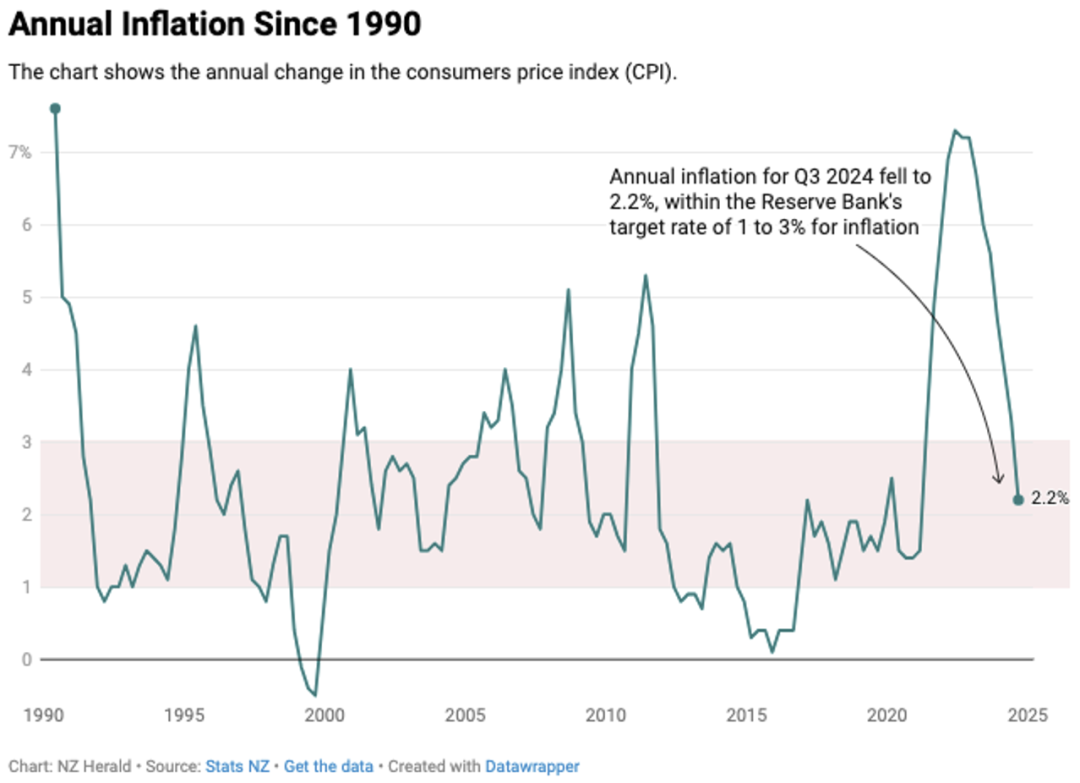
Chart of CPI changes from 1990 to the present (Source: NZ Stats)
In theory, one of the central bank’s main objectives is to influence market interest rates by adjusting the OCR, thereby regulating economic activity. Rate cuts can lower borrowing costs and help more people obtain loans. In New Zealand, however, the particular characteristics of the housing market limit this policy tool’s effectiveness. Even if rate cuts make borrowing cheaper, increased housing demand often pushes up house prices, especially when the supply of new homes is insufficient. This may be unwelcome news for first-home buyers.
Consider this example: at the beginning of 2024, New Zealand still faced considerable inflationary pressure, and the central bank failed to cut rates promptly, leaving the economy under pressure from high interest rates. Although inflation has now eased and rate cuts have provided some economic relief, house prices may rise faster than borrowing costs fall. For first-home buyers hoping to enter the market, the overall burden of buying a home has not truly eased and may even become harder to bear.
Structural problems in the housing market
New Zealand’s housing market has become increasingly financialised in recent years. Property is no longer simply a necessity for shelter; it has become a tool for households and investors to accumulate wealth. As house prices keep climbing, property owners build greater wealth through capital gains, while low-income groups and first-home buyers who have yet to enter the market are increasingly shut out by rising prices.
The imbalance between supply and demand has become one of the central problems in New Zealand’s housing market. Although rate cuts can temporarily ease mortgage pressure on buyers, the main drivers of high house prices remain, whether land shortages, high construction costs or lagging infrastructure development. Unless these structural problems are effectively addressed, housing affordability will remain an issue even with very low interest rates.
Monetary policy lags and market responses

Infometrics chief forecaster Gareth Kiernan
Monetary policy does not take effect immediately; it generally takes 6 to 9 months for its effects to show in the market. This means that although the central bank is trying to ease economic pressure through rate cuts, house prices may not cool as expected in the short term. As Infometrics chief forecaster Gareth Kiernan has pointed out, the central bank often lags behind market needs when adjusting the OCR. Despite falling inflation, the central bank has been slow to cut rates and has failed to respond effectively to market changes, resulting in a greater economic impact.
Looking back at the pandemic, the central bank cut the OCR sharply to stimulate the economy and relaxed mortgage restrictions, making loans easier to obtain. Although these policies helped the economic recovery at the time, they also boosted housing demand, with an unintended consequence: rapidly rising house prices deterred many buyers. This shows that while the current rate cuts may ease pressure on some buyers, they have not truly addressed housing affordability.
Property market distortions and unequal wealth distribution
Wealth inequality in New Zealand’s property market is growing. Those who already own property accumulate further wealth as house prices rise, while first-home buyers and low-income households find it increasingly difficult to enter the market. A policy of lowering the OCR to improve housing affordability may actually deepen the market’s wealth divide.

Kiwibank chief economist Jarrod Kerr
Kiwibank chief economist Jarrod Kerr further pointed out that although the current rate cuts are crucial to economic recovery, high interest rates have already caused considerable pain for New Zealand businesses and households. While future cuts may provide some relief for these groups, their direct effect on housing affordability may be very limited. Even as interest rates fall, investors can still profit from property appreciation, while house prices remain out of reach for first-home buyers. This not only creates an imbalance in wealth distribution but may also cause greater socioeconomic instability. Lowering the OCR as a way to improve housing affordability may, in fact, further distort the property market.
The limits of monetary policy
The analysis above shows that relying solely on OCR cuts cannot effectively resolve housing affordability problems. Although rate cuts can reduce buyers’ mortgage burdens in the short term, they often push up house prices, making the situation even harder for first-home buyers. Addressing New Zealand’s housing market problems requires more comprehensive policy measures, including increasing housing supply, improving land-use policies and advancing infrastructure development.
The central bank’s monetary policy undeniably plays an important role in controlling inflation and regulating the economy, but its influence on the housing market is limited. Only through structural reform can the government and policymakers achieve lasting housing market stability and promote balanced, healthy economic development for all New Zealanders.