
At last! Stats NZ confirms annual inflation has fallen to 3.3%. How likely is an OCR cut? The Government is considering lowering insulation standards: progress or a step backwards for the industry?
This is a substantial improvement on the dangerously high peak of 7.3% in June 2022.

Stats NZ released its consumer price index (CPI) results today as scheduled, showing that annual inflation for the year to 30 June has fallen to 3.3%, down from the annual rate of 4% recorded for the year to 31 March, and the lowest in three years. This is a substantial improvement on the dangerously high peak of 7.3% in June 2022.
However, this figure remains above the Reserve Bank of New Zealand’s target range of 1–3%, so the official cash rate (OCR) still needs to remain high. But how long will this last?
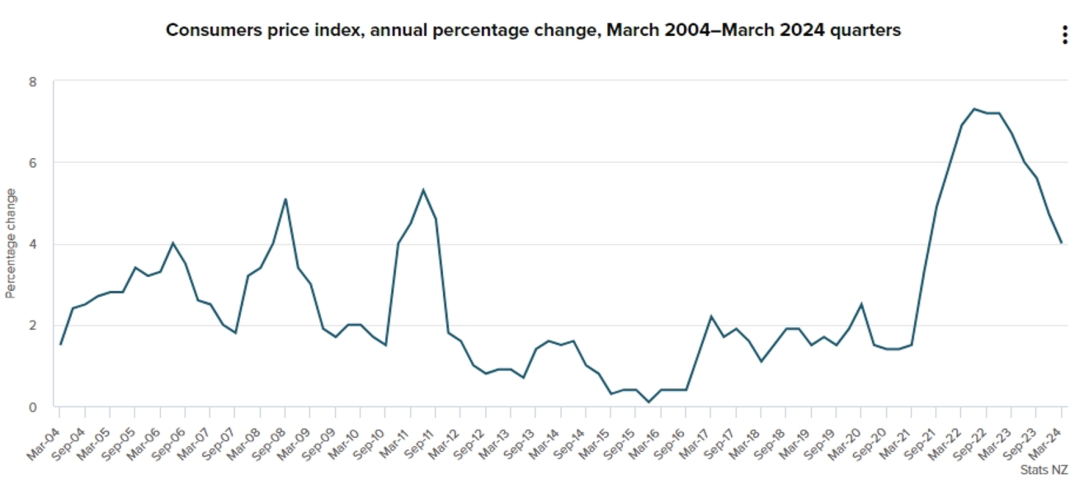
CPI changes over the past 20 years (Source: Stats NZ)
Interpreting the latest figures
The latest figures may reassure the Reserve Bank, as both imported and domestic inflation have eased. In June, tradable prices fell by 0.5%, while non-tradable prices rose by 0.9%. Annual increases were 0.3% and 5.4% respectively, below the Reserve Bank of New Zealand’s earlier forecasts of 1.1% and 5.3%, and below the 1.6% and 5.8% recorded in March.
In month 6, transport costs fell for the third consecutive quarter, while price increases for dining out, domestic holiday accommodation and retail shops were relatively modest, contributing to the improvement in overall inflation.
Housing-related costs, meanwhile, remained the largest contributor to inflation, rising 1.1% this quarter. Rents rose 1.2% over the past three months. They tend to move in line with income growth and respond more slowly to higher interest rates. Rental pressures are expected to ease as unemployment rises. Higher electricity prices also contributed to housing inflation, while construction costs continued to rise, albeit more slowly as activity in the sector contracted.
Finally, insurance costs also rose 3.1%, with earlier rounds of inflation and increased weather-related risks both affecting premiums. This persistent services inflation is what makes it difficult for monetary policy to curb inflation in the domestic economy.
Economists’ outlook
ANZ economist Henry Russell noted that non-tradable inflation had exceeded expectations for four consecutive quarters since the Reserve Bank paused interest rate increases in May 2023. A fall in second-quarter non-tradable inflation to 5.3% would therefore help narrow this gap. Russell said the unexpectedly low figures could significantly change the signals around inflation risks, increasing the likelihood of the Reserve Bank making its first rate cut before February 2025. However, this would need support from the forthcoming second-quarter labour market and GDP figures.
ASB senior economist Mark Smith said: “We are increasingly confident that inflation will fall below 3% in the second half of 2024, and that conditions are in place to sustain inflation within 1–3%. We forecast an OCR cut of 25 basis points in November, but weakness across economic indicators increases the likelihood of earlier and larger cuts by the Reserve Bank of New Zealand in 2024.” ASB also said that although the sharp decline in headline inflation appeared to create conditions for monetary easing, the Reserve Bank of New Zealand was unlikely to act immediately unless it saw a sustained decline in core inflation.
Government considers lowering building insulation standards

Building and Housing Minister Chris Penk
Building and Housing Minister Chris Penk recently said the Government was considering lowering home insulation standards, a proposal that has prompted widespread attention and debate. Penk’s proposal aims to reduce the cost of building new homes, but faces strong opposition from the climate change and building sectors.
Insulation standards: history and current position
In May 2023, the New Zealand Government made the first major upgrade to building insulation and glazing requirements in more than a decade. The change received overwhelming support from the public and the building industry, with the new standards expected to reduce heating demand in a new four-bedroom home by 40%. However, Penk said he had received complaints from builders and developers in Tauranga and the Bay of Plenty that the new H1 standards had increased the cost of new homes and caused problems such as overheating.
Benefits and drawbacks of the current policy
The insulation standards introduced in 2023 have delivered significant energy savings. According to official information, the new standards have reduced both heating demand in homes and energy use in large commercial buildings. However, Penk believes these standards have increased building costs and could create home affordability problems amid the current housing crisis. He noted that many New Zealanders still live in cars and emergency accommodation such as motels, arguing that any policy that increases housing costs is ill-timed in this context.
Industry feedback
Before the new standards were introduced, 99% of public submissions supported higher insulation standards, including submissions from major industry organisations such as builders’ and architects’ associations. However, after implementation, some builders and developers complained about overheating in new homes, higher construction costs and overly stringent standards. Despite this negative feedback, many industry experts and organisations have also said the new insulation standards are delivering significant benefits, particularly in keeping out cold and damp.
What happens next
Penk has reportedly asked the Ministry of Business, Innovation and Employment (MBIE) to urgently investigate the costs of the new standards and consider reinstating the old ones. Although the move aims to reduce building costs, it could also represent a step backwards for New Zealand’s insulation standards, affecting its commitments on climate change and energy efficiency.