
A signal of what lies ahead? Reserve Bank Governor says rate cuts will slow! How can borrowers get ahead in a fiercely competitive market?
He also specifically noted that markets had already priced in interest rate cuts of 200 to 300 basis points, reflecting optimism about future monetary policy easing.

As the Reserve Bank of New Zealand (RBNZ) adjusts the official cash rate (OCR), borrowers and savers are reassessing their financial strategies. Reserve Bank Governor Adrian Orr recently said publicly that although the OCR had fallen from its peak of 5.5% to its current level of 4.75%, future rate cuts could proceed more cautiously. Orr stressed that, despite market expectations of substantial cuts over the coming months, the Reserve Bank would take a more measured approach to avoid persistent domestic inflation pressure.
In a recent speech, Orr reflected on the Reserve Bank’s rapid interest rate increases in the post-pandemic period. Between 2021 and 2023, the OCR rose sharply from 0.25% to 5.5% to address pandemic-related economic uncertainty and inflation pressure. Orr said that although the economy had entered relatively “calm waters”, the Reserve Bank would adopt a more cautious approach to future cuts to ensure the economy operated smoothly in a low-inflation environment.
He also specifically noted that markets had already priced in interest rate cuts of 200 to 300 basis points, reflecting optimism about future monetary policy easing. Even so, Orr stressed that each step in the Reserve Bank’s rate-cutting process would be based on actual economic conditions rather than relying entirely on market expectations.
Rate-cut expectations and banks’ responses
The Reserve Bank of New Zealand has now cut the OCR twice in succession, and markets widely expect a further reduction of 50 basis points in November, potentially even 75 basis points. These expectations will undoubtedly affect commercial banks’ lending and deposit rates. While borrowers hope to see mortgage rates fall quickly, deposit rates tend to be cut faster, while mortgage rates decline more slowly.
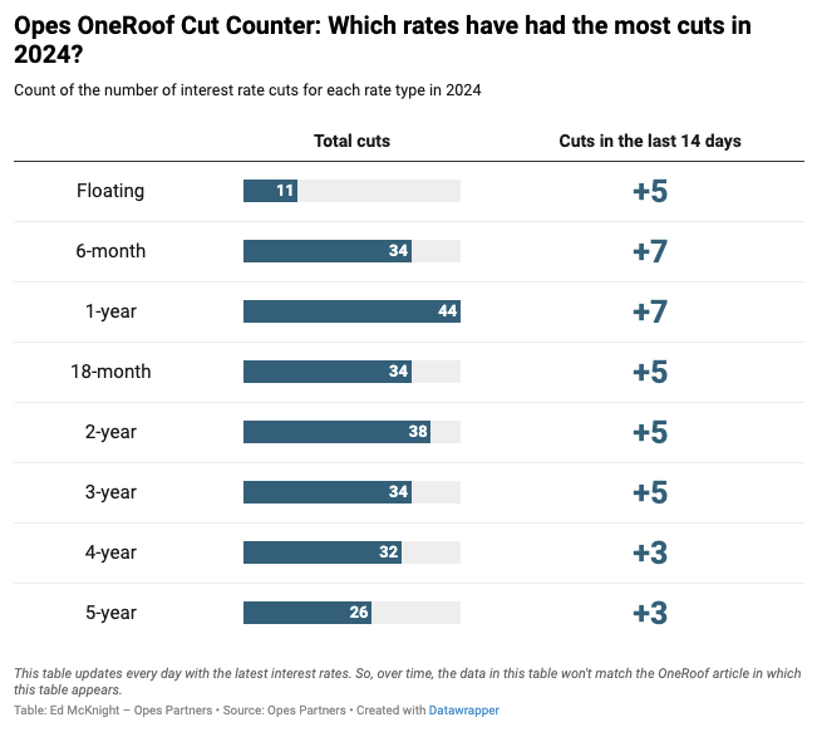
Which interest rates have fallen the most in 2024?
(Source: Opes Partners)
According to the NZ Herald, banks often stand to gain more when adjusting interest rates. Data shows that even after the first official cash rate (OCR) cut in August, the average home loan interest rate still rose to 6.37%, while deposit rates fell to 4.34%. This indicates that banks charge borrowers far more interest than they pay savers, allowing them to retain greater profit margins as interest rates change.
Borrowers benefit as bank competition intensifies
As the Reserve Bank of New Zealand cuts rates in succession, competition among banks has intensified. To attract customers, banks are not only lowering interest rates but also offering incentives such as cashback. Mortgage brokers say some banks are currently offering refinancing customers cashback of up to NZ$5000, giving borrowers more lending options.
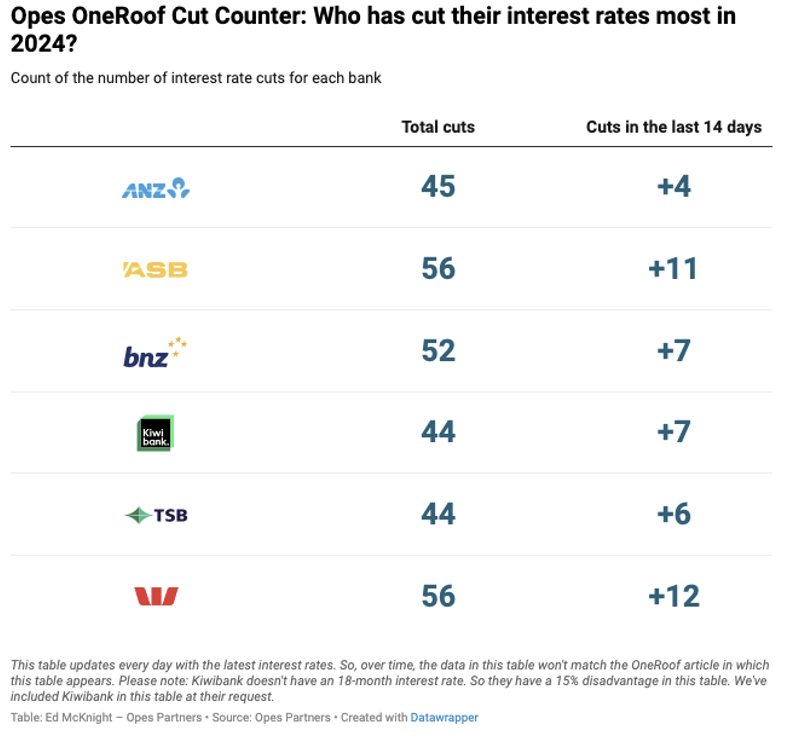
Which bank has cut interest rates the most in 2024?
(Source: Opes Partners)
Tella Home Loans chief executive Andrew Chambers recommends that borrowers take a measured approach in the current environment, such as choosing a one-year fixed rate. He said frequently changing loan arrangements in pursuit of a better deal might not produce significant savings. “It is like KiwiSaver funds. Many people try to move their KiwiSaver to the best-performing fund each year, but in practice, staying put delivers much the same result as switching frequently.”
He specifically highlighted the currently available one-year fixed rate of 5.59% as an ideal option that borrowers should lock in early. He also recommended a “lock in first, then watch the market” approach to provide peace of mind while ensuring stable borrowing costs.
Watch for banks’ unadvertised offers

Interest rate transparency is particularly important in a competitive market. While some banks heavily promote mortgage rate cuts, they rarely mention adjustments to deposit rates. Some even target particular customer groups with unadvertised rates or special offers. For example, ANZ’s 5.59% rate spread rapidly through social media and dominated the market. Although ASB and BNZ matched it, they did not advertise it publicly. This shows that banks’ rate adjustments are more than responses to market conditions: they are carefully designed marketing strategies.
A YIJU reader reported that ANZ’s special one-year mortgage rate had risen today from 5.59% to 5.89%.
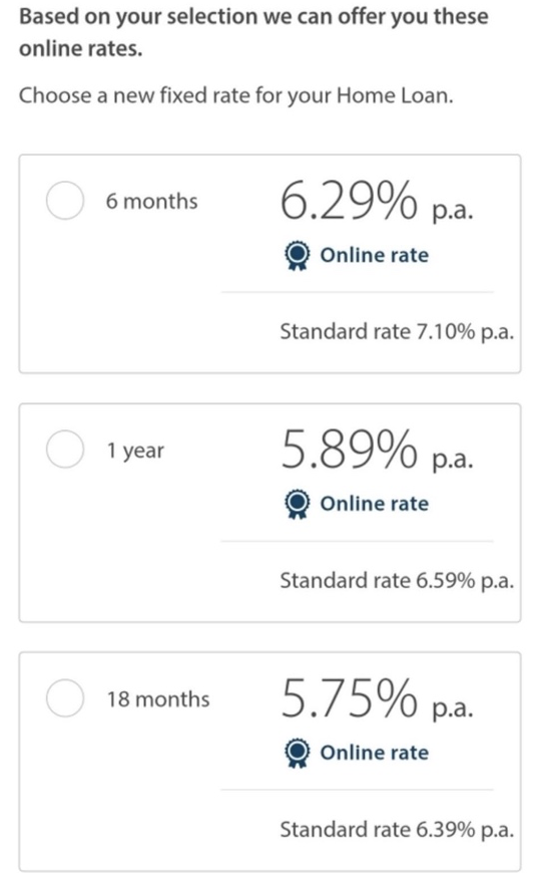
Image sourced online (for reference only)
Borrowers’ borrowing capacity has also increased significantly as banks lower their servicing test rates. A mortgage broker said that after banks lowered their servicing test rate from 8.9% to 8%, first-home buyers’ borrowing limits rose from NZ$600,000 to nearly NZ$700,000, giving buyers greater financial support and flexibility.
How can you benefit from the current interest rate environment?
In this changing interest rate environment, borrowers have many opportunities but also need to make careful decisions. They should actively negotiate with banks to secure the most competitive rates. If their chosen bank is not offering sufficiently attractive terms, experts suggest considering a switch to another bank for better lending terms.
Henry Moore of Liquid Mortgages said lower-than-expected inflation had increased pressure on the Reserve Bank of New Zealand to accelerate monetary policy easing. He noted that although the consumer price index (CPI) did not itself directly affect interest rates, the data would spur the Reserve Bank into action, with further rate cuts expected. Moore also advised borrowers to remain proactive in negotiations: banks are competing for their business, and negotiating can secure better mortgage rates and cashback.