
Breaking: major simplification! Government plans self-certification for low-risk building work! With assets shrinking and mortgages under strain, how can homeowners ease repayments without selling?
Following comprehensive consultation, the government plans to further streamline the building consent system next year.

Government plans to introduce
self-certification for low-risk building work
New Zealand Prime Minister Christopher Luxon and Building and Construction Minister Chris Penk jointly announced this afternoon that qualified builders would be allowed to self-certify low-risk work, aiming to simplify the current building consent application process and speed up residential construction. The self-certification scheme will apply to “trusted” building professionals and accredited companies undertaking “low-risk, basic residential projects”. This means qualified professionals, including plumbers and builders, will be able to certify the quality of their own work without inspections.

Prime Minister Christopher Luxon and Building and Construction Minister Chris Penk
Penk said the new policy would put builders on a similar footing to professionals such as electricians and gasfitters, who have been able to certify their own work for many years. The industry has also long called for such reform. Penk said companies building hundreds of structurally similar homes each year could complete construction through a more streamlined consent process. Penk also said that, to ensure the quality of self-certified work, the policy would introduce other safeguards, including avenues for customers to have substandard work remedied, stronger qualification requirements and strict monitoring of “negligent or incompetent” self-certifiers.
Penk stressed that the government wanted building inspection resources to focus on large, complex projects, where international experience showed building defects were more common. The current consent system leaves councils and their ratepayers responsible for all defective work, and this cautious approach to approvals further slows construction. By placing more risk on building practitioners, the government hopes to encourage high-quality construction while reducing the burden on ratepayers.
Penk said building and approving a house currently took an average of 569 days. That was far too long during a “housing shortage”: “An ordinary single-storey home may currently undergo 10 or more separate inspections. That is clearly too many, and the balance between costs and benefits has been lost.”
At the press conference, Luxon told reporters that cumbersome rules were “regulation without practical benefit”, and that the government’s changes focused on ensuring three things: qualified builders and tradespeople, strong consumer protection and penalties for poor operators, and a faster system.
Following comprehensive consultation, the government plans to further streamline the building consent system next year.
How can homeowners ease repayment pressure without selling?
In today’s complex market, with high interest rates and house prices continuing to fall, many homeowners face severe mortgage repayment pressure and intense anxiety about losing their homes. However, experts say selling is not the only option. More flexible financial planning, such as extending loan terms and restructuring debt, may help homeowners through difficult times while retaining their properties’ long-term value.
Falling house prices shrink assets and intensify mortgage pressure
According to the latest OneRoof house price data, the national average house price has fallen by nearly 13% from its post-pandemic peak, a drop of about NZ$141,000. Among the major cities, Auckland’s average house price has fallen by NZ$300,000, while Wellington’s has declined by NZ$278,000. This loss of asset value has left many first-home buyers who purchased at the market peak finding that their homes are no longer worth enough to support their next upgrade or investment, or even repay their existing loans.
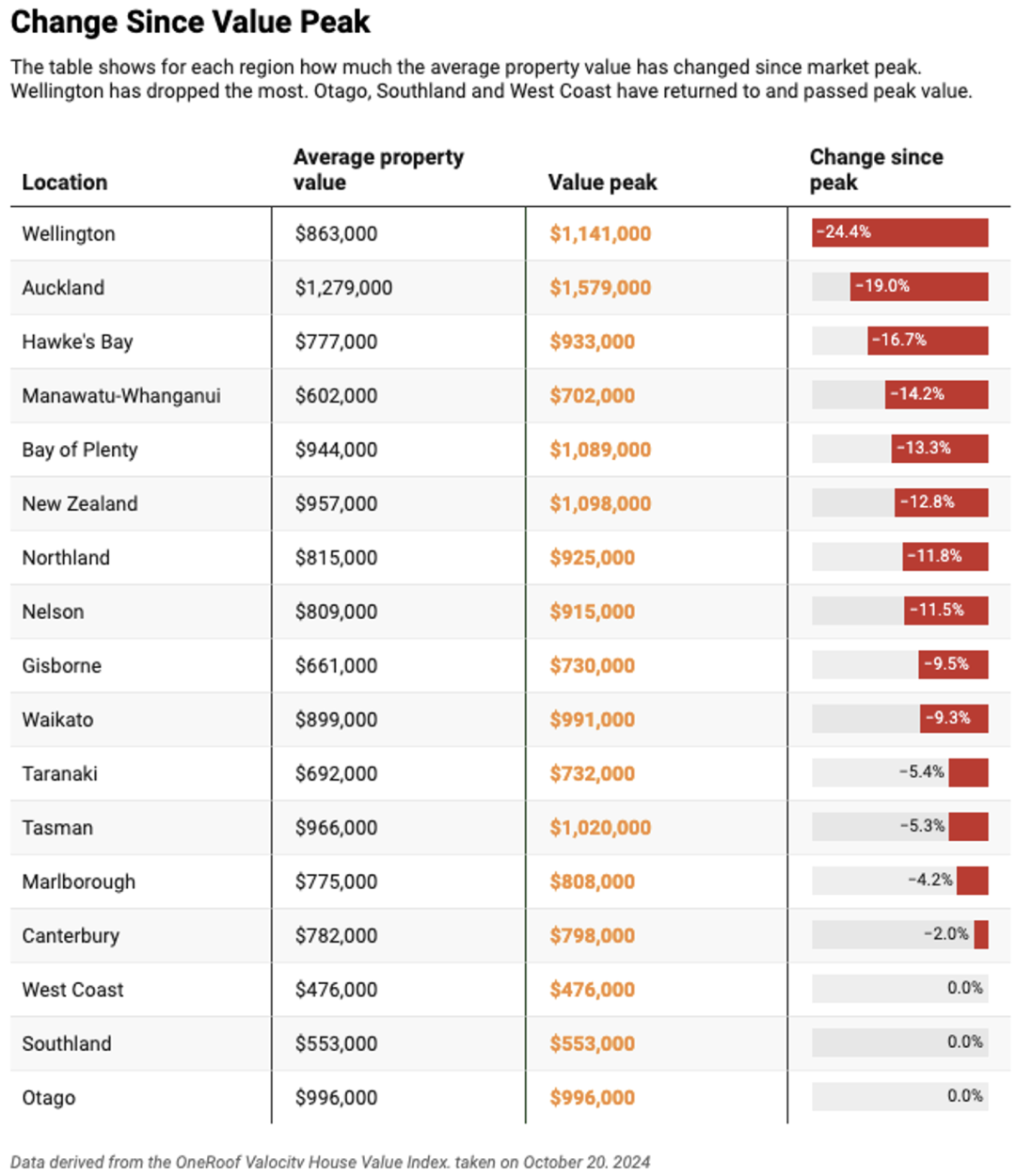
Difference between current house prices and market peaks across New Zealand regions (Source: OneRoof)
Mortgage adviser: selling is not the only solution
EasyStreet Mortgages adviser Gareth Veale said a lack of financial advice left many homeowners believing they had to sell to ease mounting mortgage pressure. Some homeowners focused immediately on “selling and downsizing” without fully understanding their lending options, believing this was their only way out. Several of his clients initially thought of selling when faced with financial difficulties. Through appropriate mortgage restructuring, however, they found they could extend their loan terms and reduce monthly repayment pressure, avoiding the risk of losing their homes.
Veale gave the example of a middle-aged Christchurch couple who had taken out a mortgage with a 15-year term. When their interest rate rose to nearly 7%, their repayments were far higher than expected. Considering their everyday household expenses and future financial plans, they believed selling was their only option. However, Veale recommended extending the loan term to 30 years, temporarily easing their repayment burden. This allowed them to keep their home and consider further adjustments once the market recovered. The couple ultimately chose this more flexible repayment arrangement.
Business owners face high financing costs as well-planned debt restructuring delivers results
For some small and medium-sized business owners, high financing costs have added financial pressure. Vaele also shared another case involving a business owner paying a vehicle loan interest rate as high as 14% for a company vehicle. This affected cash flow and increased mortgage repayment pressure. Debt restructuring helped the owner ease a liquidity crisis and avoid being forced to sell assets.
Comprehensive planning helps homeowners through financial difficulties
Tella Home Loans chief executive Andrew Chambers stressed that, in the current market, homeowners should avoid relying solely on advice from a single financial institution. Each bank’s lending options often have limitations, while mortgage advisers can draw on a range of financial products to offer more tailored solutions. Chambers said: “Customers should actively consult professionals such as accountants, financial advisers and mortgage advisers to ensure their financial arrangements suit current market conditions.”