
Confirmed: Reserve Bank holds OCR at 3.25%! An in-depth look: is the property market oversupplied, or are homes simply unaffordable?
After six consecutive interest rate cuts, the Reserve Bank of New Zealand will announce its latest official cash rate (OCR) decision at 2 pm today. Although markets widely expect the OCR to remain unchanged at 3.25%, industry opinion is sharply divided over this decision to pause, reflecting the central bank’s dilemma as it weighs slowing inflation against economic hardship.
After six consecutive interest rate cuts, the Reserve Bank of New Zealand will announce its latest official cash rate (OCR) decision at 2 pm today. Although markets widely expect the OCR to remain unchanged at 3.25%, industry opinion is sharply divided over this decision to pause, reflecting the central bank’s dilemma as it weighs slowing inflation against economic hardship.
Why the Reserve Bank held steady
The central bank’s Monetary Policy Committee said it had unanimously agreed to leave the rate unchanged, noting that annual consumer price inflation could rise towards the upper end of its 1% to 3% target band by the middle of 2025.
“However, with some spare capacity remaining in the economy and domestic inflation pressures easing, headline inflation is expected to remain within the target band and fall back to around 2% in early 2026.”
The report noted that high export prices and lower interest rates were supporting New Zealand’s economic recovery.
“However, rising global policy uncertainty and the effects of tariffs are expected to constrain global economic growth. This could slow New Zealand’s economic recovery and ease inflation pressures. The economic outlook remains highly uncertain. Further data on the pace of New Zealand’s recovery, the persistence of inflation and the effects of tariffs will determine the future path of the official cash rate.”
The committee also said further OCR cuts were expected if medium-term inflation pressures continued to ease as anticipated.
Markets bet on a hold, but divisions deepen
Most economists predict the central bank will take a wait-and-see approach this time, awaiting further economic data to support its decision, and could resume the rate-cutting cycle on 14 August. That assessment has a basis: in less than a year, the OCR has fallen sharply from 5.5% to 3.25%, a substantial cumulative reduction of 225 basis points.
For that very reason, however, some economists are cautious about further cuts, arguing that markets should be given time to absorb those already delivered. At its previous meeting, the central bank also mentioned “uncertainty” as many as 164 times, highlighting its heightened vigilance over global trade, war in the Middle East and the direction of US policy.
Calls for cuts persist, with Kiwibank and ANZ taking clear positions
Although most views favour a pause, Kiwibank chief economist Jarrod Kerr was unequivocal: “New Zealand’s economy remains in a very difficult position, and we believe the central bank should deliver further easing this week.”
He noted that households remained mired in a cost-of-living crisis, businesses faced pressures on several fronts, and the economy as a whole was still “crawling”, rather than “striding out of recession”. Only stronger policy support could get the economy truly “running”.
ANZ chief economist Sharon Zollner expressed a similar view. She warned that financial markets might be underestimating the likelihood of a cut today. This suggests that even beneath an apparent market consensus, divisions continue to simmer.
Should the central bank wait longer or act decisively?
The central bank faces a timing dilemma: while it waits for clearer data, the real economy may already be missing an opportunity for relief.
With global policy moving towards easing and major economies including Australia and Canada already cutting rates, a clearer answer may soon emerge as to whether the Reserve Bank of New Zealand can continue to chart its own course. In particular, once inflation, employment and GDP data are released in August, could this pause prove to be merely a prelude to another rapid round of rate cuts?
From 100,000 new homes to 6083 properties for sale: has Auckland’s housing crisis really eased?
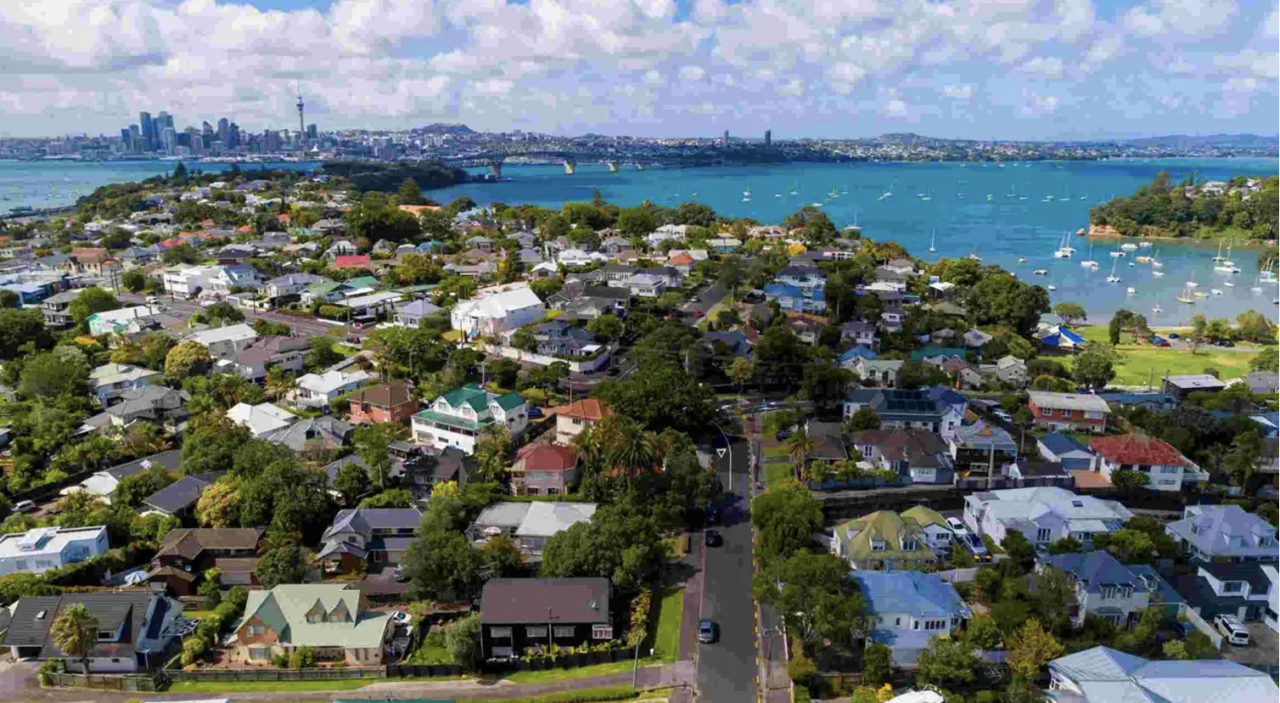
Over the past seven years, Auckland has built nearly 100,000 new homes, with annual approvals peaking at 18,100. There are currently as many as 6083 properties for sale. Judging by these figures, Auckland appears to have long since emerged from the shadow of its housing crisis and may even be heading towards oversupply.
Yet a closer look at the market, buyers’ experiences and the realities of affordability reveals that this seemingly resolved crisis is quietly becoming a more complex structural predicament.
1 The planning logic behind the supply boom
Auckland’s acceleration in housebuilding is no accident. Council chief economist Gary Blick identified the Auckland Unitary Plan, introduced in 2016, as the source of this wave of supply. The plan relaxed density restrictions, encouraged replacing a single home with three, and promoted townhouses and apartments in place of traditional standalone houses. As a result, around 89% of new homes represented a net addition, genuinely expanding the housing stock.
Council research shows the plan has the potential to accommodate 900,000 new homes, of which 650,000 are considered commercially feasible. Mayor Wayne Brown also said: “Developers are ready and willing to concentrate development in areas where we invest in infrastructure. That is the path to sustainable growth.”
Indeed, greater geographical concentration and a more diverse mix of housing have created more flexible capacity for Auckland’s population growth.
2 “From FOMO to FOOP”: psychological barriers become a new obstacle
The central issue in today’s market is that more homes have not been matched by a corresponding increase in buyers.
Independent economist Tony Alexander has found in his regular surveys of real estate agents that buyer sentiment has shifted from FOMO, the fear of missing out, to FOOP, the fear of overpaying. People are no longer rushing into the market; instead, they worry that prices will fall as soon as they buy. This marks a subtle turning point in the housing market: from buyers struggling to secure a home to homes attracting little competition.
Barfoot & Thompson managing director Peter Thompson said buyers currently had a historically high level of choice. Yet sales activity remains well below pre-pandemic levels, underscoring how expectations have become the market’s biggest variable.
3 Affordability: a gap in the figures, a gulf in reality
Auckland Council chief economist Gary Blick
Blick noted that Auckland’s median house price was currently around NZ$1,000,000, approximately 7.5 times household income. In 2000, that ratio was just 5. In other words, using the 20-year-old house-price-to-income ratio as a benchmark, today’s median house price should be NZ$680,000.
This is a systemic divergence rather than a minor adjustment. For young families in particular, the gap means that even with the desire to buy, a deposit and mortgage eligibility, they still struggle to cross the psychological threshold.
Take 32-year-old Natasha Thirani and her husband: although they are actively viewing homes and have a budget of $850,000, they still cannot afford their preferred location. She put it plainly: “Your first home isn’t your dream home, just as you wouldn’t buy a Porsche as your first car.”
4 Unable to afford a home, or unable to believe they can?
Aera founder Derek Handley posed a more provocative question: “Auckland doesn’t lack homes; it lacks people who believe they can afford one.” He said many dual-income households aged around 30 could, by making sensible use of KiwiSaver, comfortably afford a newly built townhouse priced between NZ$600,000 and NZ$650,000.
But confidence is the problem. On one side, developers are introducing modern communities, build-to-rent projects and transit-oriented development (TOD). On the other, buyers remain broadly hesitant, weighing whether to wait for lower prices. Both supply and demand appear ready to come forward, yet they still fail to connect in a functioning market.
5 Auckland in transition: the interplay of structure, positioning and policy
Major policy changes are also under way. Housing Minister Chris Bishop announced the removal of the previous government’s Medium Density Residential Standards (MDRS), which allowed three homes per site, in favour of a strategic approach to density. This would allow high-density housing of more than 15 storeys along urban rail corridors and focus intensification around transport hubs and urban centres.
Auckland councillor Richard Hills
Councillor Richard Hills also emphasised that Auckland would still need 300,000 additional homes over the next 30 years. Ideally, these should be built near metro, light rail and bus routes so that infrastructure investment delivers meaningful housing benefits.
This reflects a shift in thinking: from indiscriminate expansion to strategically concentrated supply, and from a focus on total numbers alone to consideration of housing form and accessibility.
Conclusion: the crisis is changing, but is far from over
As Gary Blick put it: “Auckland’s housing problems have not been fully resolved, but they are steadily improving.” New Zealand has neither moved towards the high house-price bubbles seen in China, Japan and South Korea nor achieved a Nordic-style housing security model. Auckland’s predicament is better understood as a three-way mismatch: regulatory constraints have eased, housing structures are changing, but public perceptions have yet to catch up.
This is more than a market issue; it requires policy, sentiment and housing structures to be brought into alignment. However many homes are built, if ordinary people cannot believe they can afford one, the apparent prosperity will ultimately be just another illusion.