
Reserve Bank of New Zealand delivers a major rate cut to 2.5%: bolstering confidence or sowing future concerns? Who are the winners and losers?
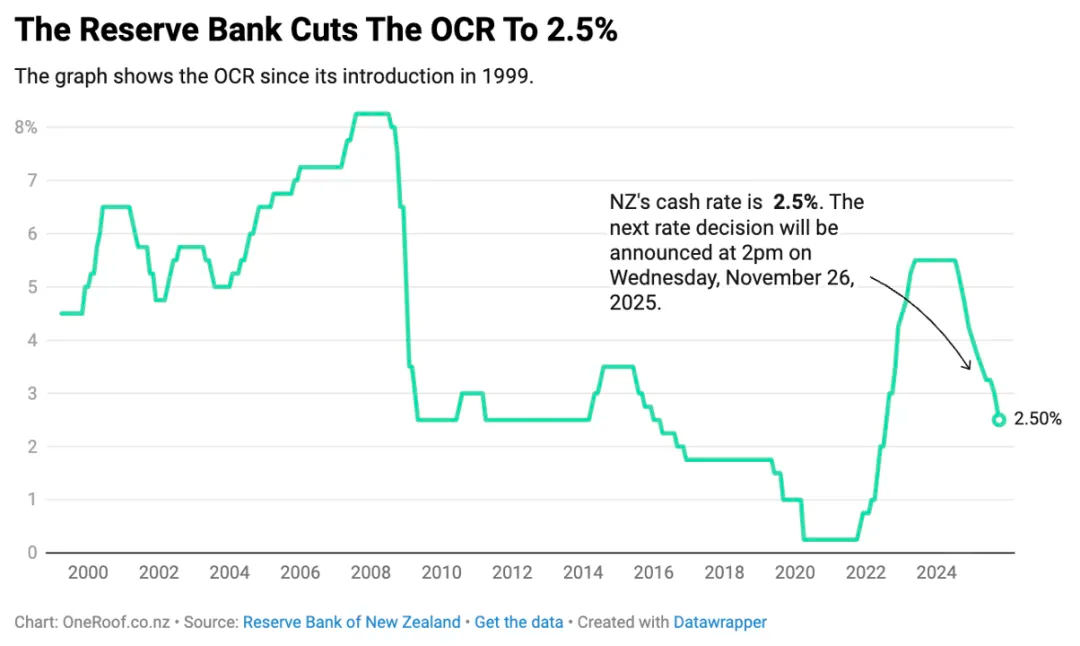
Yesterday, the Reserve Bank of New Zealand announced a 50-basis-point cut to the Official Cash Rate (OCR), bringing it to 2.5%.

Yesterday, the Reserve Bank of New Zealand announced a 50-basis-point cut to the Official Cash Rate (OCR), bringing it to 2.5%. This is the fifth cut this year and the largest. The Bank's Monetary Policy Committee (MPC) said the move was intended to send households and businesses a clear signal: the economy still has the potential to recover, and confidence is key.
The decision exceeded the expectations of many market participants. Economists had generally expected the Bank to opt for a modest 25-basis-point cut rather than a single reduction of 50 basis points. The announcement therefore triggered an immediate chain reaction: the New Zealand dollar fell, bond yields declined and share prices rose.
Background: a stalled recovery and concerns about excessive caution
The Bank's reasoning is clear. New Zealand's economic recovery has struggled since the second half of 2024. Gross domestic product (GDP) unexpectedly contracted by 0.9% in the second quarter of this year, the weakest quarterly performance in nearly two years. Although the Bank highlighted 'unusually large seasonal adjustment factors', the signal was enough to raise market concerns about the recovery's prospects.
The Monetary Policy Committee stated plainly in its meeting minutes: 'Excessive caution among households and businesses could weaken the recovery and reduce inflationary pressure over the medium term.' Meanwhile, although elevated dairy prices, adverse weather and rising energy costs have constrained supply, the Bank regards these as supply-side limitations rather than a collapse in demand.
In August, the Monetary Policy Committee made a modest 25-basis-point cut to 3.0%, forecasting that the rate would bottom out at 2.5% by year-end. The committee has now chosen to 'get there early', unanimously agreeing to an immediate 50-basis-point cut to prevent market pessimism from becoming self-reinforcing.
{ad}
Immediate market reaction: currency falls, bonds rise and shares rally
Following the announcement, the New Zealand dollar fell nearly 1% that afternoon, reaching a six-month low against the US dollar. The two-year government bond yield dropped to 2.69%, its lowest since March 2022. Meanwhile, expectations of further easing pushed share prices higher, with New Zealand's benchmark share index up 0.6% at around 2 pm.
Banks responded swiftly. ANZ led the way, announcing a 40-basis-point cut in its floating mortgage rate to 5.89%. Westpac, ASB, BNZ and Kiwibank followed, with one-year fixed rates at almost all major banks falling to 4.49%. BNZ and ASB also lowered their 18-month fixed rates to 4.49%, signalling that competition over mortgage rates has reached fever pitch.
For households with mortgages, this offers tangible relief. On a typical NZ$500,000 loan over 30 years, fortnightly repayments could fall by around NZ$300 to NZ$400.
Political reaction: praise and criticism
New Zealand Finance Minister Nicola Willis praised the Bank's decisive action, saying 'lower interest rates will leave more money in the pockets of households and businesses'. She stressed that the decision would help ease years of cost-of-living pressure and was 'a real boost for households and businesses'. Prime Minister Christopher Luxon described it on social media as 'an early Christmas present'.
The opposition, however, was unsparing. Labour's economic affairs spokesperson Barbara Edmonds said the Bank was 'cleaning up the mess created by the Luxon Government'. She criticised New Zealand's continuing economic contraction while other advanced economies were returning to growth. The Taxpayers’ Union argued that relying solely on rate cuts for stimulus was no substitute for a genuine growth strategy: 'The Government's fiscal policy urgently needs adjusting; otherwise, a fundamental economic improvement will be difficult.'
ACT leader David Seymour attributed the rate cut to 'fiscal discipline', stressing that government cuts to wasteful spending had created the conditions for lower interest rates. The political divisions highlight the complex political implications of the cut.
Impact across society: who are the winners and losers from this rate cut?
The Bank's rate cut affects different groups in society differently.
-
Mortgage holders: clearly the biggest winners. Lower floating and short-term rates directly ease monthly repayment pressure, with some households able to save more than ten thousand New Zealand dollars a year.
-
Renters: receive almost no direct benefit, while upward pressure on rents remains.
-
Savers and retirees: a low-interest-rate environment is particularly punishing for people who depend on deposit interest for their living expenses. Simplicity chief economist Shamubeel Eaqub said: 'For the two-thirds who do not have a mortgage, especially retirees who rely on savings, this is very difficult.'
The data shows that one-year term deposit rates have fallen from 6.1% to 3.79% over two years. This means a NZ$10,000 deposit now earns NZ$231 less in annual interest than it did two years ago. The figure may seem small in isolation, but accumulated over ten or twenty years, with compounding taken into account, the difference could reach thousands or even tens of thousands of New Zealand dollars.
Leighton Roberts, co-founder of investment platform Sharesies, said that as term deposit returns decline, more investors are moving money into shares and funds. This year, net deposits on Sharesies exceeded NZ$1,000,000,000 within a single year for the first time. However, he cautioned: 'Higher returns come with higher risk. Savers need to be clear about their investment timeframe and avoid risking short-term funds in the sharemarket.' -
Retail: the retail association said the rate cut would boost spending during the Christmas shopping season, helping retailers increase stock purchases and maintain employment.
For this reason, Richard Holden, chief economist at Chartered Accountants Australia and New Zealand, cautioned that a large rate cut could make consumers feel that 'things are looking bad', potentially suppressing spending instead. He warned: 'This is a shot in the arm, but it could also frighten the market.'
Expert analysis: bolstering confidence or sowing future risks?
Independent economist Tony Alexander said the Bank had chosen to act forcefully because economic data in the first half of this year was notably weak and the market's patience with the recovery was wearing thin.
He noted that floating mortgage rates would fall by around 0.5 percentage points, providing meaningful short-term relief for households and businesses. However, he also cautioned: 'The Reserve Bank of New Zealand has historically tended to ease too far, often having to raise rates sharply again two or three years later to bring inflation back under control.'
NZIER's latest business confidence survey shows that business investment intentions plunged from positive 8% to negative 13%, while the proportion planning to raise prices over the next three months rose to 7%. This suggests that inflationary pressure could return despite weak demand. Alexander suggested that ordinary borrowers might continue choosing short-term fixed rates, but for those seeking greater certainty, locking in a five-year rate below 5% could provide a form of insurance.
Outlook: a new governor is about to take office, and the easing cycle is not yet over
Markets generally expect the Bank could cut rates by a further 75 basis points in total by early 2026. The Monetary Policy Committee's November meeting will be the last chaired by current Governor Christian Hawkesby, with incoming Governor Anna Breman taking over in December. Her policy approach will determine whether the easing cycle continues or gradually draws to a close.
Globally, inflation remains subdued in major Asian economies, with China even showing signs of deflation. If external demand remains resilient, a weaker New Zealand dollar could help boost the country's exporters. However, persistent capacity constraints, weak population growth and inadequate infrastructure investment could limit the recovery's strength.
Commentary: a high-stakes bet on confidence and risk
This forceful 50-basis-point cut is the Bank's high-stakes bet amid a stalled recovery and a crisis of confidence. It may boost consumption and investment in the short term, but whether it will bring renewed inflationary pressure over the next two or three years remains highly uncertain.
For households with mortgages, this is an opportunity to ease their burden. For savers and retirees, it means lower returns and potentially a need to rethink their financial plans. With these divergent effects, do you see this rate cut as timely relief for the market, or the beginning of future risks? Share your views in the comments.