
Development or preservation? Major Devonport development enters the fast track
Devonport town centre on Auckland’s North Shore could be facing its biggest transformation in decades.
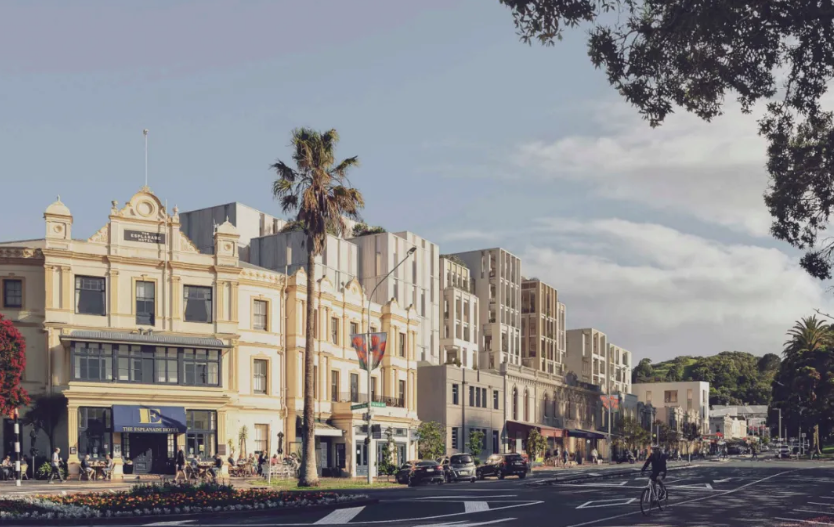
Devonport town centre on Auckland’s North Shore could be facing its biggest transformation in decades.
The controversial Devonport Lanes mixed-use development has recently been admitted to the Government’s fast-track approvals process. The proposal includes apartments, a hotel, retail and commercial space around Victoria Road, Wynyard Street and nearby areas, alongside restoration of several historic buildings.
The decision quickly sparked renewed local debate. The developer says the project could bring housing, visitors, spending and investment to an ageing town centre. Opponents fear that new buildings up to eight storeys high would dominate the historic buildings along Victoria Road and affect the existing visual relationship between Takarunga/Mt Victoria and the town.
Admission to the fast-track approvals process does not mean the project has received resource consent or can begin construction immediately. The Government has so far only agreed to refer it to an independent expert panel for assessment. Whether it ultimately gains approval, and whether its height must be reduced or its design changed, remain uncertain.
Around 90 apartments and a hotel
The Devonport Lanes application was submitted by Devonport Property Management Limited, with Peninsula Capital as the developer. Published plans cover several buildings in central Devonport Village, proposing five new buildings ranging from four to eight storeys, alongside restoration and adaptive reuse of six heritage-protected buildings along Victoria Road.
The project is expected to provide 80 to 90 apartments, a hotel with around 50 rooms, roughly a third of a hectare of retail space and about a quarter of a hectare of commercial space. Parking provision is provisionally set at between 80 and 200 spaces. Plans also include new walking and cycling connections to improve movement within the town centre. A long-vacant former ASB bank building is expected to be demolished. The proposal would reinstate its original façade following redevelopment and create a glass-roofed passage through the building for pedestrians to cross the block.
Infrastructure Minister Chris Bishop considers the project eligible for the fast-track approvals process because it offers significant regional or national benefits. The Government’s reasons include increasing housing supply, improving urban functionality, attracting more visitors and increasing use of public transport such as ferries.
Economic benefits were another important basis for admission to the fast-track process. Relevant material indicates that the project is expected to inject around NZ$358,000,000 into the construction industry over the next five years and create around 1198 full-time jobs. Once occupied, the 80 to 90 additional apartments are expected to generate around NZ$1,280,000 to NZ$1,450,000 in annual local retail spending. Over a longer period of 35 years, the project could generate around NZ$568,000,000 to NZ$789,000,000 in additional GDP. However, these figures are economic forecasts supplied by the project proponents. Actual outcomes will depend on approval, the scale ultimately built and market conditions.
Developer: historic buildings also need ongoing investment
Devonport is known for its historic streets, waterfront setting and ferry terminal, but some town centre properties are ageing and some buildings have been vacant for years. Funding historic building repairs has become an issue the community cannot avoid. Peninsula Capital says Devonport Lanes involves more than demolishing old buildings and replacing them. A key part of the project is restoring existing historic buildings and finding financially sustainable long-term uses through retail, commercial activity and public space.
The developer has previously said historic buildings need a future as well as a past. Without new investment and stable commercial uses, even preserved buildings may remain vacant or poorly maintained. The project team acknowledges that development on this scale in Devonport will inevitably be controversial, but hopes the public will consider heritage restoration, public space, housing supply and town centre vitality together, rather than focusing solely on building heights.
After waiting around three years, the developer welcomed admission to the fast-track approvals process. However, it also acknowledges that this is only the first step. The next stage requires more detailed information for the expert panel, addressing water supply, drainage, traffic, parking, viewshafts, building height, heritage protection and archaeology.
Red balloons raised to 27 metres fuel height debate
Opposition has come mainly from local heritage group Devonport Heritage. Earlier this month, the group raised red helium balloons to around 27 metres in Devonport to demonstrate the potential height of the tallest proposed building. Along Victoria Road, where buildings are predominantly two or three storeys, the height was particularly striking, making figures previously confined to planning documents much easier to visualise.
Devonport Heritage says it does not oppose additional housing or town centre renewal, but believes the proposed height and bulk exceed what the local historic setting can accommodate. Opponents point out that the existing local building height limit is around 13 metres, while some proposed buildings could reach 27 metres. Even if the historic buildings along Victoria Road remain, seven- or eight-storey buildings behind them could still change the existing streetscape.
They also worry that new buildings would obstruct some views of Takarunga/Mt Victoria, weaken the visual connection between the volcanic cone and the town centre, and cast more shade over nearby public spaces and playgrounds. Devonport Heritage recently travelled to central Auckland to present its concerns to the Tūpuna Maunga Authority. It hopes the body responsible for managing Auckland’s volcanic cones will consider the project’s effects on Takarunga/Mt Victoria and make a formal submission to the expert panel.
Beyond the buildings themselves, the group also questions the fast-track approvals mechanism. Under Auckland Council’s standard resource consent process, affected residents may generally have opportunities to make submissions or attend hearings. Fast-track approvals use a different assessment approach, and public participation may be more limited than under the traditional process. Opponents argue that a project capable of changing the appearance of Devonport’s entire town centre should involve ample community discussion.
Fast-track assessment does not mean an automatic green light
Procedurally, Chris Bishop’s decision establishes only that the project meets the criteria for referral to an expert panel. The Government considers that it could deliver housing, jobs and economic benefits, so did not reject it at the application stage for entering the fast-track process. Its fate will be determined by the substantive assessment ahead. The expert panel must assess the pressure additional homes and a hotel would place on water supply, wastewater, roads and public transport. It must also examine parking provision, heritage restoration plans, archaeological effects, and the impact of new buildings on views of Takarunga/Mt Victoria and Devonport’s streetscape. The panel can approve or reject the application, or require design changes and impose conditions relating to building height, construction management, traffic and heritage protection. It is therefore inaccurate to interpret this decision as approval of the project itself.
What kind of development does Devonport need?
The dispute appears to concern the height of a few buildings, but it reflects questions facing many established Auckland communities. Devonport has a regular ferry service and convenient connections to the city centre. From an urban planning perspective, adding housing where public transport and commercial facilities are already relatively well established makes more sense than continued outward expansion. Yet Devonport also attracts residents and visitors because of its long-preserved low-rise streets, historic shops, waterfront setting and the distinctive backdrop of Takarunga/Mt Victoria. If the scale of development is mishandled, retaining some old façades may still leave the entire neighbourhood’s scale and character changed.
Heritage preservation must also confront the question of funding. Old buildings need repairs, empty shops need new uses, and the town centre needs sufficient foot traffic and spending. Rejecting development entirely may not secure better protection for historic buildings. But accepting buildings that are too tall or too large to attract investment could strip the setting being protected of its original value. Whether Devonport Lanes can strike that balance will now be for the expert panel to judge.
This decision affects more than Devonport. As more major projects use the fast-track approvals mechanism, similar debates may arise in other established Auckland communities: how much additional housing and investment should there be? How much should historic neighbourhoods change to accommodate urban growth? Devonport Lanes has crossed its first threshold, but remains some way from final approval. For this century-old seaside town, the real decision is what kind of place the Devonport of the future should become.