
The further house prices fall, the longer buyers wait? Three challenges behind New Zealand’s homebuilding rebound
New Zealand’s housing market is showing a divergence: house prices are still slowly falling and buyers remain hesitant, yet building consents and residential construction activity have already picked up.
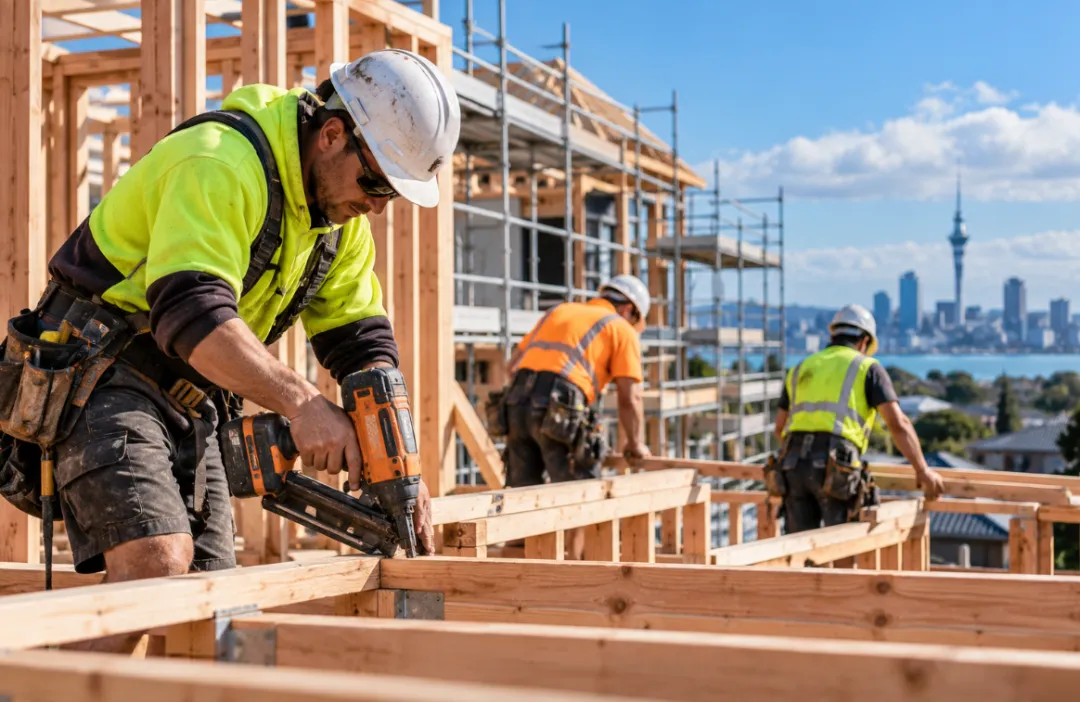
New Zealand’s housing market is showing a divergence: house prices are still slowly falling and buyers remain hesitant, yet building consents and residential construction activity have already picked up.
These signals are not contradictory. The market for buying and selling homes reflects current willingness to transact, while construction activity is influenced by earlier project plans and construction timelines. So can the current building rebound translate into a sustained, profitable recovery?
Why are buyers still waiting as house prices fall?
In his analysis on 5 October, Cotality chief economist Kelvin Davidson noted that the national median residential property value fell 0.3% in September to just over NZ$797,000. This was the sixth consecutive monthly decline, taking it below the previous cyclical low in June 2023.
The market is adjusting gradually rather than falling sharply. Auckland and Wellington continued to weaken, while Hamilton and Christchurch recorded slight increases, with regional differences remaining pronounced.
Falling prices have not automatically sparked enthusiasm among buyers. Analysis released by Tony Alexander on 7 October showed that just 8% of surveyed agents observed a ‘fear of missing out’ among buyers; 45% said buyers were worried that prices would continue to fall after they purchased.
In the survey, the net proportion of agents observing an increase in first-home buyers rose to 45%, but investors remained relatively scarce. This suggests there are active buyers in the market, but a broad recovery in demand has yet to emerge.
There was also a divergence between the North and South Islands: the net proportion of agents reporting falling house prices was 47% in the North Island and 10% in the South Island. Here, ‘net proportion’ means the difference between the proportions giving different responses, not the percentage decline in house prices.
The construction rebound has support, but also a time lag
In its Eco-Pulse released by chief economist Mike Jones on 1 October, BNZ noted that residential construction activity grew 4.4% quarter on quarter in the second quarter, the strongest quarterly increase since 2021. Before this, residential construction volumes had declined for almost five years, contracting by around a quarter overall.
Building consents are also sending positive signals. Data cited by Davidson showed that 3,440 new homes were consented in August, up 12% year on year. The total for the past 12 months was close to 41,300, the highest level since August 2023.
However, consent is only one step in progressing a project. BNZ noted that some developments had been paused or scaled back because of the weak market, and the conversion of consents into actual construction may be less consistent than in the past.
The existing project pipeline can therefore support construction activity over the coming months, but continued growth will also require supportive sales, financing and cost conditions.
1. First challenge: weak selling prices and renewed pressure on building costs
The most immediate difficulty for developers is that home selling prices lack upward momentum, while building costs face fresh pressure.
BNZ noted that construction costs were showing signs of rising again after around three years of relative stability. Energy prices could push up spending on transport, diesel, plastics and paint, while a weaker New Zealand dollar would also add to cost pressures for some imported materials.
When sales revenue is difficult to increase but costs are rising, project margins narrow. Even with consent granted, developers may still reconsider: is it worth starting construction now?
2. Second challenge: financing costs affect both buyers and sellers
Both housing market analyses mentioned rising mortgage rates. For buyers, lower house prices do not necessarily mean a corresponding reduction in monthly repayments. For developers, higher financing costs could increase expenses while holding a project and during construction.
In its forecasts as at 28 September, BNZ expected the OCR to rise to 3.75% by March 2027. This is the bank’s forecast, rather than a confirmed interest rate path, but it indicates a cautious assessment of financing conditions.
If project sales slow and capital remains tied up for longer, interest costs could further erode profits.
3. Third challenge: can demand keep pace with rising supply?
BNZ expects annual population growth to remain below 1% next year. If new housing supply continues to grow faster than the population, the market will need to pay closer attention to whether homes’ locations, types and prices meet actual demand.
Meanwhile, townhouses now account for more than 40% of new homes consented nationwide, reaching 53% in Auckland. An increase in dwelling numbers does not mean a proportional increase in floor area or project value, and consent numbers alone cannot indicate the health of the industry.
Active first-home buyers are supporting the market, but relatively few investors and weak demand from existing homeowners looking to move could both limit the pace at which new homes are absorbed.
YIJU’s perspective: Recovery depends on whether projects can make it through the entire process
Taken together, the three reports provide grounds for a rebound in residential construction, but a full recovery still faces constraints. BNZ also leans towards the view that the cycle has turned, although future growth may be moderate.
The key developments to keep tracking are how many consents turn into construction starts, whether new-home sales improve, and whether projects deliver reasonable profits on completion.
For construction businesses and developers, a market recovery brings opportunities while also requiring more careful cost control and product positioning. For buyers, greater choice and weaker competition offer room to compare options, but decisions still need to be grounded in their income, ability to service a mortgage and long-term housing needs.
Rising building consents are a positive signal; progressing from approval to construction and sale is the real test this residential construction recovery needs to pass.