
2019 third-quarter review
Latest survey: business confidence falls to a 10-year low The latest ANZ Business Outlook survey shows New Zealand business confidence has fallen to a “pessimistic” level, affecting employme

Latest survey: business confidence falls to a 10-year low
The latest ANZ Business Outlook survey shows New Zealand business confidence has fallen to a “pessimistic” level, affecting employment. ANZ’s September Business Outlook survey found that overall business confidence fell by 2 percentage points, with 54% of respondents expecting business conditions to deteriorate over the coming year—the lowest confidence reading since April 2008.
Businesses’ expectations for their own prospects over the coming year fell by 1 percentage point, the fourth consecutive decline and the lowest level since April 2009. 40% of companies said they expected credit to become harder to obtain, an increase of 1%. Export intentions rose by 3 percentage points, with 2% of businesses expecting exports to increase.
Employment intentions rose by 1% but remained historically low. ANZ chief economist Sharon Zollner wrote: “Fundamentally, economic conditions remain sound.” “Commodity prices are still reasonable; population growth is positive; monetary conditions have eased. But a prolonged lack of confidence is starting to affect the New Zealand economy and threatens the tight labour market.”
Zollner said one positive sign was that employment intentions in construction had recovered. The construction industry accounts for 9% of employment. Critics, including the Government, have accused business confidence surveys of being excessively negative and politically biased.
{Ad}
New Zealand economic growth hits a five-year low
On 19 September, Stats NZ released figures showing that annual growth in New Zealand’s gross domestic product (GDP) slowed to 2.1% in the second quarter, down from 2.5% in the first quarter. This was the weakest annual growth since the fourth quarter of 2013. On a quarterly basis, the economy grew by 0.5% in the second quarter, slightly below the first quarter’s 0.6%.
Nevertheless, this growth rate was still above the 0.4% expected.
“The services sector accounts for around two-thirds of the economy and was the main contributor to GDP growth this quarter,” said national accounts senior manager Gary Dunnet. “Behind the slowdown in GDP growth was reduced investment in non-residential buildings and in food, beverage and tobacco manufacturing.”
Notably, Stats NZ said in its statement that, measured at current prices, New Zealand’s economy reached a record US$300,000,000,000 in June this year. “It took the economy around 14 years to grow from US$1000 to US$200,000,000,000, then 9 years to reach US$300,000,000,000,” Dunnet said.
ASB economist Mark Smith said in a commentary: “Today’s GDP figures confirm that New Zealand’s economic growth remained below its previous trend in the first half of 2019.” He said the Reserve Bank of New Zealand’s substantial OCR cuts so far this year appeared justified given the marked slowdown in economic growth.
He said: “We will be watching closely for fresh signs of the effects of cuts to the official cash rate, and signs that New Zealand’s growth outlook is improving.”
“However, the signs for the second half of 2019 do not look much better so far.” Smith said business confidence remained weak, while consumers seemed reluctant to “follow the central bank’s instructions and go out and spend”.
Reserve Bank Governor: New Zealand’s economy has shown resilience
On 30 September, Reserve Bank of New Zealand Governor Adrian Orr commented in a statement accompanying the release of the 2018–2019 annual report.
Orr noted: “New Zealand’s economy has shown resilience through a period of weak global growth and heightened global uncertainty.” He said: “Our economic and policy environment is constantly changing, and we are adapting to ensure we are ready to meet New Zealanders’ needs now and in the future.”
Orr also said: “Throughout the year, our focus has been on laying the foundations for significant change to help us grow and innovate.”
Orr also noted: “One of our highlights was the new framework for how our monetary policy function operates, which took effect on 1 April 2019. We worked with the Treasury to design, implement and embed a new framework intended to deliver better monetary policy outcomes for New Zealand.” “Still below its previous trend.”
He said the Reserve Bank of New Zealand’s substantial OCR cuts so far this year appeared justified given the marked slowdown in economic growth. He said: “We will be watching closely for fresh signs of the effects of cuts to the official cash rate, and signs that New Zealand’s growth outlook is improving.”
New tenancy rules take effect: tenants must take responsibility for property damage
The Residential Tenancies Amendment Act 2019 officially took effect on 27 August. The new legislation makes three main changes: tenants must bear some responsibility for property damage; the criteria for testing properties for drug contamination are broadened, with landlords able to enter for testing after giving two days’ notice; and rented garages or unconsented buildings are brought within the rules. This means tenants in unlawful rental premises can also take legal action against their landlords and seek rent refunds, rather than simply having to accept their bad luck.
One of the main changes in the latest tenancy legislation concerns responsibility for accidental property damage.
Previously, landlords paid for accidental property damage as long as tenants had not caused it deliberately.
Under the new rules, however, tenants must bear a share of responsibility for accidental property damage even when it is not deliberate: compensation is capped at 4 weeks’ rent or the landlord’s insurance excess, whichever is lower. Insurers may not pursue tenants for any further losses unless they can prove the damage was deliberate.
Notably, making tenants liable for compensation also brings a related change. To ensure tenants understand the compensation provisions, landlords or property managers must provide details of the property’s insurance, including the amount payable if damage occurs, and notify tenants in writing. Failure to do so can result in a fine of up to NZ$500.
The new legislation also allows landlords to enter their properties to test for drug contamination after giving tenants 48 hours’ notice. Landlords must clearly explain the purpose of the test and provide tenants with written results within seven days of receiving them. If contamination exceeds safety standards, either party may terminate the tenancy.
New Zealand construction falls 1.5% in the second quarter
Westpac senior economist Satish Ranchhod noted that total building activity in New Zealand fell by 1.5% in the June quarter, below Westpac’s forecast growth of 0.9% and analysts’ average forecast of 1.3% growth.
He noted that the decline was mainly associated with non-residential building activity, which fell by 3.4% in the quarter after strong increases in the previous two quarters. The decline was concentrated in Auckland.
Residential construction was largely flat in the second quarter. Activity continued to increase in Auckland and Canterbury but fell elsewhere. Over the longer term, construction activity was expected to remain strong in 2019, supported by residential, commercial and infrastructure construction. Westpac expected a further increase in 2020.
Government changes procurement rules to support construction
New Zealand’s Treasury will amend procurement rules to help develop the construction industry and reduce carbon emissions from public sector vehicles. Economic Development Minister David Parker said these two areas could benefit more from future public spending on goods and services. The Government currently spends around NZ$41,000,000,000 a year buying goods and services from third-party suppliers, equivalent to approximately 18% of GDP.
To “use public spending in a more sophisticated way” and “do so in areas where it can make a real difference”, the Government is renaming the “Rules of Sourcing” the “Rules of Procurement”.
The new rules are more specific. They look beyond the price of products purchased to ensure procurement helps the transition to a low-carbon economy, inclusive growth and prosperity. The changes focus on four priority areas: transitioning to a net-zero-emissions economy and systems that reduce waste, including light vehicles, government office supplies and industrial heating; construction skills and training for contracts worth more than NZ$9,000,000; raising employment standards for cleaning, security and forestry contractors, and health and safety standards in high-risk sectors; and improving small and medium-sized businesses’ access to procurement opportunities, such as software purchasing.
These are only the initial priorities, with flexibility to add others in future. The new rules will apply to all new procurement processes after 1 October.
KiwiBuild reset incorporates rent-to-own
On 4 September, Housing Minister Megan Woods announced a reset of KiwiBuild. Following 7 months of policy development, the much-anticipated reset includes a range of new housing initiatives to make government assistance more accessible to first-home buyers.
The KiwiBuild reset includes the following main changes:
• Scrapping the target of building 100,000 homes within 10 years;
• Allocating four hundred million New Zealand dollars to fund the Progressive Home Ownership scheme;
• Requiring buyers of studio apartments and one-bedroom homes to commit to living in them for only one year, rather than three;
• Allowing friends and family members to each contribute NZ$10,000 in KiwiSaver HomeStart first-home assistance towards a joint deposit;
• Reducing the home loan deposit requirement from 10% to 5%.
The Progressive Home Ownership scheme has now been allocated NZ$400,000,000 from KiwiBuild’s NZ$2,000,000,000 budget. It aims to help up to 4000 households into home ownership through rent-to-own or shared equity schemes.
The rent-to-own scheme gives prospective homeowners discounted rent so they can save to buy a home.
Reducing the mortgage deposit requirement from 10% to 5% will also be a significant help to first-home buyers.
Real Estate Institute of New Zealand (REINZ) chief executive Bindi Norwell said: “The deposit is often the biggest barrier to buying a home for first-home buyers.”
The new rules also mean that, from 1 October this year, family members and friends will each be able to contribute NZ$10,000 in KiwiSaver HomeStart first-home assistance to buy their first home.
Under the current rules, a household earning a combined NZ$130,000, with three people working full-time and one part-time, intending to buy a NZ$700,000 home can receive only two First Home grants, totalling 20,000.
Under the new scheme, however, they will receive NZ$40,000 in assistance and withdraw NZ$70,000 from their KiwiSaver accounts.
Housing Minister Woods said: “Together, these changes will help more people into homes, provide new support for home buying and help those shut out of the market.”
To track progress, the Government will also introduce an online dashboard containing a range of indicators updated monthly.
The dashboard will launch at the end of October. It will highlight average weekly rental costs, the number of KiwiBuild and public homes under construction, the number of KiwiBuild homeowners and other measures.
Chinese builders win seven House of the Year awards
The Auckland awards ceremony for the 2019 House of the Year (HOY) competition, organised by the Master Builders Association, recently concluded at Sky City. The industry event attracted more than 600 professionals, with Chinese builders taking home seven awards that evening.
As Chinese builders play an increasingly important role in construction, their outstanding projects are appearing more frequently at leading industry events such as HOY. In 2019, Chinese builders won seven awards in Auckland alone: 1 gold, 3 silver and 3 bronze! YC Homes took gold in the GIB Show Home category!
Chinese builders also performed well outside Auckland. Greenland was particularly notable: its two companies won two gold and three silver awards in Canterbury, making it one of the region’s big winners! Waikato’s 8 Great Homes also won gold in the luxury homes category for properties over $2,000,000.
In an interview with YIJU New Zealand, Master Builders Association National Support Officer Wang Chenmu said few Chinese construction companies had entered HOY in the past, but participation had begun to grow in recent years. Greater participation by Chinese builders brings them another step closer to the Supreme Award.
Based on their scores, some Auckland gold award winners will join entrants from other regions on 23 November this year to compete for the 2019 HOY national awards.
{Ad}
OCR falls 50 basis points to a 20-year low
On 7 August, the Reserve Bank of New Zealand announced a 50-basis-point cut in the official cash rate (OCR) to 1%, a 20-year low!
Following the US Federal Reserve’s interest rate cut, economists widely expected the Reserve Bank to follow with another cut in August. They got the direction right but not the outcome: most expected a cut of only 25 basis points, yet the Bank cut by 50 basis points in one move, from 1.5% to 1.0%. The new rate also set a record low for New Zealand’s official cash rate.
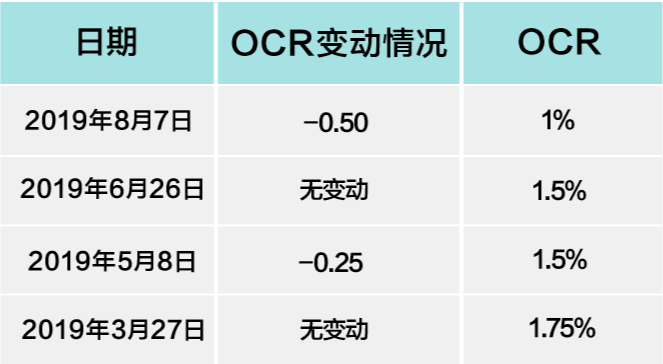
The August cut was already the second this year, taking the rate to a 20-year low
The Reserve Bank of New Zealand said in a statement: “A lower OCR is necessary to ensure inflation rises to the midpoint of the target range and employment remains near its maximum sustainable level.
” According to the Bank, demand for New Zealand goods and services is currently weaker because of global trade tensions.
It also noted that business confidence in New Zealand remained subdued, as low profitability in some sectors was affecting investment decisions.
New Zealand’s inflation rate currently stands at 1.7%. This interest rate cut means money deposited in the bank will lose value a little faster. Some economists also believe New Zealand’s OCR could fall further to 0.7% by the end of the year. The era of zero interest rates seems to be beckoning.
QV releases latest New Zealand house price data
QV recently released its latest New Zealand house price data. Of the 15 cities surveyed, 6 saw prices trend down over the past three months, while prices in the remaining 9 rose or held steady. Auckland house prices continued to fall.
Over the 3 months to July, Auckland’s average price fell a further 0.8%, marking the 8th consecutive month of declining house prices.
Auckland house prices were down 2.6% from a year earlier, with the average sale price falling from NZ$1,050,000 in November last year to NZ$1,020,000 in July;
Meanwhile, North Shore prices fell 4.1% over the past 12 months. Nevertheless, central Auckland house prices remained 90% above their 2007 peak.
Central Wellington house prices fell, but the region continued to rise overall. Prices in central Wellington fell 0.5% while areas outside the centre recorded strong growth. As a result, prices across the Wellington region rose 0.9% over the past three months rather than falling.
Cities that had previously been star performers in house price growth—Tauranga, Hamilton, Rotorua and Queenstown—also followed Auckland’s downward trend. Tauranga fell 0.3%, Hamilton 0.1%, Rotorua and Queenstown 1.5%, and Napier 0.2%. Lower-priced housing markets were all catching up.
QV’s figures showed more cities with flat or rising prices than with falling prices. The fortunate cities still gaining against a weak market shared one feature: their homes were relatively inexpensive to begin with. As lower-priced markets, their continuing growth was unsurprising.
Christchurch prices were flat over the past three months. Hastings and Palmerston North took first and second place for quarterly growth, rising 2.5% and 2.4% respectively.
Interestingly, the areas with the strongest price growth over the past 12 months all had average prices below $365,000, including Whanganui (up 21.7%) and Gisborne (up 16.1%).
By contrast, cities with weak growth had average house prices above $540,000. Whangārei, for example, with an average price of $547,000, recorded growth of just 2.9% over the past year, its lowest growth rate in four years.
Another interesting feature of Whangārei was that Auckland buyers accounted for 23% of the area’s total sales in 2016, but their share had fallen to 14% by 2019.