
New Zealand immigration policy trends: where next?
Many factors influence government decisions and Immigration New Zealand’s processing speed. Some are well known, while others are more subtle.
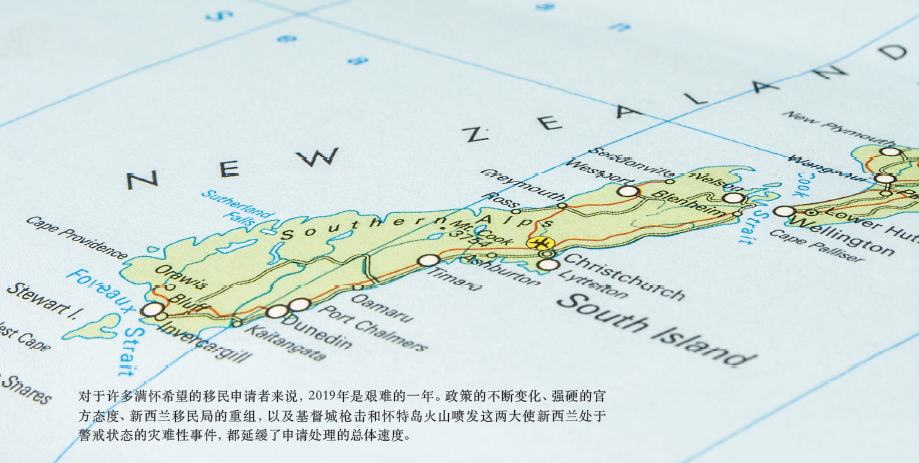
2019: processing delays
Many factors influence government decisions and Immigration New Zealand’s processing speed. Some are well known, while others are more subtle. Among these, I believe the following are the main reasons: changes to major work visa policies.
New policies require new training, and Immigration New Zealand officers need more time to begin implementing the new requirements.
Sometimes, the government has yet to set out detailed and clear criteria, which can leave immigration officers confused about the meaning and purpose of new policies and legislation, increasing processing times.
The result: during implementation, immigration officers may make errors that increase processing times, with further delays as those errors are corrected.
A change in Immigration New Zealand’s approach.
Immigration New Zealand appointed a new departmental head at the end of 2018, signalling a new direction in visa assessments.
New leadership, also means new ways of working and the appointment of new middle managers, while existing managers must adapt to the new system.
The result: instability in Immigration New Zealand’s internal structure slows workflow. Political influence. For example, following strong political lobbying by New Zealand First, the Parent Resident Visa Category reopened, but with tougher requirements.
The result: it has become harder for the people concerned to immigrate to New Zealand.
Restructuring at Immigration New Zealand.
At present, several offices have closed, and as operations have been consolidated, a new division called Border and Visa Operations has been established.
The ultimate effects remain to be seen, but during the restructuring, many experienced immigration officers were promoted, reassigned or left voluntarily. Once new immigration officers begin work, they need training (which takes time), experience (which takes time), and quality assessments by their supervisors (which take time).
The result: significantly longer processing times, and poorer customer service.
Disasters in New Zealand. The Christchurch mosque shootings and the White Island eruption both put New Zealand on alert, placing additional pressure on Immigration New Zealand, as substantial resources were diverted to processing urgent visas for temporary visitors and emergency response personnel.
While we agree that humanitarian work should take priority, nevertheless—
The result: as resources are diverted to urgent or priority areas, other applications are delayed.
2020: a year of uncertainty
2020 is a year full of uncertainty. As the general election approaches, various views and ideas about immigration will again be put to the test. To help us understand immigration trends in 2020, we need to consider the following four indisputable facts:
Residence visa quotas have been reduced.
We discussed this in our previous article, which analysed the reduction in visa quotas. As of December 2019, around 35,000 applicants were still awaiting decisions.
In stark contrast, Immigration New Zealand has only about 120 residence visa officers. Applicants outnumber available places. Overall, the most popular residence category is the Skilled Migrant Category.
Peter Elms, National Manager of Visa Services at Immigration New Zealand, stated: “New Zealand remains an attractive destination, and application volumes are growing steadily across all categories.
The Skilled Migrant Category is now oversubscribed. We are also seeing, increased risk and complexity in applications.
”Over the past three years, immigration to New Zealand has undergone unprecedented change and growth. However, over the past four years, New Zealand’s immigration doors have gradually been closing, prompting more people to apply before the opportunity disappears altogether.
For example, consider Michelle and Hikari, whose story I mentioned previously (see the article QR code in issue 8), a young couple trying to apply for residence under the Skilled Migrant Category.
When they first applied in 2015, the points threshold for consideration was 100 points, and applicants with 140 points could be automatically selected and invited to apply.
Provided an applicant had worked in New Zealand for a full year, there was no English language test requirement, nor any minimum income requirement.
Over the four years since 2015, requirements have steadily increased: English language testing became compulsory; minimum pay requirements rose each year ($23.49 → $24.29 → $25 → $25.5); and the points threshold for selection and an invitation to apply increased to 160.
The latest update on the couple is that, they are currently waiting for their application to be allocated to an immigration officer, alongside 35,000 other applicants in the queue.
More applicants will qualify under the Skilled Migrant Category. On 30 October 2019, the ANZSCO occupation classification list was updated.
As a result, 44 additional occupations were “upgraded” to skill level 1, 2 or 3 on the skilled occupation list.
Some of these newly included occupations employ large numbers of work visa holders in New Zealand, such as childcare workers, tour guides, bank workers and personal care assistants.
Although accurate data is unavailable to establish how many would qualify to apply for residence, it is clear, that a larger pool of eligible applicants will place further pressure on the immigration system.
For example, New Zealand has approximately 33,000 care workers (personal care assistants), most of whom hold work visas. Care workers’ wages are generally linked to benchmark pay rates, which are linked to New Zealand’s median wage.
Consequently, this means that, under certain conditions, when the Skilled Migrant Category pay threshold rises, care workers will receive corresponding pay increases, making them eligible to apply.
Even if only 20% of these 33,000 people are eligible and able to apply for residence visas, that would add 6600 new immigration applications.
Added to the existing backlog of 35,000 applications, this would leave more than 40,000 applications awaiting decisions, to be handled by 120 immigration officers. In other words, each officer would have an average backlog of 346.67 applications.
In our experience, a typical experienced immigration officer, can process 200 to 250 residence applications a year.
That was before residence visa assessment standards were tightened in 2018, so a more realistic figure is around 150–200 residence applications a year.
On that basis, the backlog could cause delays of up to two years, without accounting for future applications. Demand for New Zealand residence is currently high, and will remain so.
As global instability increases (including Brexit, tighter US immigration policies, a global economic slowdown, Australian bushfires, and the China–US trade war), New Zealand continues to be seen as safe and attractive.
Whatever someone’s reason for migrating, New Zealand is an ideal destination: a stable society with a pleasant climate, offering a “permanent resident” visa with no minimum stay requirement.
The future: requirements will rise further
As the law of supply and demand dictates, when demand exceeds supply, prices rise.
Immigration officers can now afford to be highly selective, because there is no shortage of applicants willing to wait. Consequently, we expect, the “price” of applying to rise further.
Raising the Skilled Migrant Category EOI points threshold. To manage the limited residence quota, the simplest approach is to raise the EOI points threshold.
This measure had already been used before 2016, when the points requirement was raised to 160.
So, another increase to 170 or 180, would be both reasonable and highly effective. It would deter many potential future applicants, particularly those working in skilled occupations to accumulate 2 or 4 years of work experience.
Raising income requirements
Although this is less likely, it cannot be ruled out. Income requirements are linked to New Zealand’s median wage as calculated by Stats NZ.
Because this is based on official data, increases cannot depart too far from actual conditions. However, no law prevents the government from setting a higher income requirement.
Therefore, if Parliament wishes to raise income requirements, it remains possible. There is precedent for this, so increasing the income requirement, for example to 1.1 times the median wage (from NZ$25.50 to NZ$28.05 an hour), would face little opposition.
• Continuing to extend processing times
Unfortunately, this appears to be Immigration New Zealand’s current approach: large numbers of applicants waiting while processing moves slowly.
• Capping partnership residence visas
Partnership residence visas are currently uncapped (with no numerical limit), which is one reason for slow processing in the Skilled Migrant Category. Between 2018 and 2019, 10,749 partnership residence applications were approved, accounting for approximately 20% of the immigration quota of 50,000–60,000 people.
Between 2009 and 2019, total applications ranged from a low of 7197 (in the 2014/2015 financial year) to a high of 9264 (in the 2016/2017 financial year).
The annual average is approximately 8000 applications. In line with the previous overall decline rate of around 30%, this could lead to a potential annual cap of 5500 applications.
Capping partnership applications is controversial because it affects human rights. However, it should be pointed out that Immigration New Zealand has previously capped parent residence visas.
• Increasing the minimum period of living together for partnership residence
The current requirement is to have lived together for at least 12 months when applying. This could increase to 24 months.
Of course, we consider an increase unlikely, but it has been discussed for years and remains an option. It is also considered reasonable because partnership work visas currently allow a maximum term of 24 months.
Corresponding changes to partnership work visas and partnership residence visas would therefore be feasible and straightforward to implement.
Overall, whatever Parliament ultimately decides, immigrating to New Zealand will only become harder: more requirements, more time, more money and more scrutiny.
The best approach is to apply as soon as you meet the requirements, because delay could prove costly. Immigration is also cyclical, much like house prices or the share market.
2020 will be an election year, and much could happen within 6 months. For example, if our Prime Minister chose to leave the Labour Party for a role at the United Nations, and the National Party won the next election, it would completely change the future of New Zealand immigration policy.

About the author
Sonny Lam
has 10 years of litigation experience and previously worked as an immigration officer at Immigration New Zealand. He is currently an immigration lawyer at Forest Harrison Lawyers.
After leaving Immigration New Zealand in 2015, he began specialising in immigration, bringing a distinctive perspective on technical immigration matters and the effective preparation of applications, and providing sound professional advice from the perspectives of both applicants and the immigration officers assessing their cases.