
The housing market amid the pandemic
The ratio of sales to new listings has long been regarded as an important predictor of Auckland house prices. In early March, ASB economists were still concerned that New Zealand’s low housing inventory would push prices higher as demand increased. Without more new listings, Auckland house price growth was very likely to exceed economists’ forecast of 7.5% by the middle of this year.
The ratio of sales to new listings has long been regarded as an important predictor of Auckland house prices.
In early March, ASB economists were still concerned that New Zealand’s low housing inventory would push prices higher as demand increased.
{ad}
Without more new listings, Auckland house price growth was very likely to exceed economists’ forecast of 7.5% by the middle of this year.
At that point, there were clear signs that New Zealand’s housing market was picking up. Sales over the preceding few months were around 10% higher than a year earlier.
In February this year, the national median time to sell a home fell to its lowest level since 2004, at just 28.7 days. The sooner the virus stops spreading, the faster and stronger the economic recovery can be.
The same applies to the housing market. Expectations for market activity have been revised down, as the rapid spread of coronavirus may bring it to a halt.
On 25 March, New Zealand announced a nationwide lockdown. Apart from those in essential roles or emergency services, most people were required to stay home most of the time.
In-person property viewings and public auctions were naturally halted too. People could only view properties and negotiate by video, or find other ways to complete transactions.
Like the slowdown in other economic activity, the decline in housing market activity was an expected consequence of lockdown. New Zealand’s housing market was virtually frozen during this period.
Once home sales resume, prices are also very likely to fall. Although mortgage holidays will reduce some pandemic-related forced sales, unemployment and disruption to business operations will weaken people’s motivation to buy. Some prospective buyers will also be too anxious about the situation to act.
Political decisions that put life and health first deserve support and praise.
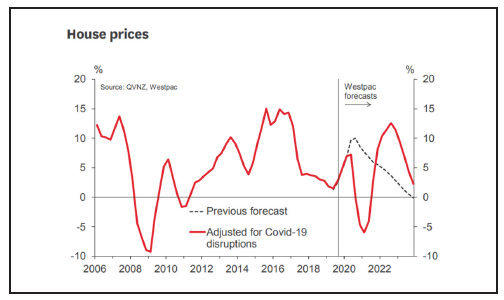
But they have also rewritten the housing market’s fate in 2020. How quickly prices fall will depend mainly on market sentiment, which is the hardest factor to predict. Drawing on data from previous New Zealand recessions, Westpac expects house prices to fall by 7% from April through the first half of 2020.
ASB has lowered its house price forecast for this year by a full 5 percentage points: “House price growth is expected to fall to zero by March 2021. Prices will decline slightly during the coming second and third quarters. Notably, annual house price growth was negative during all four of New Zealand’s previous recessions.
Without government assistance to ease pressure on jobs and mortgage repayments, house prices could fall further.
Given uncertainty in the wider economy, increasing job insecurity and slower wage growth, ASB economists also expect house prices to remain broadly stagnant in 2021, with gains difficult to achieve.
Westpac is much more optimistic about the outlook, forecasting house price growth of 8% in 2021 and 22% in 2022. A gloomy short-term economic outlook. Housing market trends are heavily influenced by the economy.
The sooner the virus stops spreading, the faster and stronger the economic recovery can be, helping lift the housing market. A Westpac report notes that the depth of coronavirus’s economic impact depends on New Zealand’s alert level and how long it remains in place.
Alert level two is expected to remain in place until September. At this level, international travellers cannot enter the country and domestic travel is restricted, reducing economic activity by nearly 4%.
Alert level three is expected to remain in place until June. At this level, all large gatherings are banned, while public venues such as cafés, restaurants, cinemas and libraries close;
some non-essential work stops, while other operations continue. Under these conditions, GDP could fall by 8%. At alert level four, our current situation, economic activity falls by 33%.
Until the outbreak is truly over, anxiety and caution will persist. Recovery after the pandemic. The International Monetary Fund (IMF) believes coronavirus is having a severe impact on the global economy.
The outlook for the global economy in 2020 is very bleak, with a recession at least as severe as the global financial crisis, if not worse. The Organisation for Economic Co-operation and Development (OECD) warns that the coronavirus outbreak could leave the world economy growing at its slowest pace since 2009 this year.
In New Zealand, lockdown could last longer than the anticipated four weeks.
The longer lockdown lasts, the greater its impact on the wider economy. Economists find it difficult to forecast the outlook when so much remains unknown.
Although no one can yet estimate the extent of coronavirus’s impact on New Zealand’s economy, many people have already lost their jobs because of it.
An ASB report says New Zealand is very likely to experience two quarters of negative growth, and makes the bold prediction that coronavirus will shrink GDP by 6% in 2020.
Learning from the extent of coronavirus’s impact on other countries, the New Zealand government moved quickly, introducing a series of policies to protect jobs, incomes and business operations before lockdown formally began.
On 17 March, the government announced an injection of NZ$12,100,000,000 into the economy, equivalent to 4% of gross domestic product (GDP).
According to a comparison by New Zealand Finance Minister Grant Robertson, the stimulus package was larger than the response to the global financial crisis and exceeded the measures currently announced by countries including Australia and Singapore.
The government hopes this will cushion the impact of the global slowdown and domestic lockdown. New Zealand economists have praised the move as “timely” and “appropriately aggressive”. On 3 April, international credit rating agency Moody’s reaffirmed New Zealand’s top Aaa credit rating.
The New Zealand government subsequently introduced further policies to reduce the outbreak’s negative effects and keep the economy running.
Even so, ASB economists remain cautious about the recovery after the pandemic. Their report on coronavirus’s impact, released on 27 March, says the subsequent economic recovery is expected to be gradual.
Westpac also believes that although recovery after the pandemic will be faster than after previous economic crises, a genuine, comprehensive recovery will take years. Anxiety and caution are widespread.
Most people are focused on security and saving money, and will not suddenly increase their spending.
The incomes of many businesses, households and even governments have been affected during the pandemic and will take time to recover. These factors will weaken the intended stimulus from low interest rates and government assistance programmes.
The economy will eventually recover, but not before the end of 2022. Only then will New Zealand’s economic activity exceed its level at the end of 2019. The official interest rate is also unlikely to rise before 2024.