
Who says an economic crisis offers no opportunities? These projects are also calling for Chinese businesses
To soften the impact of the COVID-19 pandemic and swiftly rescue and revitalise New Zealand’s economy, the Government has announced an expert group to seek shovel-ready projects and additional infrastructure investment. It also plans to pass legislation in June to fast-track approvals for shovel-ready projects.
To soften the impact of the COVID-19 pandemic and swiftly rescue and revitalise New Zealand’s economy, the Government has announced an expert group to seek shovel-ready projects and additional infrastructure investment. It also plans to pass legislation in June to fast-track approvals for shovel-ready projects.
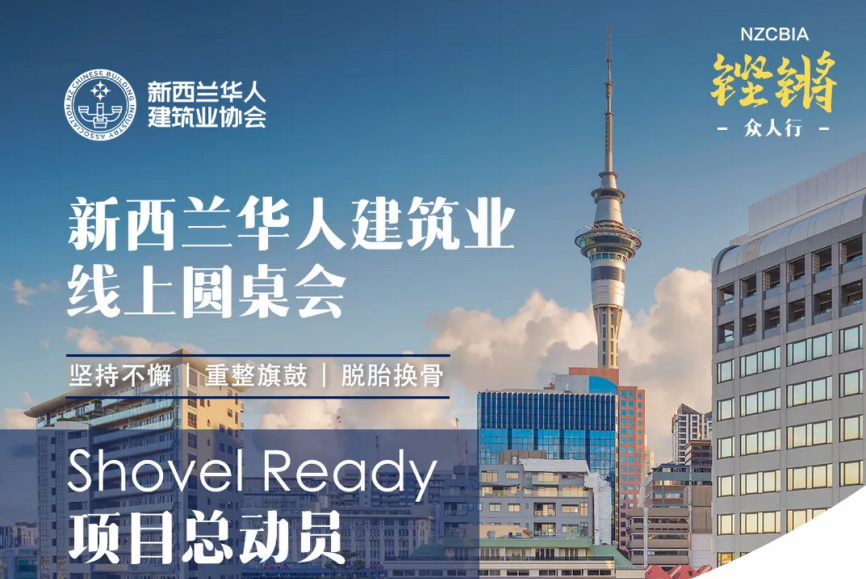
How can Chinese construction businesses participate, seizing opportunities for their own businesses during this crisis while also contributing as a community to New Zealand’s economic recovery? To answer these questions, the New Zealand Chinese Building Industry Association (NZCBIA) will hold an online forum this Thursday.
{ad}
Government backing for shovel-ready projects
Since taking office, the Labour Government has shown considerable enthusiasm for infrastructure development. At the end of January this year, before the pandemic broke out, it had already proposed an investment programme of NZ$12,000,000,000. After the outbreak, the Government introduced economic stimulus measures related to infrastructure investment and development in two stages to combat the economic crisis:
- On 1 April, the Government announced it would seek shovel-ready projects through the Infrastructure Industry Reference Group (IRG). Investment in these projects would be additional to the NZ$12,000,000,000 already committed;
- On 3 May, Cabinet approved plans to legislate for fast-tracked approvals of shovel-ready projects, with the legislation to be completed in June.
Meanwhile, the National Party, which had already expressed greater concern about the severe economic damage a full lockdown would cause New Zealand businesses, also strongly emphasises the importance of infrastructure. It believes infrastructure can boost the economy and help the country respond to future crises. “There is no doubt that the Government’s role is critical, because it can fund high-quality transport and water infrastructure. This crisis has exposed shortcomings in the health system’s digital infrastructure, which should be effectively upgraded. A good example of government contribution is the previous National Government’s substantial investment in ultra-fast broadband, which has helped the country withstand the test of recent weeks and greatly improved efficiency.” While discussing the Government’s role in infrastructure investment, National finance spokesperson Paul Goldsmith also stressed the importance of private sector participation. He said private investment remained the central driver of economic growth.
“Successful economies should make it easier for investment to flow into more productive areas. They welcome investment, avoid excessive regulation or taxation, provide clear and consistent rules, implement them appropriately, and do not keep changing them.
With effective government support, strong private capital investment in infrastructure and technology, drawing on our exceptional environmental advantages while carefully protecting our global brand, will provide a pathway back to work and towards prosperity in the years ahead.”
This suggests that although the September election adds uncertainty to New Zealand’s political and economic outlook, support for and progress on shovel-ready projects will continue over the long term.
Selection criteria for shovel-ready projects
IRG chair Mark Binns wrote to the industry about the information-gathering process and the types of projects involved. His letter identified four criteria for selecting shovel-ready projects:
- How ready projects are for construction now, or realistically could be within the next 6 to 12 months;
- Category A projects: projects currently or previously under construction but put on hold because of COVID-19, which are unlikely to progress without government support, or whose pace, scale or scope would be significantly affected.
- Category B projects: projects highly likely to have started construction within the next 6 months, before 31 October 2020, had it not been for COVID-19.
- Category C projects: projects that could have started construction within the next 12 months, before 30 May 2021, had it not been for COVID-19.
- Whether projects are horizontal or vertical infrastructure and provide benefits to public utilities or regions;
- Whether they deliver economic, social or environmental benefits;
- Whether they deliver national or regional benefits.
- Whether projects are of sufficient scale and deliver substantial employment benefits, meaning a value above $10,000,000; and
- Projects’ overall benefits and risks.
- The risk of projects not starting within the proposed timeframe;
- The risk of projects not being completed on time, or differing from expectations in cost or scale;
- The risk of projects failing to deliver the anticipated overall benefits outlined.
The project group will reportedly assess candidate projects, gather supplementary explanations and information, and submit them to the Government. Once it receives government feedback and guidance on next steps, it will contact the relevant parties as soon as possible.
Fast-track approvals available for shovel-ready projects
On 3 May, the Government announced another important element of its COVID-19 recovery plan: temporary changes to relevant provisions of the Resource Management Act to fast-track approvals for eligible development and infrastructure projects. The new legislation is expected to pass in June and be repealed two years later.
For a country such as New Zealand, where both the Government and the public consistently put environmental protection first, this was a difficult decision. But as Environment Minister David Parker said: “The usual approval processes cannot provide the speed and certainty currently needed to respond to the economic consequences of COVID-19. The new process will get construction projects started and people into work sooner.” He also emphasised: “Part 2 of the Resource Management Act will still apply. Construction projects need to progress on time, but environmental safeguards remain essential.”
Parker said projects eligible to apply for fast-track approval include roads, walking and cycling paths, railways, housing, river and estuary dredging, new wetlands, flood protection works, and projects to prevent landfill erosion. These can broadly be divided into three categories:
- Some major government-led projects, including certain projects in the New Zealand Transport Agency’s (NZTA) land transport programme.
- Certain projects undertaken by government agencies.
- A range of shovel-ready projects identified by the IRG.
How Chinese construction businesses can seize the opportunity
As outlined above, shovel-ready projects are crucial both to New Zealand’s overall economic recovery and to helping participating private businesses navigate the crisis and achieve further growth. How can Chinese businesses, already firmly established in New Zealand’s construction industry, secure a share? NZCBIA president Frank Xu said this was precisely the purpose of the forum:
- To help Chinese investors and developers understand government policies on shovel-ready projects designed to stimulate the economy. The forum has therefore invited experts from across the relevant industry supply chain to analyse these policies in depth, clarify their economic impact and examine their feasibility;
- To explore how Chinese investors and developers can benefit from or participate in these projects. The hope is that the forum will bring together Chinese shovel-ready projects and help advance them in collaboration with relevant government departments and industries.
Frank Xu stressed: “NZCBIA believes Chinese shovel-ready projects, as an important component of private investment projects, are an indispensable means of stimulating the economy during the current crisis. The coming months through to a year from now are critical to economic recovery. Private shovel-ready investment and development projects can start more flexibly and quickly than major government projects, providing a much-needed boost during the economy’s most turbulent and uncertain period before those larger projects begin to have an effect.”
The forum’s invited guests include:
- Hon Paul Goldsmith: National Party MP, finance spokesperson, economist and author of biographies of prominent New Zealand political and business figures including John Banks, Don Brash, William Gallagher, Alan Gibbs and Te Hemara Tauhia.
- Dr Jian Yang: senior National Party MP, chair of Parliament’s Governance and Administration Committee, National’s statistics spokesperson and associate spokesperson for ethnic communities.
- Luke Zheng – managing director of Eastern Construction Group and NZCBIA board member, with 20 years focused on project development and construction in the New Zealand market.
- Franky Wang – BNZ Head of Asia Business Activation, with extensive knowledge of New Zealand banking policies and operations;
- Frank Li – developer of the OKLA Albany project, with expertise in planning, coordinating and delivering major projects;
- James Lee – CBRE Auckland Director of Capital Markets, specialising in New Zealand’s major development project market;
- Ben Yu – host of the property investment education programme “Workers Talk Property”.
They will present and discuss the following topics:
- The importance of private investment to the economy and how policy can stimulate it;
- The National Party’s views and proposed measures for future economic development;
- An introduction to current or potential shovel-ready projects;
- How the banking sector views and supports these projects;
- Future property market trends and the market’s current challenges and opportunities;
- How private investors and developers view policies to stimulate the economy through shovel-ready projects, and what government policy support they would like for private development projects;
- The feasibility of these new policies and whether they can help transform the industry;
- Can Chinese investors and developers benefit from these new policies, and how? How can we secure greater support for our own shovel-ready projects?