Could the third quarter bring a stronger rebound than expected? Economists interpret the latest GDP figures
New Zealand’s gross domestic product (GDP) fell 1.6% in the first quarter ending in March 2020, exceeding the 1% decline forecast by most economic analysts. This shows that the global spread of COVID-19 and its early arrival in New Zealand had already dealt a significant blow to the local economy. Let us look at economists’ interpretations.
Biggest fall in 29 years
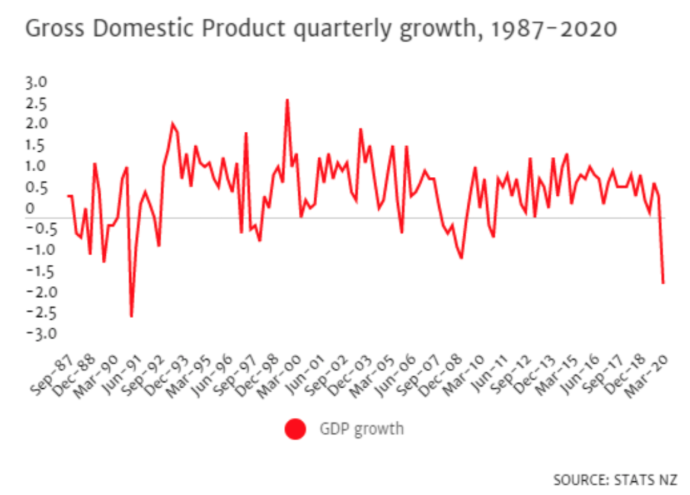
Stats NZ announced yesterday that, in the first quarter of this year, GDP fell 1.6%, the biggest decline in 29 years.
Stats NZ national accounts senior manager Paul Pascoe said: “The 1.6% fall exceeded the quarterly declines during the global financial crisis in 2009. It was also the largest quarterly decline since the 2.4% fall in the first quarter ending in March 1991.”
{ad}
First-quarter GDP figures show a widespread weakening in domestic economic activity following travel restrictions and New Zealand’s lockdown, which began in late March.
Drought in some regions also contributed to the decline in GDP.
New National Party leader Todd Muller said the figures “confirm National’s worst fears about the looming economic and employment crisis”.
He added: “On a per capita basis, the news is even worse — New Zealanders’ average incomes fell 2.2% in the first quarter ending in March.”
Many economists, however, believe the figures are not entirely gloomy.
ASB said the decline “exceeded both our expectations and those of the market”, but noted it was less severe than the 2.4% fall forecast by the Reserve Bank in its May Monetary Policy Statement.
Impact by industry
The services sector was the main contributor to the decline in economic activity in the first quarter, accounting for almost GDP half of the overall decline. Hospitality — accommodation, restaurants and bars — was the hardest-hit industry, falling 7.8%, mainly because tourism slumped after border controls were introduced to contain the spread of COVID-19.
Construction fell 4.1%, while transport, postal and warehousing services declined 5.2%. These declines directly reflected lockdown measures such as construction site closures and non-essential workers staying home. A substantial part of the transport industry, including air transport, was also affected by travel restrictions.
Household consumption expenditure fell 0.3%. Spending on durable goods, such as cars, declined markedly.
The only area to buck the trend in the first-quarter figures was strong growth in spending on everyday goods, which even partly offset the decline. This was partly because many households stocked up on essentials, including flour and toilet paper, ahead of lockdown.
A worse second quarter expected
Although a fall of 1.6% may seem alarming, it could look insignificant beside the forecasts for the coming second quarter. The pandemic lockdown is expected to cause a double-digit fall in second-quarter GDP.
Westpac senior economist Michael Gordon said the first-quarter GDP decline was “within the range of expectations”, “given that the full impact of lockdown remains unknown”.
Infometrics economists forecast a 16% decline in GDP next quarter.
ANZ economist Liz Kendall believes the worst economic effects are still unfolding for many people: unemployment is rising, many businesses are struggling, and the difficulties facing tourism cannot be ignored.
However, ASB chief economist Nick Tuffley and senior economist Jane Turner said: “We hope the Reserve Bank of New Zealand will revise its second-quarter GDP forecast, particularly to reflect New Zealand’s faster-than-expected move to Alert Level 1 and the very encouraging recent economic indicators.”
Recovery prospects for the third quarter
Even the most pessimistic views only question whether recent signs of a rebound can last or sustain their upward trend. Nobody denies that signs of an economic rebound have emerged.
Electronic card spending figures released by Stats NZ last week showed a stronger-than-expected post-lockdown spending “rebound”.
Westpac chief economist Dominick Stephens said mounting recent evidence suggested the economic impact of COVID-19 was less severe than initially feared.
The bank’s consumer confidence survey showed that, although consumers’ confidence about the year ahead was weak, it had not fallen below levels seen during the global financial crisis in 2009.
ANZ economist Liz Kendall said New Zealand was currently experiencing a post-lockdown economic rebound. “However, the lasting recessionary impact of this crisis will depend on how trends develop from here.
” She said: “We will closely monitor high-frequency data in the third quarter, including the housing market, business confidence and household spending, to understand underlying economic trends and identify prospects for recovery.
For now, we can only wait and see.”
International comparisons
New Zealand is certainly not the only country whose GDP has fallen because of COVID-19. Many countries have recently released first-quarter GDP figures showing declines of varying sizes across the world’s other major industrial economies: Australia fell 0.3%, Canada 2.1%, Japan 0.6%, the UK 2.0% and the US 1.3%.
Comparisons over time
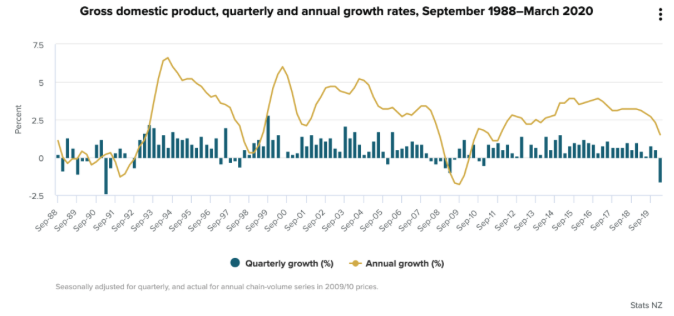
Domestically, annual GDP growth slowed to 1.5% in the year ending in March 2020, compared with 3.1% in the year ending in March 2019.
Although this was a precipitous decline, annual GDP growth had actually been slowing gradually since December 2016, when it stood at 3.9%.
Stats NZ said whether the first-quarter contraction signalled a technical recession would only be confirmed once second-quarter figures were released, as a recession is usually defined as GDP declining for two consecutive quarters.