
As the interest rate war intensifies, how do you choose the right home loan from a dizzying range?
The latest property market data report shows the market began rebounding in May. As New Zealand’s major banks repeatedly cut mortgage rates, every buyer is undoubtedly concerned about choosing the best-value loan and buying the home they want with the smallest outlay.

The property market remains resilient
When COVID-19 first broke out, some economists predicted a severe blow to New Zealand’s property market, with sharp falls in sales volumes and prices. But 3 months later, the latest joint market survey by economist Tony Alexander and the Real Estate Institute of New Zealand (REINZ) showed that although the earlier lockdown had lengthened selling times and reduced new listings, house prices remained stable and continued to rise. In Auckland, the median house price even rose to NZ$910,000, its third-highest level on record.
{ad}
REINZ chief executive Bindi Norwell said: ‘We are hearing from real estate agents across New Zealand that demand is strong and prices are rising in some areas. Compared with some economists’ early predictions for the property market after the pandemic, this feedback is undoubtedly positive.’
Looking more closely at why the property market remains active and resilient, factors certainly include demand exceeding available listings and large numbers of Kiwis returning from overseas. However, the following government measures have undoubtedly played a crucial positive role:
- The Reserve Bank lowered the Official Cash Rate to a record low of 25% in March;
- The Reserve Bank removed LVR restrictions from 1 May.
Competition over low interest rates intensifies
Since the Reserve Bank of New Zealand lowered the Official Cash Rate (OCR) and indicated in early May that it remained open to further OCR cuts, commercial banks have repeatedly lowered mortgage rates. The NZ Herald has even described the competition as ‘mortgage wars’.
New Zealand’s four main commercial banks currently offer floating mortgage rates of around 4.44% or 4.45%. Fixed rates vary by term, but have all fallen below 3%.
Last week, Kiwibank announced a cut to its floating mortgage rate, the latest move by a major New Zealand commercial bank in the intensifying mortgage competition.
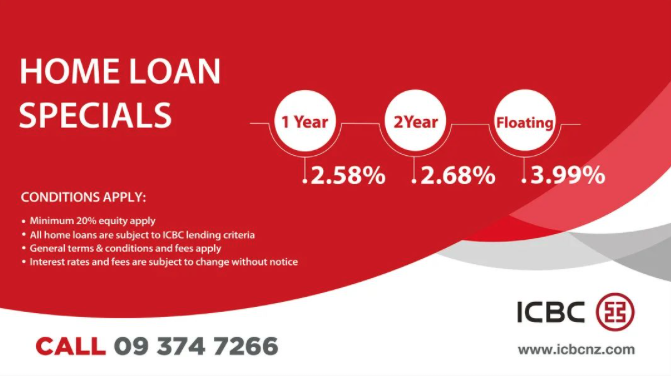
Chinese-owned Industrial and Commercial Bank of China (ICBC New Zealand) has also introduced record-low mortgage rates: 2.58% for one year and 2.68% for two years.
How to save money on your mortgage
‘More than 85% of home loan customers use fixed rates,’ a Westpac spokesperson said. Mortgage adviser Sara Hartigan told TVNZ that although the latest round of rate cuts was unlikely to be the last, she still recommended New Zealanders choose fixed rather than floating rates where possible. ‘In an uncertain economic environment, particularly if there is some doubt about job security, a fixed rate is the better option,’ she said.
However, ICBC recently launched its Offset Home Loan (OHL), based on a floating rate of 3.99%. The product allows customers to use balances in designated deposit accounts to offset their floating loan balance, reducing interest costs while maintaining flexible cash flow.
A quick guide to ICBC New Zealand’s Offset Home Loan (OHL):
Suppose a borrower takes out a NZ$1,000,000 home loan with ICBC New Zealand, of which NZ$300,000 is an Offset Home Loan. The borrower also opens a deposit account with ICBC and can deposit temporarily surplus funds at any time. Interest on the Offset Home Loan portion is calculated on the net difference between the loan amount and the deposit account balance. There are three possible scenarios:
- Deposit balance = NZ$300,000: the deposit balance offsets the loan balance, so the customer pays no interest on the Offset Home Loan.
- Deposit balance
- Deposit balance > NZ$300,000: the customer pays no interest on the Offset Home Loan, and the bank pays no interest on deposits above NZ$300,000.
With fixed mortgage rates already extremely low, using this floating-rate product as a supplement can offer borrowers the following benefits:
- Lower interest payments. Customers only pay interest on the difference between the balances.
- Flexible cash flow management. The deposit account can also be used for everyday spending.
- Greater flexibility to repay the loan early.
Offset Home Loan (OHL) is available to ICBC New Zealand borrowers (new applicants/existing borrowers), with a minimum floating loan amount of 100,000 New Zealand dollars and a maximum of the following proportion of the total loan: 30% or 500,000 New Zealand dollars, whichever is lower.
ICBC New Zealand home loan application criteria:
- New Zealand-sourced income only;
- Available for purchasing owner-occupied homes and investment properties;
- The minimum loan amount is NZ$300,000.00.