Latest commercial property report: existing market among Asia-Pacific's most optimistic, but concerns over development pipeline
It has been almost a month since normal economic activity and daily life fully resumed in New Zealand. How has the pandemic affected the country's business environment, particularly in Auckland, its most important economic centre? Colliers International offered another assessment today with the release of its latest commercial property market research report.

Construction market: projects yet to start or awaiting development may be shelved
Years of demand outstripping supply in Auckland's CBD and metropolitan office markets have prompted relatively strong development activity.
By the end of 2019, the CBD vacancy rate had fallen to a record low of 4.7%, while the vacancy rate across the metropolitan office market was just 5.6%.
Despite approximately 28,000 square metres of new space being completed over the past 12 months, the metropolitan vacancy rate has continued to decline.
Five major projects are currently under construction in Auckland's CBD, with more than 87,000 square metres of new office space expected to be completed by the end of 2021.
In the metropolitan market, 35,000 square metres of new buildings will be completed over the same period.
Before the COVID-19 pandemic, market forecasts suggested that additional stock would ease supply and demand pressures without creating an oversupply. Continued demand growth was expected to keep driving construction and development, with this momentum lasting for several years.
However, circumstances changed following the COVID-19 outbreak, and those forecasts changed accordingly.
According to the latest economic forecasts, although New Zealand has successfully contained widespread transmission of the virus and most economic activity has resumed faster than many expected,
- the economy has undeniably entered a recession;
- unemployment is expected to rise to between 8% and 10%;
- lockdown has also directly changed how people work and may bring lasting changes to working habits.
All these uncertainties could affect the construction market in the future.
The vast majority of projects currently under construction in Auckland's CBD are nearing completion, and pre-leasing levels are high.
There is therefore no reason to expect their construction to be disrupted. The same applies to new-build and refurbishment projects currently under way in the metropolitan market.
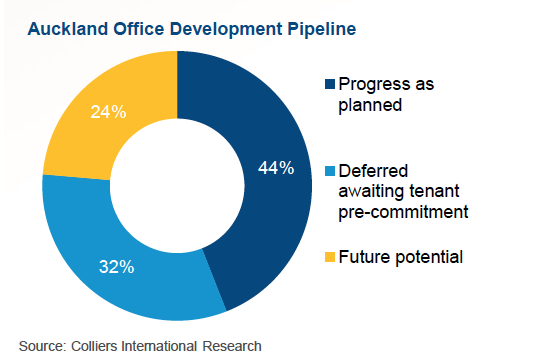
When assessing future market supply, potential changes are therefore likely to centre on projects that have been approved but have yet to enter construction, and even more so on those still at the planning and feasibility assessment stages.
The Colliers report suggests that, given changing market conditions, projects comprising approximately 75,250 square metres of floor area in the CBD and 73,300 square metres in the metropolitan market may be unable to proceed without sufficient pre-leasing.
It is too early to predict which projects will be shelved. The development pipeline remains unclear, as does the length of any delays. However, securing committed tenants as early as possible and increasing pre-leasing are steps every project approaching construction should be taking now.
Subsequently, delays to new projects will clearly help contain, as far as possible, the increase in vacancy rates caused by the completion of projects already under construction and the effects of COVID-19.
{ad}
Offices: among Asia-Pacific's most optimistic markets
The COVID-19 pandemic has had a major impact on rental growth prospects across Asia-Pacific's office markets.
However, Colliers' latest research report suggests Auckland's outlook is more optimistic than that of most office markets in the region.
Effective office rents in Auckland may fall over the coming year as landlords facing vacancy pressures offer greater incentives to attract tenants. However, this may be relatively short-lived.
Over the next five years, Auckland has one of the most optimistic rental growth outlooks in Asia-Pacific.
Singapore leads with forecast average annual growth of 3.3%, followed by Melbourne at 2.9%, Australia's strongest-performing market. Auckland follows closely, with forecast growth of 2.2%.
Industrial property: very strong recent transaction activity
The industrial sector's strong ability to withstand risk, and the widespread view that it is the most resilient and robust sector in the current recession, have driven very strong transaction activity in recent weeks.
Industrial property sales data nationwide show that prices and yields for major assets have remained largely unchanged from before the COVID-19 outbreak.
This strong transaction activity is being driven by a range of buyers, including syndicates, high-net-worth individuals and owner-occupiers.
For example, the Tomoana Food Hub food processing and distribution centre on the outskirts of Hastings sold for NZ$41,000,000;
in the Auckland region, a property on Boundary Road in Papakura sold at a yield of 5%;
property group Argosy sold a property at 180–202 Hutt Road, Wellington, to a local private investor for NZ$23,500,000;
Christchurch's market has also been relatively active, with a property on Wigram Close selling to an owner-occupier for NZ$4,100,000.
Retail: spending rebounds strongly
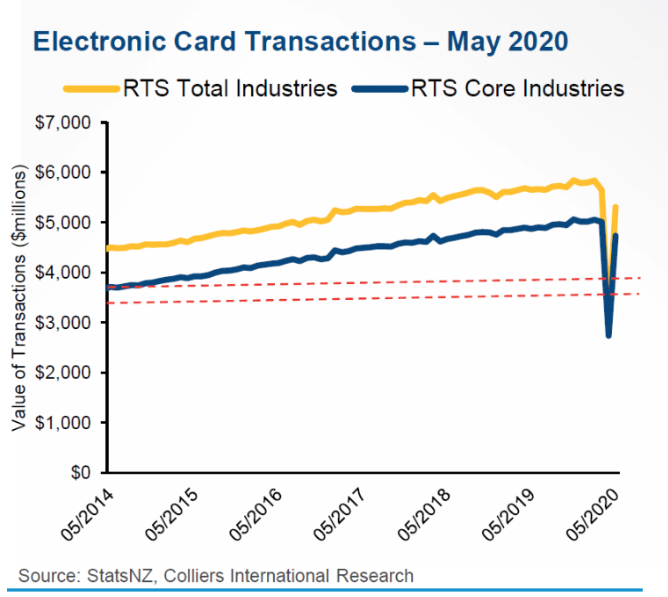
The latest electronic card transaction data from Stats NZ show a strong recovery in retail spending as New Zealanders returned to shops after lockdown and engaged in ‘revenge spending’.
In May, total core retail spending reached NZ$4,600,000,000, up 73% from April.
This V-shaped rebound is an encouraging indicator of consumer sentiment, although it also reflects the extent to which demand was suppressed during lockdown.
A clearer and more accurate assessment of changes in market sentiment and the economic impact of COVID-19 may therefore require several more months.
Current data show that spending in May 2020 was down 2.5% from NZ$4,700,000,000 in the same month last year. However, it remained well above the 10-year average of NZ$3,900,000,000 and the 20-year average of NZ$3,600,000,000. (See the red dashed lines in the chart.)