
The next residential property boom is coming
After a brief market lull and a 5%–10% fall in house prices, pessimism pervades the property market. My prediction, however, is quite the opposite: I believe New Zealand's property sector may be heading for one final major boom.

I too once thought house prices had peaked. Now, however, I firmly believe another wave of price rises lies ahead over the next ten years, taking New Zealand's average house price to NZ$1,000,000.
Some will say this is hardly difficult to predict, because property prices double every ten years anyway. The outcome may be the same, but the reasoning behind the prediction is different.
Predictably, some readers may regard me as “just” a mortgage broker and consider my discussion of house price growth a case of confirmation bias (1).
The global financial crisis of ’08 really was a financial crisis. When it erupted in ’08, lending standards were so lax that even people with no income could borrow to buy homes at extremely low “honeymoon rates” (2). These loans, made to borrowers who essentially had neither income nor jobs, were commonly known as “NINJA loans” (3).
When those honeymoon rates expired, many borrowers could not afford the much higher standard market rates and ultimately fell into arrears.
{ad}
New Zealand also felt the shock waves of this global financial crisis, but was barely affected because its lending standards were much stricter.
Compared with the financial crisis of 2008, the recession of 2020 is an entirely different situation: it was triggered by the COVID-19 pandemic, but will result in widespread job losses.
For years, we have discussed unemployment caused by job automation. Now, a step change has suddenly happened overnight: unemployment is expected to reach 10%.
For the property market, the risk from rising unemployment is that it will lead to forced house sales and falling prices.
Rising unemployment will increase the supply of homes for sale and reduce buyer demand. However bad things become, unemployment is a temporary factor, and the economy will inevitably rebound within the next two to three years.
Economists predict that New Zealand will return to normal economic growth by 2023. Almost everyone can foresee house prices falling in the short term because of the COVID-19 pandemic.
What differs from the past is that the government has introduced extensive economic stimulus measures, while banks are competing to offer extremely low mortgage rates and allow repayment deferrals, to rescue the economy, the property market and people affected by the pandemic.
Lower house prices will offer people with strong credit histories a good opportunity to buy. Given today's extremely low mortgage rates, when exactly is the right time for buyers to re-enter the market?
Where is the property market heading?
Some doomsayers continue to predict steep falls in house prices.
Some argue that if house prices can double in six years, they can halve in three. Others point to affordability, arguing that homes are less affordable now than in the past.
Whatever their reasoning, the central argument is that the market is overvalued and prices will return to their long-term average.
I could accept that argument if they used the correct long-term average and adjusted it for structural changes in interest rates. But they do not.
So let us judge directly from the data.
New Zealand house prices rise by less than 4% a year.
Taking the median house price in 2000 as NZ$170,000 and allowing for household income growth of less than 4% a year, New Zealand's median house price should now be NZ$365,000.
If income growth were the only consideration, property values would double every twenty years. Clearly, however, that is not the case.
In fact, the actual median house price in 2020 was NZ$670,000.
Does that mean the doomsayers really are right? Today, mortgage rates are below 3.00%.
Meanwhile, New Zealand's lending market has grown from NZ$62,000,000,000 in 2000 to NZ$280,000,000,000 today.
As debt levels rise, the economy becomes more sensitive to small changes in interest rates, and the Reserve Bank's neutral official cash rate has gradually declined.
Put simply, a mortgage rate of 5% today has become as frightening for borrowers as 9% was twenty years ago.
What matters most, therefore, is borrowers' capacity to pay—how much they can afford—and we need to consider offering lower mortgage rates.

For example, if we set the income-adjusted house price at NZ$365,000, the total interest cost at the 8% mortgage rate of 2000 would be: 365,000 × 8% = NZ$29,200. This is the amount of interest the borrower would have been expected to pay.
Calculating the median house price using today's lower mortgage rate of 4% gives: 29,200 / 4% = NZ$730,000.
We call this figure our “fair market price”. New Zealand's actual median house price is NZ$670,000, so there is reason to believe prices could rise further to the fair market price of NZ$730,000.
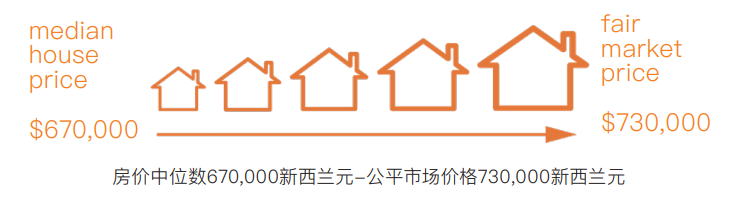
Although house prices have actually quadrupled since 2000, household income growth and lower long-term interest rates fully explain this.
Now, if house prices fall by 10% to NZ$603,000, the gap between the median house price and the fair market price will widen further.
What does this mean? House prices will rise sharply when the unemployment rate rebounds.
If household incomes continue to grow by 4% a year over the next ten years, New Zealand's median house price will reach NZ$1,000,000 by 2030.
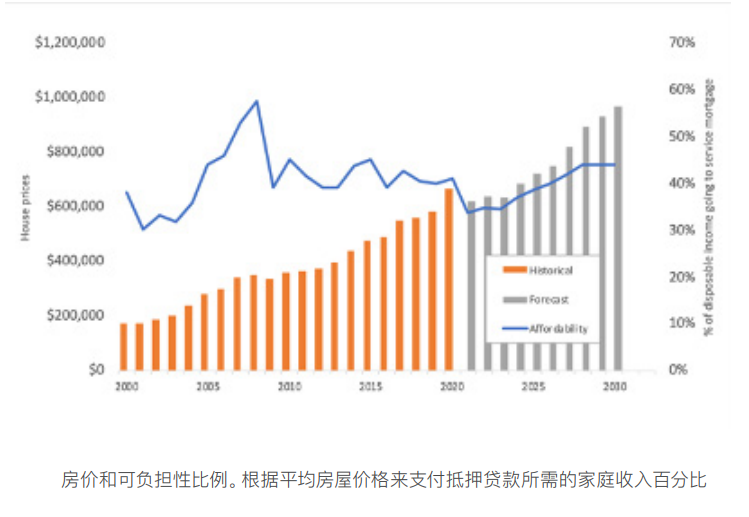
The blue line in the chart above shows the percentage of household income used for mortgage repayments.
The chart shows that even as house prices rise, household income will not change significantly over time.
The grey bars show projected future house prices. The fall in house prices caused by the COVID-19 pandemic will initially produce a temporary decline in the proportion of income used for mortgage repayments;
then, as house prices rise steadily, the proportion of income used for mortgage repayments will increase only slightly and proportionately, thanks to gradual household income growth and assuming mortgage rates remain low.
NZ$1,000,000 sounds like a lot, but our idea of what it means to be a millionaire is shaped by historical perceptions.
In 1960, being a millionaire really meant something.
Today, anyone in their 50s who owns a property and has retirement savings will be a so-called “millionaire on paper”.
If you put NZ$1,000,000 in the bank, it will generate NZ$13,400 a year after tax—hardly enough for one person to live comfortably in New Zealand without dipping into their savings.
By 2030, the average house price will reach NZ$1,000,000.
For old-school New Zealand purists who dislike the obsession with property, remember that a bet on property is a bet on the government, the Reserve Bank and financial institutions.
The entire system is designed to protect long-term property prices, with property serving as our principal store of wealth.
In a world where governments can print money, I believe property has replaced gold as the standard.
Owning a home remains something people aspire to.
Finally, in this “Great Depression”, first-home owners pay an average of NZ$280 a week in interest, while renting the same home costs NZ$550 a week.
If they lose their jobs, they can defer mortgage repayments for six months or make interest-only payments.
Tenants, on the other hand, can live on the “street” or, if they are lucky enough, in social housing.
Which would you rather be? Now that we have discussed so much data and the reasoning behind these projections, are you still pessimistic about the future of New Zealand house prices?
About the author:

John Bolton
John Bolton is a former ANZ general manager and the founder of Squirrel Mortgage. Since its establishment in 2007, Squirrel Mortgage has helped homebuyers and investors settle around one hundred million New Zealand dollars in lending each month. A leader in New Zealand's financial lending sector and one of the first three recipients of a P2P lending licence, the company has won virtually every industry award over the past 10 years.