
How should investment beginners allocate their assets during the pandemic?
In 2020, the COVID-19 pandemic caused a global recession, leaving industries struggling across the board. Share markets, however, fell before rebounding. After the Nasdaq index reached a record high, China's A-share market also began showing signs of a bull market after years in the doldrums, finally breaking through 3000 points and surging past 3400 points, a gain of more than 15%. New Zealand's share market has also lived up to expectations, looking set to regain its pre-pandemic high in July. Suddenly, everyone is talking about shares and money, and a nationwide share-trading frenzy seems to be emerging once again. So what exactly are people trading on when they trade shares?
In 2020, the COVID-19 pandemic caused a global recession, leaving industries struggling across the board. Share markets, however, fell before rebounding. After the Nasdaq index reached a record high, China's A-share market also began showing signs of a bull market after years in the doldrums, finally breaking through 3000 points and surging past 3400 points, a gain of more than 15%. New Zealand's share market has also lived up to expectations, looking set to regain its pre-pandemic high in July.
Suddenly, everyone is talking about shares and money, and a nationwide share-trading frenzy seems to be emerging once again. So what exactly are people trading on when they trade shares?
What determines share prices? Actual value plus growth potential
A share price essentially represents a company's value. In theory, the stronger the company and the greater its net assets—total assets minus total liabilities—the higher its share price.
Like other markets, the share market has buyers and sellers negotiating prices. Each side names a price, and if they reach agreement, the transaction price becomes the share price at that moment.
When considering prices, buyers and sellers take into account both the company's current actual value—its net assets—and its growth potential, or their confidence in the company.
If the financial information published by a company is accurate and reliable, its value can be roughly estimated, allowing a reasonable share price to be assessed. Meanwhile, positive and negative market news changes buyers' and sellers' confidence in the company, and these changes are ultimately reflected in its share price.
{ad}
What has the share market revealed? Buyers' and sellers' confidence
Over the past six months, the share market could be said to have reflected buyers' and sellers' confidence through a series of record-breaking performances. We will use the S&P 500 as a reference here.
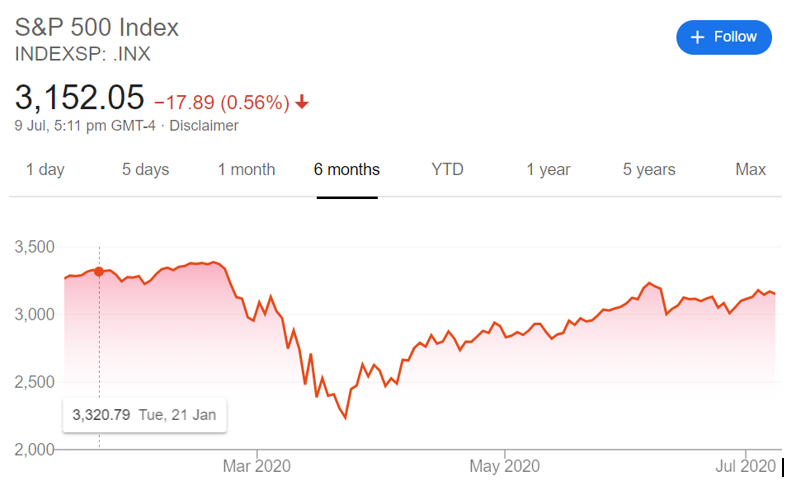
As the chart shows, the S&P index traced a deep V over six months. Its rebound, which began in late March, covered in three months the ground it had taken almost three years to cover previously—from over 2300 points to over 3100 points. This was unprecedented.
This happened because, from late February, COVID-19 outbreaks emerged in country after country. Borders closed, countries locked down, economic indicators plunged and panic spread. This directly caused buyers' and sellers' confidence to collapse. The S&P index fell from its record high of 3,386 points to its level at the end of 2016—2,237 points—triggering circuit breakers four times in quick succession and bringing capital markets close to collapse.
Governments then introduced monetary and fiscal policies to rescue their markets. Suddenly, the news was full of references to interest rate cuts, monetary easing,
government subsidies and government bond issuance. The continuous flow of funding gave the market—buyers and sellers—confidence. These policies also made their impact felt in capital markets, and the S&P index began a volatile recovery. By 9 July, it had recovered to 3,152 points.
The same scenario played out in New Zealand.
As the chart below shows, the NZX 50 also traced a deep V.
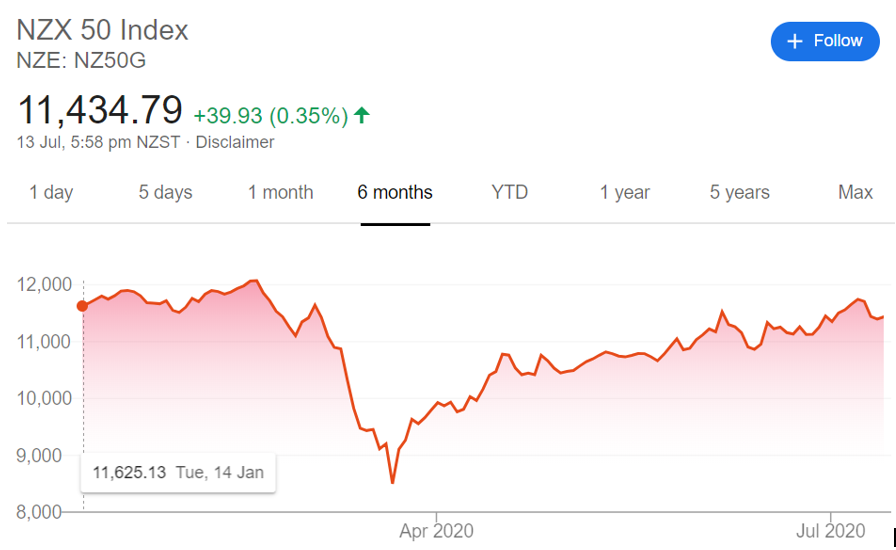
By 13 July, the NZX 50 was close to returning to its pre-pandemic high. During this period, the New Zealand Government did everything it could, introducing the monetary and fiscal policies mentioned above. Their effectiveness in rescuing the market was plain to see.
However, the global pandemic is far from over. Indeed, it could be said to be intensifying worldwide: of the world's 233 countries and territories, 213 have now been affected—almost none have escaped. Countries are recording anywhere from a hundred thousand or more to tens of thousands of new confirmed cases each day.
Over these past few months, experts from many fields have thoroughly analysed the pandemic's effects on the economy, foreign trade, production and other areas. Yet something invisible and intangible has rarely been mentioned: confidence.
The potential effects of confidence on share prices have been explained in detail above. Another thing confidence affects also needs to be mentioned: credit.
What happens when credit is affected? A devastating butterfly effect
Buying a house, buying a car, doing business—every transaction that requires borrowing is underpinned by credit. It is credit that enables people to access funds far beyond their own income and assets.
For example, when buying a house, you use a 20% deposit and your earning capacity to secure a loan for 80% and complete the purchase. You get a home, the developer receives 100% of the purchase price, and everyone is happy.
Why were you able to obtain that 80% loan? Because you completed various forms and supplied information during your application. The bank used that information to carry out various assessments and ultimately decided that your creditworthiness was sufficient to support the transaction.
But the pandemic has sharply increased uncertainty in the market, affecting the confidence of both borrowers and lenders. Could you lose your job? Could your employer go out of business?
Could house prices fall, leaving the property insufficient as collateral? Could banks face funding shortages? Could there be widespread mortgage defaults?
All these questions make borrowers and lenders more cautious. The amount of funding that credit can support then shrinks, ultimately reducing total lending. This affects all industries and society as a whole, rather than property transactions alone, so the resulting contraction in lending amounts to an astronomical sum.
In a commercial society, a contraction in lending reduces spending. One person's (A's) spending is another person's (B's) income. When B's income falls, their borrowing capacity falls further, and B's spending will fall by a multiple of that amount, while C, whose income comes from B's spending…
New Zealand's wage subsidy is also due to end soon. Even with the subsidy, many people have been receiving only 80% of their usual income.
The loss of income goes beyond these immediately visible figures: there is also a butterfly effect from the credit that income supports.
A contraction in lending therefore creates a shortage of funding across society. A shortage on this scale can have a devastating effect on the economy.
This is one reason governments implement quantitative easing and print money at a frantic pace. Through deliberate intervention, they hope to replace the funding lost across society as lending contracts, preventing the wider economy from collapsing through excessive financial blood loss.
Opinions differ on how long this approach can sustain the economy, or whether it can do so at all. But it never hurts to prepare for the worst.
One point needs particular emphasis: the funding lost because of the pandemic and the contraction in lending is money supported by credit that does not 'really exist';
the money created through government quantitative easing, however, is actually printed. Once the pandemic's effects have passed, the amount of actual money in society will have increased substantially, and credit will recover too. More money can support more credit, eventually leaving society awash with hot money. At that point, inflation and further rises in asset prices may be difficult to avoid.
Bank interest rates have now hit rock bottom and may even fall below it into negative territory. In any event, they are unlikely to outpace inflation.
The share market, meanwhile, is extremely volatile and highly uncertain.
With this difficult choice, asset allocation becomes particularly important: as the saying goes, do not put all your eggs in one basket.
How should you allocate assets? Funds offer the greatest convenience
The right approach to asset allocation varies from person to person. Risk tolerance, available funds, investment time frames and other factors all influence the final allocation.
For ordinary investors, funds are undoubtedly among the most convenient tools for asset allocation.
A fund is a pool of money managed by a professional fund manager. Its size allows greater diversification when managing investments, as well as access to a wider range of financial products, many of which are available only to institutional investors.
The assets a fund invests in can generally be divided into growth assets and income assets.
Growth assets include shares, property and other asset types, such as options, futures and commodities. Income assets mainly include term deposits and bonds.
Funds can be further divided into five types according to the proportion of growth assets they hold.
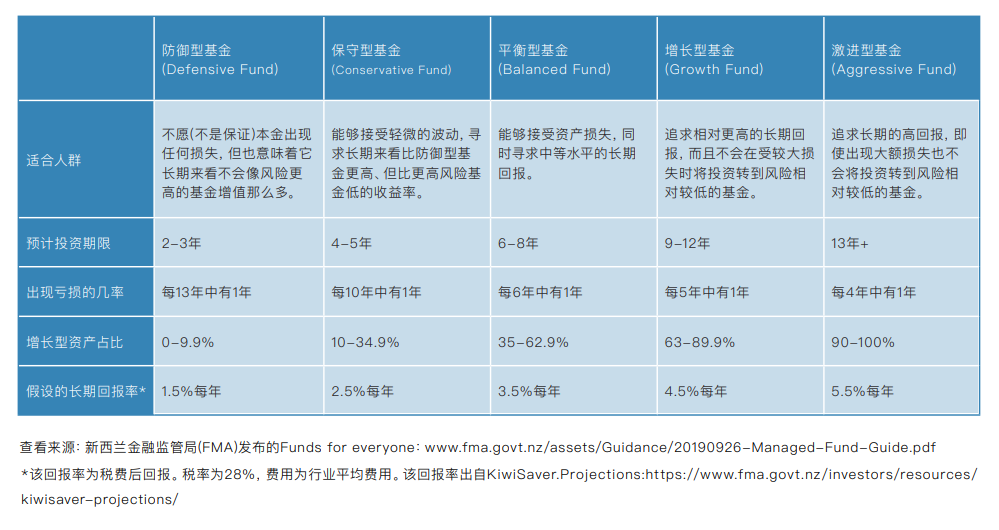
These five types are only a basic classification. Each individual fund has its own characteristics, and investors can choose a suitable fund based on their circumstances.
New Zealand's fund market currently offers many options. Alongside funds offered by all the major banks, there are numerous fund managers of different sizes and with different investment philosophies.
Here are three examples of different types of fund manager:
Smartshares is a New Zealand fund manager controlled by the New Zealand Exchange (NZX). Its main distinguishing feature is passive management, and its principal offerings are exchange-traded funds. New Zealand investors can buy various types of ETF through Smartshares to diversify their investments.
Pathfinder is a New Zealand fund manager whose main focus is Environmental, Social and Governance investing (ESG, meaning investment in companies that contribute to, or have a positive impact on, the environment, society and corporate governance), including companies in the high-tech and new energy sectors.
Castle Point is a New Zealand firm whose investment philosophy centres on long-term value investing. It also uses different financial instruments to protect investors' principal and currently focuses mainly on the Australian and New Zealand markets.
Bear in mind that legitimate fund managers must hold a licence issued by New Zealand's Financial Markets Authority. Their websites usually provide detailed information about their funds, including historical returns, fees, investment philosophy and key personnel. This information can provide strong support for informed investment decisions. Investors can also seek advice from financial advisers.
Finally, the old saying still applies: investing involves risk, so enter the market with care. May you all navigate the challenges successfully.
Disclaimer
The text and images in this article are merely a compilation of publicly available information and do not take your personal circumstances into account. Nothing here constitutes an opinion, recommendation or invitation to buy, sell or hold investment products. If you have any questions, please consult an appropriate professional. The author accepts no related liability.
About the author:

Derek Chen(Pen name: Uncle Mi)
Uncle Mi currently works in financial regulation in New Zealand and is familiar with financial licence applications, AML/CFT compliance and auditing, and fund management and operations. He also runs an independent media account. His WeChat public account mainly publishes original articles on finance, combining the realities of New Zealand's financial sector with financial theory to explain everyday financial knowledge in accessible language. Search for 'APLUSNZ' to follow Uncle Mi's WeChat public account.