
New Zealand stands out across Asia-Pacific, with strong commercial property operations and transactions in the second quarter
In the second quarter, New Zealand went through an outbreak, a nationwide lockdown, the elimination of community transmission, the resumption of production and a return to normal domestic life. It was a turbulent three months. Through a series of economic reports, Colliers International has revealed how New Zealand's commercial property sector performed during the quarter. Overall, it stood out across Asia-Pacific.
Amid the turmoil of people and governments worldwide grappling with COVID-19 and the political and economic crises it triggered, the first half of 2020 quietly slipped by. In the second quarter, New Zealand went through an outbreak, a nationwide lockdown, the elimination of community transmission, the resumption of production and a return to normal domestic life. It was a turbulent three months. Through a series of economic reports, Colliers International has revealed how New Zealand's commercial property sector performed during the quarter. Overall, it stood out across Asia-Pacific.
Since early June, New Zealanders' confidence has gradually recovered as an economic recovery driven by domestic demand has begun to gather strong momentum. Low interest rates have boosted investor sentiment, with strategic landholdings and high-quality properties becoming buyers' preferred targets.
{ad}
Hotels: an encouraging rebound driven by domestic demand
Throughout the second quarter, New Zealand's hotel industry struggled, treading on thin ice. This was partly due to the devastating impact of border closures on international tourism, while the nationwide lockdown in April and May also restricted domestic travel. However, the industry reached a turning point earlier than expected in June, prompting Colliers International to reach an encouraging conclusion when comparing conditions across Asia-Pacific: In just one month, many hotels experienced a remarkable rebound in performance, making New Zealand one of the world's best-performing markets at present.
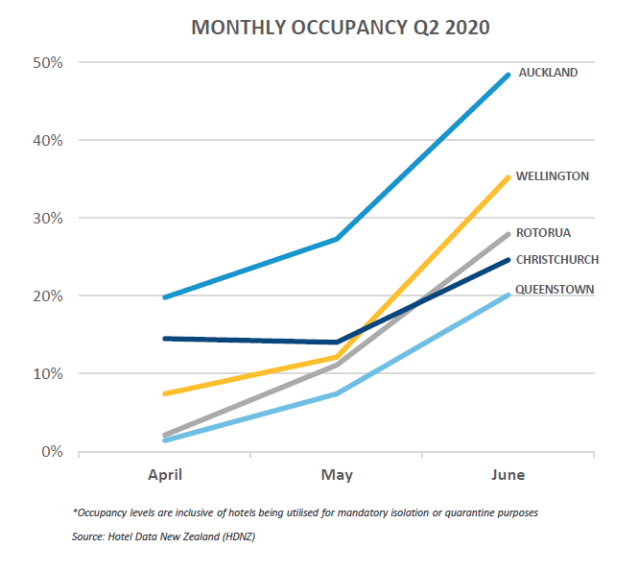
Key factors behind this trend include:
- Mandatory isolation
Although the Government has repeatedly said that the number of citizens and residents returning to New Zealand has exceeded capacity, and has restricted some flights, arrivals continue to increase. To keep communities safe, all arrivals must undergo 14 days of mandatory isolation in designated hotel facilities. This has generated strong demand for many hotels nationwide.
So far, 29 hotels with nearly 6,000 rooms across the country are being used as mandatory isolation facilities. An estimated 40% of hotel rooms in Auckland are being used for isolation, followed by Christchurch (31%), Rotorua (20%) and Wellington (3%). Forecasts suggest this demand will continue to grow throughout 2020, and possibly into 2021, as more New Zealanders return.
- Domestic tourism
Since domestic travel restrictions were lifted in early June, demand for domestic tourism has rebounded strongly, especially at weekends and during holidays.
Queenstown, Wellington and Rotorua have led the domestic tourism market, with monthly room occupancy increases ranging from 20% to 35% by the end of June. There are indications that the July school holidays will lift room occupancy above 50% across most of the country by the end of July.
- Business demand.
Other encouraging green shoots of recovery include:
- Accommodation demand from groups entering on special visas for particular activities, such as the Avatar 2 film crew and America's Cup teams.
- Accommodation demand generated by domestic interregional travel as sporting, music and cultural events, along with business activities, conferences and exhibitions, resume nationwide.
However, it is now very clear that any short-term recovery in the hotel industry will be driven primarily by the domestic market, while borders remain closed. Both the proposed trans-Tasman bubble and a broader resumption of inbound international travel are likely to face further delays, potentially until early 2021.
Industrial property: some fluctuations emerge after the pandemic
Industries hit by the pandemic may rebound once it ends. Equally, industries that were largely unaffected or even benefited during the pandemic may reasonably experience a gradual downturn afterwards as the powerful short-term stimulus fades. This in no way indicates a crisis in the industrial property market. On the contrary, continued growth can be expected given the severe imbalance between supply and demand.
Vacancy rates may rise slightly
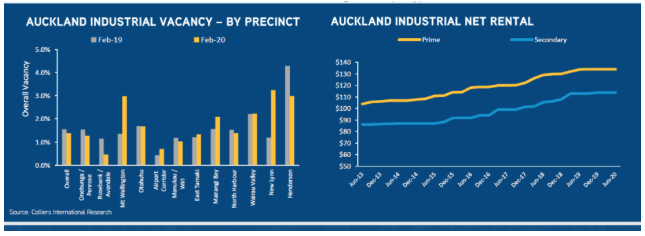
As the effects of COVID-19 gradually subside, strong market conditions for some industrial land have eased, potentially leading to higher vacancy rates. However, industrial property was among the sectors least affected by the pandemic, with some areas even benefiting, so any increase in vacancy rates is expected to remain modest; for example, the pre-pandemic vacancy rate in February 2020 was just 1.4%.
One way to ease vacancy rates is to support demand through a substantial increase in infrastructure investment and growth in transport, warehousing and postal services. These industries could expand rapidly as online shopping and delivery services become increasingly popular.
- Construction and development remain constrained
Although the construction industry has responded relatively positively to urgent, strong market demand, development on industrial land will remain limited. Only around 200,000 square metres are currently under construction, representing about 1.6% of total supply. The availability of vacant land is a major constraint, as substantial holdings of important vacant industrial land are controlled by a small number of key stakeholders.
- Rents may ease slightly
Auckland industrial property rents have risen for ten consecutive years. Prime warehouse rents now typically exceed NZ$134 per square metre, while secondary warehouse rents average around NZ$114 per square metre. Rents are expected to fall in the short term, mainly as a result of the Government's economic stimulus measures, although the decline will be limited.
- Quality assets remain an investment favourite
Although industrial property prices are currently at historic lows, economic uncertainty will make investors more cautious, including conducting more thorough due diligence before buying. As noted earlier, yields may also decline, with more pronounced falls for properties with lower-quality leases in less prominent locations. Quality assets will nevertheless remain highly attractive to investors.
Property sales: local buyers drive transaction volumes
Despite lockdown restrictions covering much of the second quarter, some transactions were still completed. The main contributing factors were:
- Some transactions had already progressed well in the first quarter, before the pandemic began, and were simply completed in the second quarter.
- As lockdown restrictions were lifted, pent-up market demand rose markedly, bringing a substantial increase in transaction volumes.
- The Reserve Bank of New Zealand's commitment to maintaining liquidity and low interest rates has strongly supported property investment and returns. The spread between New Zealand's 10-year government bonds and average prime yields is the highest in Asia-Pacific.
- Overseas buying activity was very strong before COVID-19, but overseas buyers more commonly adopted a wait-and-see approach during the second quarter. This allowed local private investors and syndicates to step in and drive transaction volumes.
The main investment trends of the second quarter are expected to continue into the third quarter of 2020, with further strong growth in market activity ahead.
- Transaction volumes will exceed those of the second quarter but are unlikely to approach third-quarter levels in 2019.
- Local buyers are likely to remain the most active participants, although increasing numbers of overseas buyers are expected to reassess their wait-and-see strategies and look for opportunities to enter the market.
Major commercial property transactions in June
» A local private developer acquired the 3.17-hectare Caughey Preston rest home site at 17 Upland Road, Remuera, for an undisclosed price. The property has significant redevelopment potential, and the transaction was completed during the nationwide lockdown.
» Stonefields Market, a neighbourhood retail property with 17 leased premises and a net lettable area of 2887 square metres, was acquired by a local private investor from developer Templeton Retail for an undisclosed price.
» A vacant CBD site at 38 Fort Street, with development potential, was sold to a local private developer for NZ$21,300 per square metre.