
Up again, and again! Records tumble across several regions as New Zealanders’ demand for homes proves unstoppable
Another month has begun. Like the young man waiting for the upstairs neighbour’s other shoe to drop, each month we await the sharp fall in house prices predicted by economists, only to find the next month’s market reports showing that prices have risen yet again!

New Zealand property website realestate.co.nz yesterday released its residential market report for month 7. Real-time data shows that although new listings have increased since lockdown ended, low stock levels across the country continue to push residential property prices higher.
Stock shortages push average asking prices higher
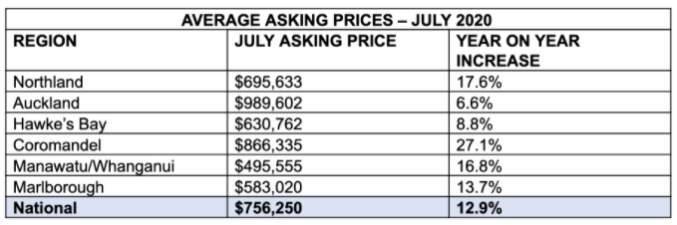
Nationwide, the total number of homes available for sale in July fell 11.0% compared with 2019, while the national average asking price rose 3.9% to NZ$756,250. Realestate.co.nz spokesperson Vanessa Taylor said that despite speculation prices would fall once the COVID-19 pandemic stabilised, the market appeared to be performing well.
{ad}
Commenting on the data, Vanessa said: “It has now been three months since the country moved down to alert level three. Although we can never be too absolute in our conclusions, the fact is that the price declines many predicted simply have not happened.”
Vanessa believes the serious problem facing New Zealand’s residential property market is a shortage of housing. The large number of New Zealanders returning from overseas could make the situation worse.
Five regions, including Auckland, set record asking prices
In July, asking prices rose in almost every region nationwide. Among them, Northland (Northland), Auckland, Hawke’s Bay (Hawke’s Bay), Coromandel (Coromandel) and Manawatu/Whanganui (Manawatu/Whanganui) recorded asking prices across these five regions at their highest levels in 13 years.
Vanessa explained that lockdown restrictions on listing properties meant fewer than 3,000 new properties came onto the market in April 2020. The price surge in April therefore reflected a shortage of supply and was significantly distorted.
Removing April prices from the historical data provides a better picture of the market’s actual condition.
Excluding data from the April lockdown, July set an all-time record for national property asking prices.
If the unusually inflated April prices are excluded, Marlborough also reached an all-time high in July, alongside the other five regions.
Vanessa said: “Removing the April national asking price peak of NZ$858,432, we can see that national average asking prices have been trending upwards since the end of last year, and the pace of increase has not slowed since lockdown ended.”
Month on month, the national average asking price in July rose 3.9% compared with June 2020.
Vanessa said persistently high asking prices might be unwelcome news for those hoping to negotiate a bargain, but were giving sellers considerable confidence.
10 regions record all-time lows in available stock
Of the country’s 19 regions, Northland, Gisborne, Taranaki, the West Coast, Canterbury, Coromandel, Marlborough, Wairarapa, the Central North Island and Manawatu/Whanganui all recorded their lowest stock levels in 13 years in July.
The largest declines were in Taranaki, Wairarapa and Marlborough, where the total number of homes available for sale fell 48.4%, 46.2% and 41.0% respectively.
Vanessa said record-low stock in more than half the country’s regions could be the main reason national average asking prices continued to rise last month.
“New Zealand’s property market clearly reflects the relationship between supply and demand. When housing stock is low, prices rise because demand exceeds supply.
Realestate.co.nz’s website traffic data shows that demand for property is currently very high,”
Vanessa said. The website’s real-time user data shows that compared with July 2019, total users in July this year increased 16.1%, while average browsing time increased by more than 12.6%.
However, bucking the overall trend of stock shortages, the total number of homes available for sale in Hawke’s Bay, Central Otago/Lakes, Southland and Otago increased 17.8%, 17.8%, 10.2% and 1.2% respectively.
Among these regions, average asking prices fell as stock increased, except in Hawke’s Bay, where asking prices rose 3.5%.
Average asking prices fell 4.9% month on month in Central Otago/Lakes, 1.7% in Otago and 3.4% in Southland.

New listings increase nationwide 20.7%
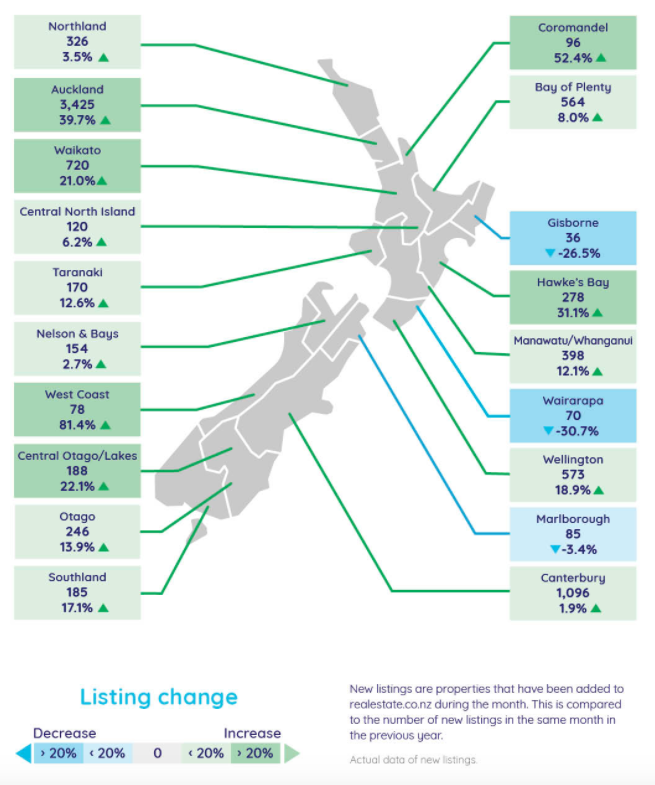
Despite the overall stock shortage, around 9,000 properties were newly listed nationwide in July, up 20.7% on the same period last year, giving buyers more homes to choose from.
However, strong demand and stock shortages across the country mean buyers are rushing to secure properties as soon as they are listed.
Compared with July 2019, the regions with the largest increases in new listings were the West Coast (81.0%, 78 properties), Coromandel (52.4%, 96 properties) and Auckland (39.7%, 3,425 properties).
Only three regions nationwide recorded fewer new listings last month: Gisborne (26.5%), Wairarapa (30.7%) and Marlborough (3.4%).
New buyers entering the market drive growth
Vanessa said that although the substantial increase in new listings compared with last year offered some hope, the wave of returning New Zealanders could significantly increase demand and put greater pressure on an already severely constrained market.
“Stats NZ reports that a record number of New Zealanders, approximately more than 47,000, have returned home since border restrictions were introduced in March.
I think this has also contributed to the additional demand in the property market,” Vanessa said.
Realestate.co.nz data shows that international traffic to the website has increased 12.9% since April.
This suggests New Zealanders living overseas may already be looking for homes before returning. The continuing increase in new users could also indicate that many new property buyers are driving market demand.
7 th month’s featured region: Manawatu/Whanganui
Average asking prices in Manawatu/Whanganui have risen steadily since the start of 2019. In July, the average approached NZ$500,000, setting an all-time asking price record of NZ$495,555.
The average asking price rose 16.8% compared with July 2019, indicating that the region’s sustained house price growth over recent years is set to continue.
In July 2018, the region’s average asking price was NZ$357,206, which was NZ$138,349 below its latest peak.
As elsewhere in New Zealand, the increase in new listings alongside a shortage of available stock reflects strong demand for property in the region.
Vanessa said: “New listings in the region rose 12.1% year on year in July, but stock fell to its lowest level in 13 years, with just 580 properties available for sale. This shows that demand far exceeds supply.” This could be good news for local sellers.