
Safeguarding tenants’ health, protecting landlords’ assets and enhancing property values (Healthy Homes Standards explained, part one)
What exactly do the Healthy Homes Standards require? What difficulties might arise when working towards compliance, and how can they be resolved? We will invite professionals from Guardian Property Management to explain these issues one by one. Stay tuned.

The 2019 residential tenancies regulations on healthy homes standards (Residential Tenancies (Healthy Homes Standards) Regulations 2019,) became law on 1 July 2019. The standards will make a substantial contribution to the wellbeing of New Zealand households, while also weighing on many property owners’ minds. What exactly do the Healthy Homes Standards require? What difficulties might arise when working towards compliance, and how can they be resolved? We will invite professionals from Guardian Property Management to explain these issues one by one. Stay tuned.
Why are the Healthy Homes Standards important?
Nearly 600,000 households in New Zealand rent their homes, and research shows that rental properties are generally of poorer quality than owner-occupied homes. Living in cold, damp and mouldy homes can cause health problems, particularly asthma and cardiovascular disease. Improving the quality of rental properties will improve tenants’ health. For property owners, although this does involve an expense, warm, dry homes are less prone to mould over the long term, and buildings will not suffer damage from mould growth. This better protects landlords’ assets.
What do the Healthy Homes Standards mainly cover?
The standards mainly cover five areas: heating, thermal insulation, ventilation, moisture ingress and drainage, and draught stopping.
{ad}
The five areas of the Healthy Homes Standards
Heating
Heating
- All rental properties must have one or more fixed heaters that directly heat the main living room to at least 18°C and can maintain this temperature throughout the year;
- Certain inefficient, expensive-to-run or unhealthy heaters will not meet the standard;
- The Heating Assessment Tool is available at tenancy.govt.nz/heating-tool (external link). Use it to find out the minimum heating requirements, check whether existing heating complies, or determine whether new heaters need to be installed.
Insulation
Insulation - From 1 July 2019, ceiling and underfloor insulation must be installed in all rental properties wherever possible;
- Existing insulation in some rental properties will need to be topped up or replaced. Depending on the property’s location (see the diagram below), ceiling insulation must meet at least the required R-value*;
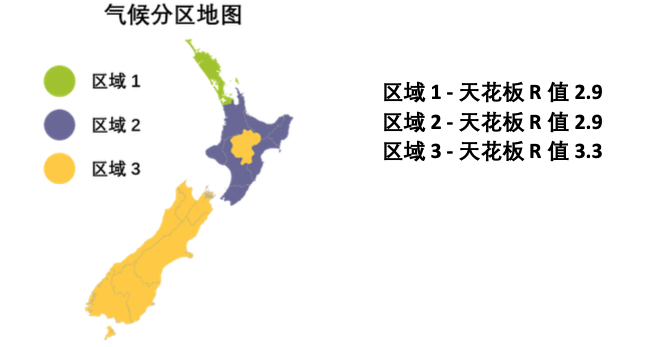
- Existing ceiling insulation installed before 1 July 2016 must be at least 120 millimetres thick. Underfloor insulation must have an R-value of at least 3.
- *“R” stands for resistance. The R-value measures insulation’s ability to resist heat flow.
Ventilation
Ventilation
- All bedrooms, dining rooms, living rooms, lounges and kitchens in rental properties must have at least one door or window, including skylights, that opens to the outside.
- The combined area of these doors and windows in each room must be at least 5% of its floor area. The doors and windows must be able to be fixed in an open position.
- All kitchens and bathrooms must have an extractor fan that vents to the outside.
Moisture ingress and drainage
Moisture ingress and drainage
- Rental properties must have an effective drainage system to remove rainwater, surface water and groundwater, including appropriate drainage outlets.
- The drainage system must include gutters, downpipes and drains to carry water away from the roof.
- If a rental property has an enclosed subfloor space, a ground moisture barrier must be installed where reasonably practicable.
Draught stopping
Draught stopping- Landlords must fill or block any unreasonable gaps and holes in walls, ceilings, windows, floors and doors to prevent noticeable draughts.
- Open fireplaces must be blocked off unless the tenant and landlord agree otherwise.
Healthy Homes Standards compliance timeline
From 1 July 2019- Ceiling and underfloor insulation must be installed in all rental properties where reasonably practicable.
- Landlords must sign a statement for any new, varied or renewed tenancy agreement confirming that they will comply with, or already meet, the Healthy Homes Standards.
- Supplementing the existing requirements introduced on 1 July 2016, all new tenancy agreements must include a statement describing the insulation used in the property, including its location, type and condition. These two statements can be combined and covered by a single signature.
- Landlords must retain relevant records to demonstrate compliance with any Healthy Homes Standards that apply, or will apply during the tenancy.
In 2020, from 1 December -
Landlords must provide a statement for any new, varied or renewed tenancy agreement describing the property’s current compliance with the Healthy Homes Standards (statement download link: https://www.tenancy.govt.nz/assets/compliance-statement.pdf)
Note: Failure to provide this statement, or providing inaccurate information, may result in a fine of NZ$500. If you have questions or difficulties completing the statement, it is advisable to promptly engage an independent professional property inspection company to provide an inspection report.
From 1 July 2021 -
- Private landlords must ensure their rental properties meet the Healthy Homes Standards within 90 days of a new or renewed tenancy taking effect.
From 1 July 2023 - All Housing New Zealand homes and registered homes provided by community housing providers must meet the Healthy Homes Standards.
From 1 July 2024 - All rental properties must meet the Healthy Homes Standards.
What records must landlords retain to demonstrate compliance with the Healthy Homes Standards?Under the 1986 residential tenancies legislation (Residential Tenancies Act 1986), landlords are already required to retain copies of certain documents relating to their rental properties, such as inspection records and records of maintenance or repairs.
In addition, the Healthy Homes Standards require landlords to retain relevant documents, including:
- Certificates of compliance;
- Records of calculations of the living room’s required heating capacity, including printouts of results from using the Heating Assessment Tool;
- Certificates of acceptance;
- Receipts issued by building practitioners;
- Invoices issued by building practitioners and/or other service providers;
- Receipts for any building materials and/or components;
- Photographic evidence of compliance;
- Records of work by building practitioners or independent qualified persons;
- Professional assessments by licensed building practitioners, independent qualified persons or other relevant professionals;
- A code compliance certificate or compliance statement where an extractor fan forms part of an unconventional, larger ventilation system;
- Land Information Memoranda or building information reports, or sections of these reports, that reasonably demonstrate compliance;
- Product manuals/schedules for equipment installed to meet the standards;
- Other important documents or records that reasonably demonstrate compliance.
What exemptions are available under the Healthy Homes Standards?
There are three general exemptions from the standards:
- Where an owner intends to demolish or substantially rebuild a rental property and has applied for the relevant resource consent or building consent before the compliance deadline. This exemption lasts for up to 12 months from that deadline. In some circumstances it may end earlier, for example if the relevant consent lapses or is terminated, or the consent application is declined. Owners must provide evidence that they have applied for the relevant resource consent or building consent if requested. Where an exemption has been granted because of such an application and the application is subsequently declined, the owner has 90 days to take steps to bring the property up to the Healthy Homes Standards, unless they challenge the refusal. The exemption is reinstated during the challenge until the authorities make a decision.
- Where the tenant is the former owner of the rental property and the tenancy began immediately after the landlord purchased it from them. In this case, the exemption can apply for 12 months from the start of the tenancy.
- Where the rental property forms only part of a building and the landlord does not own the entire building, for example where they own only one apartment. The landlord may be partially exempt from some requirements of the standards:
- If facilities need to be installed in a part of the building that is not wholly owned by the landlord.
- If the work requires access to an area that is not exclusively owned by the landlord.
In both cases, however, the landlord must still take all reasonable steps to ensure the rental property complies with the standards as fully as reasonably practicable.
Note: If an exemption ceases to apply during a tenancy, for example because a building consent expires, the landlord must bring the property up to the Healthy Homes Standards as soon as reasonably practicable.
In addition to these three general exemptions, each of the five areas covered by the standards has its own specific exemptions. We will explain these in detail in future instalments. Stay tuned.
Summary
Although the standards require landlords to make a “compulsory” outlay, over the long term this can be an investment with a reasonable return. Incomplete statistics suggest that rental properties in better overall condition command NZ$30–50 more per week than comparable properties, meaning annual rental income is expected to be NZ$1,560–2,600 higher. This can help landlords gradually recover the cost of compliance, while also increasing property values and reducing maintenance costs.
Demand for healthy homes inspections is currently very high. Owners are therefore advised to arrange inspections early, then use the inspection report and their circumstances to seek reasonable quotes and organise a programme of repairs.
About the author:

Lawson Sun is currently the North Shore regional manager at Guardian Property Management. With a background in finance, accounting and marketing, and more than four years’ accounting experience, he specialises in comprehensive letting and management solutions for investment property owners. Guardian Property Management has worked in New Zealand’s property management industry for more than a decade and currently has five offices, serving all of Auckland and Hamilton.