
Take a look! What does history tell us about how elections affect New Zealand’s property market?
The COVID-19 pandemic and the accompanying global economic downturn are affecting property markets worldwide. In New Zealand, another factor is also crucial to the market’s near-term direction: the general election taking place next month.

Colliers International has analysed property sales and confidence surveys during the past six New Zealand general elections to assess whether the 2020 election will affect property investment.
Residential market
Analysis of residential sales activity before and after the past six elections shows that sales generally continue along their existing trajectory unless the Government introduces major property policies.
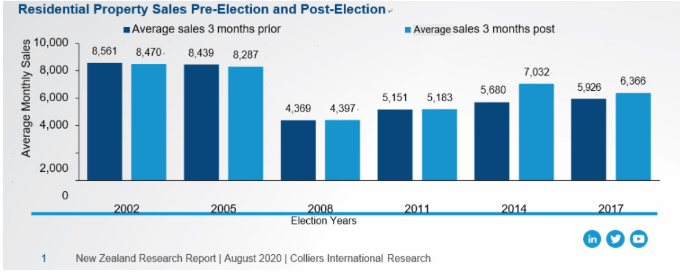
Of the six general elections since 2000, five had little effect on sales activity. The only exception was the 2014 election.
In 2014, Labour proposed a capital gains tax and called for restrictions on overseas buyers’ eligibility to purchase residential property.
These policies contrasted sharply with National’s position at the time, which favoured maintaining the status quo.
{ad}
This policy divide slowed sales activity before the election. Once National was elected to govern, market uncertainty cleared and sales quickly rose sharply.
In most cases, potential housing policy changes have a greater impact on residential investors than on owner-occupiers.
For example, in 2014, total mortgage lending to investors rose from NZ$1,167,000,000 in August, the month before the election, to NZ$1,421,000,000 in October, an increase of 21%.
By comparison, total mortgage lending to first-home buyers and other owner-occupiers increased by only 8.6%.
Across elections since 2000, the main drivers of property market changes have been regulatory, economic, financial and demographic factors, such as changes to LVR restrictions, interest rates, access to finance, migration and housing supply.
Interestingly, in the current economic environment, the recent removal of LVR restrictions and further interest rate cuts have increased investors’ and first-home buyers’ shares of mortgage lending.
Looking ahead to the 2020 election, no ‘restrictive’ housing policies or regulatory measures have yet been announced. The 2020 election can therefore be expected to have little impact on the residential market.
This also suggests that economic, financial and demographic factors will be the main variables affecting residential sales activity for the remainder of 2020. At the time of writing, lending and sales activity are both very strong, in sharp contrast to the many economic forecasts predicting a weakening market.
Commercial property market
Since 2000, analysis of commercial and industrial property sales activity shows little change in sales trends during general elections, possibly because policy changes have less impact on this sector than on residential property.
However, analysis of client confidence shows some signs that commercial property investors are also affected.
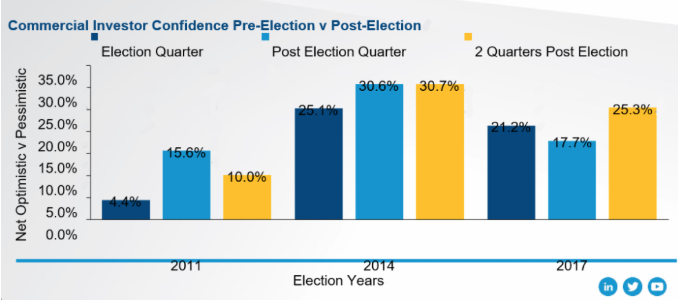
- Commercial and industrial investors adopt a slightly more cautious approach before elections, but quickly return to normal market levels seen outside election periods.
A commercial and industrial property investor confidence survey conducted around the 2011 election showed net optimism—the proportion of positive responses minus negative responses—at 4.4% in the fourth quarter of 2011, rising to 15.6% in the first quarter of 2012.
Around the 2014 election, net optimism rose from 25.1% in the third quarter to 30.6% in the fourth quarter.
- Research into business confidence surveys also found that readings are generally lower under Labour governments than under National governments.
The period after the 2017 election was a slight exception. Confidence did not rise immediately, instead falling in the fourth quarter before climbing again in the first quarter of the following year.
The main reason may have been the lengthy coalition negotiations following that year’s September election, with the composition of the government not finalised until October 2017.
- Elections generally have less impact on commercial and industrial property markets than the broader economic and financial environment.
For example, in 2008, the November election result did not significantly change investor confidence, as businesses were largely occupied with responding to the adverse effects of the global financial crisis.
Although New Zealand is very likely in a technical recession because of COVID-19, and unemployment is likely to rise further in the short term before gradually improving, current investment activity suggests these economic conditions have not been enough to affect commercial property sales activity.
Across the commercial property market, low interest rates are encouraging investors to seek quality assets backed by leases, aiming to restore returns to pre-COVID-19 levels. Rising land acquisition volumes and prices also suggest that investors are looking beyond potential short-term volatility to longer-term returns.
- Office market
Emerging trends in Auckland Transport’s latest public transport patronage data suggest that new patterns of workplace use may already be taking shape.
Public transport patronage in July rose 18.1% to 6,200,000 journeys, compared with 5,200,000 in June. The increase in July suggests that most Aucklanders have returned to their workplaces, particularly later in the week on Thursdays and Fridays, although numbers remain slightly below the same month last year.
Globally, COVID-19 has prompted many companies to reassess their corporate property strategies and explore alternative workspace options.
A recent Colliers International survey of office occupiers found many changes to workspace arrangements, with nearly two-thirds of respondents saying they intended to work from home one or two days a week.
Auckland Transport’s data also reflects this attitude. For example, in July 2020, passenger numbers across all public transport modes fell significantly on Mondays and Tuesdays compared with the same period last year.
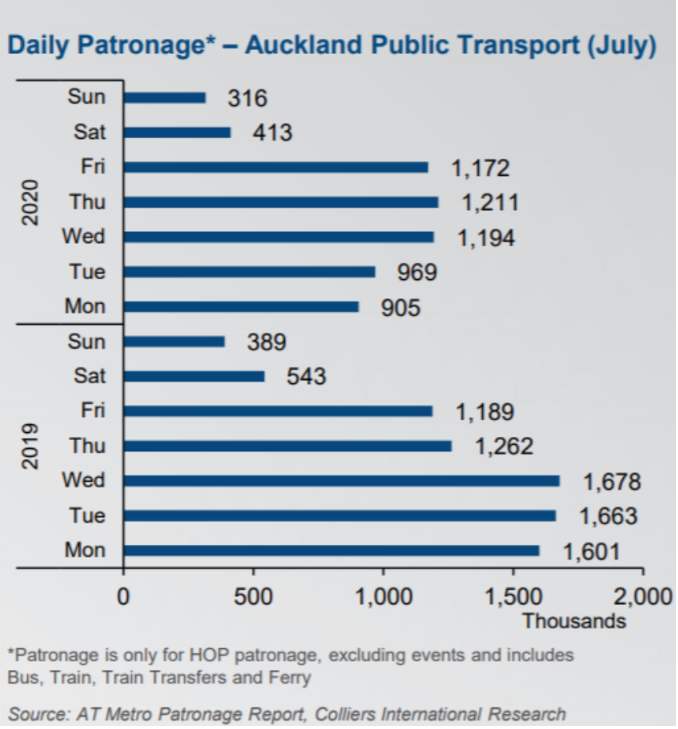
Despite clear signs of change, it may be too early to attribute these shifts entirely to changes in corporate property strategies, as many other economic uncertainties are also at play.
Over the coming months, commuter numbers in central Auckland may increase as new office spaces such as the PWC building open and tenants move into new premises.
Industrial land market
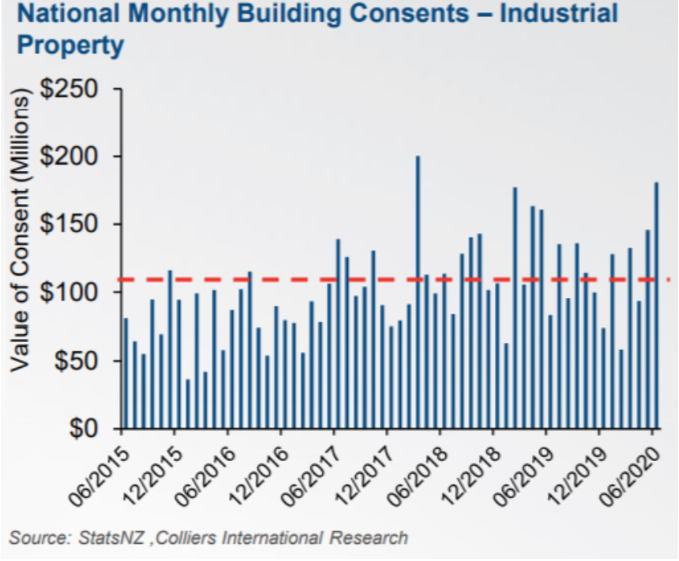
Industrial property development remains active across New Zealand. The latest monthly building consent data from Stats NZ also shows sustained strength in this sector.
The market value of industrial property building consents reached NZ$180,000,000 in June 2020, marking another peak and the highest level since March 2018,
well above the monthly average of NZ$100,000,000 over the past 5 years.
Low interest rates and industrial land’s resilience during economic uncertainty continue to support strong investment demand for industrial property.
Hawke’s Bay is among the regions recording the greatest growth in market value and consent numbers, reflecting its potential for future growth.
A key factor was a recent record-priced transaction in the region. In June, food and processing business Tomoana Food Hub sold a site of approximately 10.4 hectares to Queenstown-based property group Mitchell Mackersy for NZ$41,100,000.
Retail market
Google Mobility data tracks and measures activity among users who have enabled location sharing, and its latest figures show some signs of recovery.
Compared with the baseline for visits to retail and recreation locations, the average change in July was -5.2%, compared with -16.0% in June and -87.4% in April, during the Level-4 lockdown.
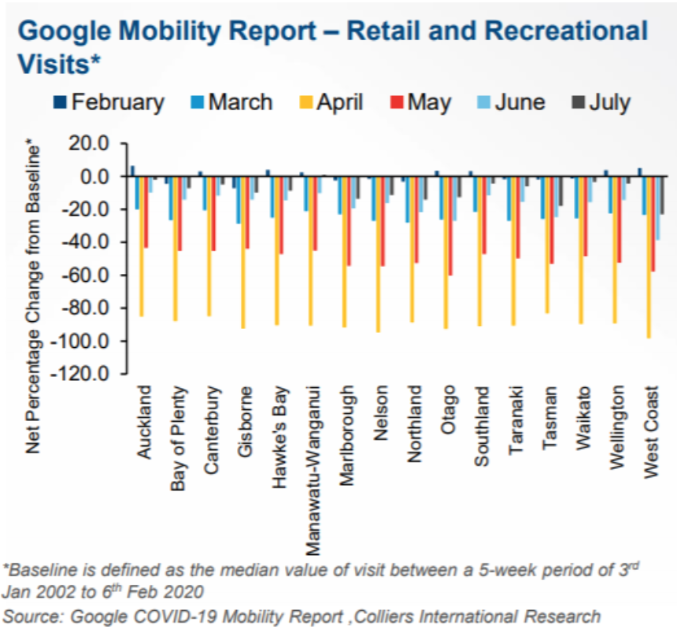
Regional data shows a substantial increase in visits to tourism hotspots, particularly those in the South Island, indicating a relatively rapid tourism recovery even though New Zealand’s borders remain closed to international visitors.
Tourism activity in July was therefore driven primarily by domestic visitors, coinciding with the school holidays and winter ski season.
Air New Zealand estimates that around 16,100 passengers typically arrive or depart on domestic flights at Auckland Airport during the busy school holidays, equivalent to about 57% of domestic passenger numbers in 2019.
Monthly data shows that the West Coast recovered fastest, moving from -38.7% in June 2020 to -23.0% in July 2020, a net increase of 15.7%;
Otago recovered closest to the baseline, moving from -27.1% in June 2020 to -12.5% in July 2020, a net increase of 14.5%.