
It may no longer be 'too early' to discuss Level 4 — can New Zealand's economy withstand another lockdown?!
Where did this sudden community transmission begin? How long will the second wave last, and how severe will it be? Will Auckland become another Melbourne? Can New Zealand's economy withstand another nationwide lockdown? These questions have been weighing on every New Zealander's mind in recent days.

Current cases may be just the tip of the iceberg
'We know that around 20% of infected people cause about 80% of secondary infections.' Today's exponential rise in confirmed cases has borne out these words from health experts.
At today's 1h afternoon press conference, Director-General of Health Ashley Bloomfield confirmed that 13 of the 14 cases confirmed today were linked to the affected South Auckland household.
It is already known that members of this household and their close contacts alone have connections across multiple parts of Auckland and have travelled to Rotorua. The emergence of more cases now clearly points to more chains of transmission.
Although Bloomfield said earlier this morning that it was too early to conclude whether the country needed to return to Alert Level Four, few would now doubt that more linked cases will emerge in the coming days, potentially 'not just in Auckland, but across the country'.
University of Auckland professor Shaun Hendy, director of Te Pūnaha Matatini, New Zealand's Centre of Research Excellence for Complex Systems and Data Analytics, said the confirmed cases had no history of overseas travel. This meant they were likely to have been infected through community transmission, suggesting that Auckland 'may already have multiple chains of transmission'.
The implication is that the first community case now identified is highly likely to be a link in a transmission chain, rather than its starting point.
{ad}
What another shutdown would mean for New Zealand's economy
Worldwide, confirmed cases have exceeded 20,000,000, with deaths approaching 750,000.
The second wave in the Australian state of Victoria has been far more severe than the first. The concern is not only whether New Zealand's healthcare system can successfully fight the virus again, but also whether its economy, which has only just begun to show signs of recovery, can withstand another nationwide shutdown.
Infometrics economist Brad Olsen said the renewed outbreak of community transmission had 'thrown cold water on the recovering economy'.
'Preliminary economic forecasts estimate that during Level 3 lockdown, 28% of Auckland's workforce — around 250,000 people — will be unable to work as normal, and direct consumer spending will fall by 60,000,000–69,000,000 over 3 days.
' ASB economists forecast that economic activity in Auckland could fall by around 20% under Level 3 restrictions, while the rest of the country could see a decline of around 8% under Level 2.
In a joint report, ASB senior economists Mark Smith and Jane Turner and chief economist Nick Tuffley noted that non-essential industries would suffer substantial economic losses under Alert Levels 3 and 4.
They urged: 'If lockdowns like this persist for a long time, or potentially become a regular feature in future, then
we call on the Government to consider now how to better determine which sectors can be allowed to continue operating under stricter alert levels.
' New Zealand's fiscal position is now considerably weaker than during the first lockdown. Improving and refining response strategies will help ease the economic burden.
- The economic impact of New Zealand's latest COVID-19 outbreak is highly uncertain. It will depend on the outbreak's severity and duration, the containment measures adopted, and the economy's ability to respond.
- Our estimates suggest that while the impact on New Zealand's GDP is relatively limited, it could easily grow.
- COVID-19 looks set to remain with us for a long time. Now would be a good time to plan ahead and explore effective ways to respond to COVID-19 that minimise its economic and social burden.
- Uncertainty increases further
Lockdown restrictions are scheduled to end at midnight this Friday, but future restrictions appear likely to depend on how the outbreak develops, which is itself uncertain.
Uncertainty is a key word in assessing the recent outbreak's potential health and economic effects.
The emergence of new community transmission cases has heightened that uncertainty. The specific effects will depend on several key factors:
- The severity and duration of the outbreak
The more severe and prolonged the outbreak, the harder it will be to control, and the greater the subsequent economic disruption and potential losses.
- Containment measures.
The longer and more extensive the measures to prevent the virus spreading, including physical distancing, the greater their economic cost.
- Government support measures.
The more effective the measures taken by the Government, including the central bank, to mitigate the outbreak's effects, the lower the economic cost.
With fiscal and monetary policy measures already close to full capacity, the Government now has less room to provide further support than it did in March.
- Economic structure.
Whether the economy's structure is sufficiently adaptable and flexible, including how quickly and smoothly it can shift to remote working and physical distancing.
In short, the less time the outbreak disrupts the economy, the less the economy depends on physical contact, and the more flexibly and readily economic activity can adapt to changes in the outbreak, the better the economy will cope and the smaller the impact will be.
- Estimating the potential economic impact
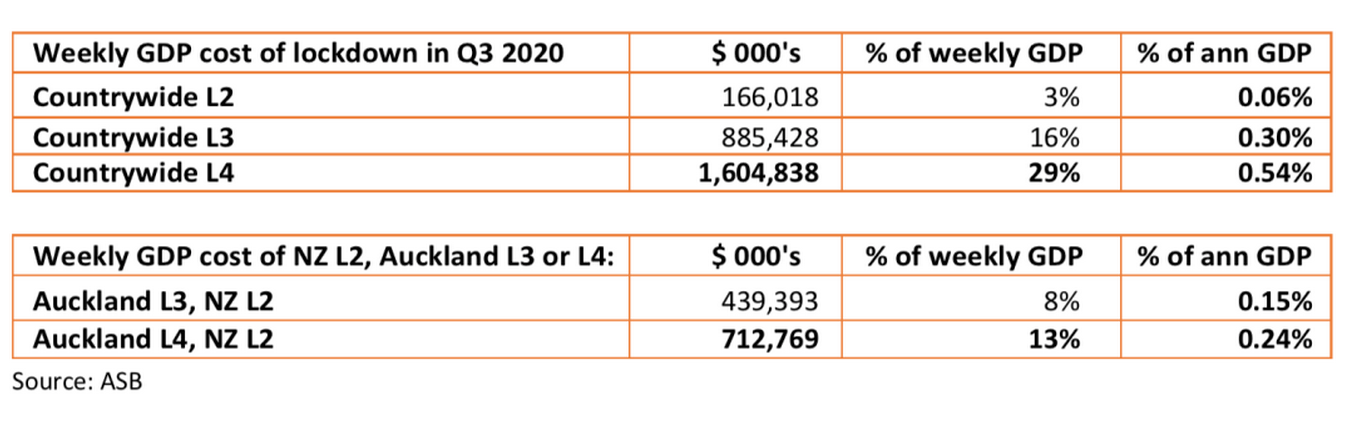
Although it is still early in the new outbreak and lockdown, making the severity of the economic impact difficult to determine, ASB economists have nevertheless attempted to show in a table how rising alert levels would affect the weekly cost to national GDP relative to their forecast baseline.
If the whole country moved to Level 3, economic activity would fall to 84% of its level in this year's third quarter. Each subsequent week New Zealand remained at Level 3 would reduce annual national GDP for the year ending December 2020 by 0.3%. If New Zealand moved to Level 4, each week would reduce annual GDP by an estimated 0.5%.
Overall, the higher the alert level and the wider its reach, the greater the hit to New Zealand's GDP.
Auckland has the strongest economy among New Zealand's 16 main regions, accounting for 38% of national GDP, around 33% of jobs and a third of the population. It is therefore necessary to discuss the impact on New Zealand's economy if the outbreak remains contained within Auckland, even though this may be unlikely.
- Assuming the current settings remain unchanged — Level 3 in Auckland and Level 2 elsewhere — each week would reduce annual GDP by around 15%;
- If Auckland moved to Level 4 while other regions remained at Level 2, the GDP impact would rise to around 25% per week.
- The second wave: where can we do better?
ASB economists said that although it might feel as though we were back where we started, the previous lockdown gave us a crash course in changing the way we work. Many of the lessons learned will help us respond to a new wave of infections and lockdowns.
- Where feasible, it is crucial to be able to smoothly adapt workplaces for physical distancing and shift to online and digital ways of working.
- The pandemic will not end globally in the short term, and lockdowns may occur more than once or twice. The Government should use this opportunity to develop effective contingency plans and prepare before problems arise.
- For businesses elsewhere in New Zealand, Auckland's timely lockdown has bought more breathing space to respond. While they can still operate relatively normally, they should make full use of this time to prepare.