
New listings edge up and asking prices surge, with supply and demand still strong in August
As the pandemic ebbs and flows, people's working lives, home lives and even moods rise and fall with it. In 2020, when everything has become uncertain, there seems to be just one constant in New Zealand that keeps defying authoritative forecasts: continually rising house prices.
Real-time data from realestate.co.nz shows that property prices continue to climb across New Zealand. Asking prices in Northland, Bay of Plenty, Taranaki and the Central North Island, in particular, have reached record highs for this time of year.
Continuing the trend seen in July, new listings around the country increased compared with the same period last year. However, total national housing stock, along with stock in nine regions, still fell to record lows.
Realestate.co.nz spokesperson Vanessa Taylor said several factors would continue to drive asking prices higher.
{ad}
“I think low interest rates and the removal of LVR restrictions earlier this year have brought more people into the property market. Many overseas New Zealanders have also returned home because of COVID-19, so there is currently no shortage of buyers in New Zealand.”
“As we can see in the crowded rental market, everyone needs somewhere to live. Given New Zealand's longstanding housing shortage, I expect demand to remain high, as both owner-occupiers and investors have clear goals for buying property.”Vanessa said.
In August, realestate.co.nz attracted around 1,300,000 users, up 21.0% on August last year. The site typically attracts just over 1,200,000 users during the February market peak, so demand in August 2020 clearly exceeded the summer peak.
Housing stock hits record lows nationally and in nine regions
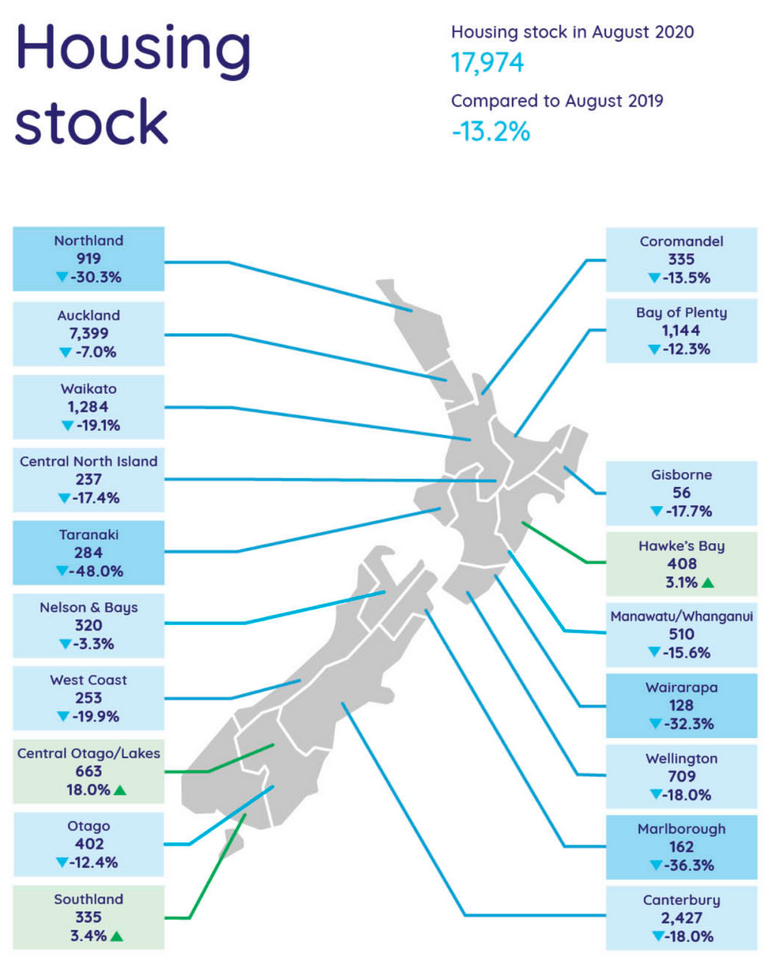
New Zealand's housing shortage showed no sign of easing in August, with 9 of the country's 19 regions recording their lowest stock levels in the website's 13-year history. Nationwide, the total number of homes available for sale fell 13.2% year on year to just 17974, and was down 7.6% from July.
Taranaki recorded the largest decline in housing stock, with just 284 homes available to buy, down 47.9% from August 2019. Listings in Taranaki have been trending down since the beginning of 2019, when nearly 700 homes were on the market. With supply falling, the region's average asking price has naturally risen noticeably.
Vanessa said: “New Zealand's housing shortage has not improved. Nearly half of the regions are at record lows, and buyers nationwide have less choice than ever before.”
According to Stats NZ, New Zealand's population passed 5,000,000 earlier this year. Vanessa said rapid population growth and the large number of New Zealanders returning from overseas had both increased demand for property. “Many New Zealanders are now unable or unwilling to move overseas, which may also be putting pressure on the market.”
According to the website's data, only three regions recorded year-on-year growth in the total number of homes for sale: Hawke's Bay, up 3.1% to 408; Central Otago/Lakes, up 18.0% to 663; and Southland, up 3.2% to 335.
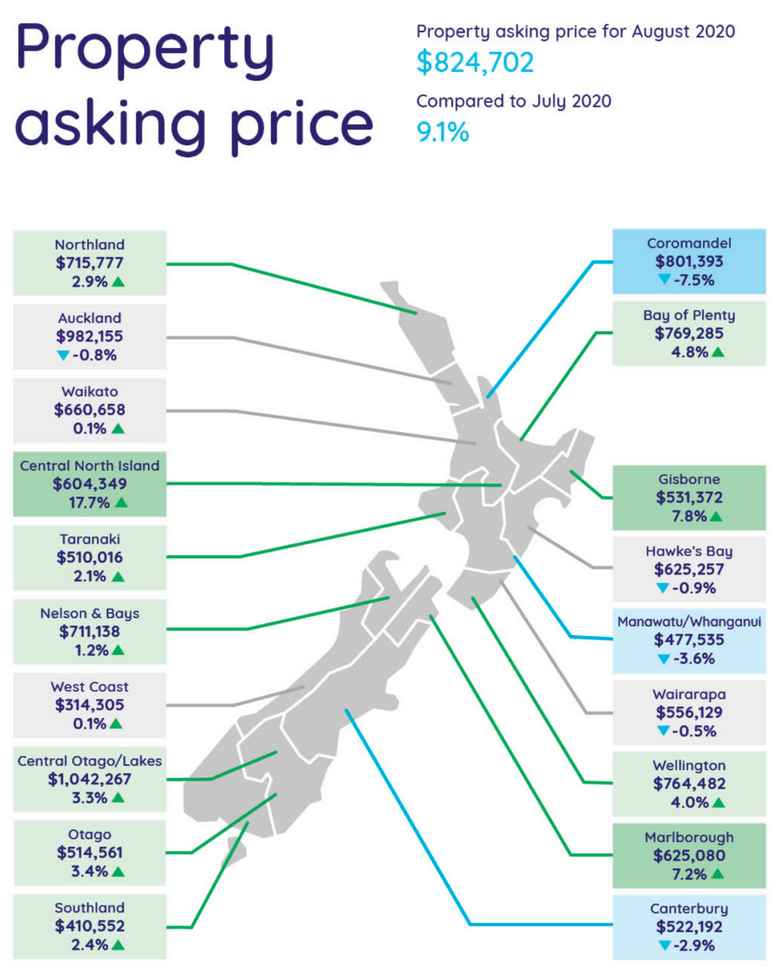
National average asking price passes $800,000
In August, the national average asking price rose 21.7% year on year and 9.1% from the previous month.
Excluding the artificially high figures recorded during the April lockdown, the national average asking price exceeded NZ$800,000 for the first time in August 2020.
Vanessa said fewer than 3,000 new properties were listed in April 2020, and the supply shortage caused prices to jump sharply in April. Removing the anomalous April prices from long-term statistics would therefore better reflect actual market conditions.
“Leaving aside the exceptional April peak, the national average asking price has largely remained between NZ$700,000 and NZ$750,000 throughout 2020. The jump of nearly NZ$70,000 from July to August is therefore particularly significant for the market.”
She believed the increase was probably driven by prices in certain regions. Average asking prices in Northland, Bay of Plenty, Taranaki and the Central North Island all reached their highest levels since records began in 2007.
New listings avoid the winter slowdown
Vendors usually wait until spring or summer to list their homes, so new listings tend to decline each winter.
However, real-time data from realestate.co.nz shows this was not the case in 2020. Nationwide, new listings in August rose 16.0% year on year, with only 4 of the country's 19 regions bucking this upward trend.
Vanessa believed there could be two reasons for this change:
- The earlier April lockdown prevented vendors from listing homes as usual, creating a backlog of properties around the country;
- Recent changes in people's living circumstances.
“COVID-19 has changed the way many people work. More New Zealanders are placing greater importance on their homes. With remote working becoming increasingly common, I would not be surprised to see people's housing requirements changing too.”
In August, the regions with the largest year-on-year increases in new listings were Wairarapa, up 91.2% to 130; Southland, up 44.5% to 198; and Nelson and Bays, up 43.7% to 194.
Vanessa said: “Housing supply was particularly tight in these three regions for much of 2019 and 2020, so it is encouraging to see vendors in these areas coming to market in strong numbers.
Central North Island average asking price passes $600,000 for the first time
The Central North Island recorded the largest rise in average asking prices in August, climbing nearly NZ$100,000 from the July average of NZ$513,257 to NZ$604,349. This was an increase of 17.8% month on month and 20.2% year on year.
In line with the national stock trend, the total number of homes for sale in the region reached a record low for the second consecutive month in August, with just 237 available. This was down 17.4% year on year and 16.0% from July.
“When market supply falls, prices often rise. Although new listings in the region increased 4.3% year on year, I believe the Central North Island's price rises are being driven by demand outstripping supply.”Vanessa said.
Real-time data from realestate.co.nz shows that Taumarunui, Ohakune, Turangi, Kinloch and Taupo were the most searched locations in the Central North Island among the website's users in August.