
Auckland property sales and prices surge in August as agencies come prepared for lockdown
Auckland has just been through another Level 3 lockdown. Industry professionals still vividly remember the temporary disruption the previous lockdown caused to New Zealand's property market. How has Auckland's market performed this time?
Prepared for the challenge
The latest market report from leading real estate agency Barfoot & Thompson shows that Auckland's residential market was largely unaffected in August. Sale prices reached a record high, while sales volumes hit their highest level in 8 years.
Barfoot & Thompson managing director Peter Thompson said stringent restrictions during the first lockdown brought Auckland's entire property market to a standstill. In August, however, the market successfully weathered the restrictions.
“Most vendors were prepared for lockdown restrictions and readily accepted and adopted the alternative sales methods we offered. Sales activity was barely affected.”
Peter attributed the strong sales performance maintained in August to the development of online selling and innovation in traditional sales methods that the first lockdown brought to the property industry.
{ad}
“This means that, from now on, online selling will sit alongside the traditional, more familiar ways of transacting in the property market.”
- The transition from face-to-face to online transactions has been relatively seamless. Those willing to try these new online methods have gradually discovered that they work very well, with online auctions one example.
- Meanwhile, the easing of rules and regulations has also given many traditional sales methods a new look. For example, the government has relaxed some restrictions relating to final legal documentation.
Carey Smith, chief executive of another major New Zealand real estate agency, Ray White, echoed this view when reviewing his company's August performance.
The company's sales performance in August set a new company record.
Carey said that although lockdown restrictions on property transactions had significantly affected clients' ability to view homes,
“Business in August was disrupted to some extent in many respects, but rapidly shifting Auckland's sales network to virtual online platforms enabled strong sales momentum to continue.”
Exceptional sales performance
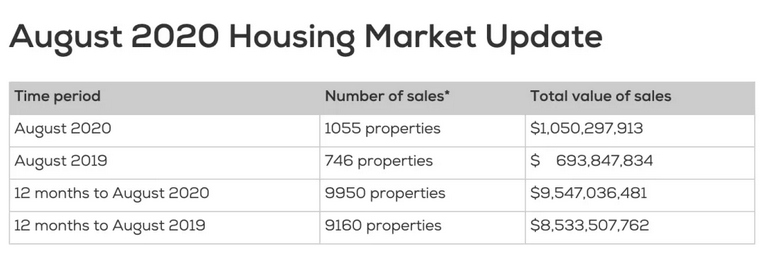
Both Peter Thompson and Carey Smith described their respective companies' August sales performance as exceptional.
Barfoot & Thompson completed 1055 sales in Auckland, down 3.7% on the previous month but up 41.4% on the same period last year.
Ray White's nationwide sales performance rose 84.4% compared with August 2019. It completed 1,648 transactions, with sales totalling NZ$1,248,000,000.
Record average sale price
Barfoot & Thompson's figures show that sale prices in August were even stronger than in July.
- The average sale price was NZ$995,543, up 7% on the previous month and 7% on the same period last year. It also exceeded the previous record, set in March this year, by NZ$2000.
- The median price was NZ$911,500, up 4% on the previous month and 9.8% on the same period last year. This was the third-highest median price on record.
Of the homes sold, 60 fetched more than NZ$2,000,000, while a further 454 sold for more than NZ$1,000,000.
Sales above a million dollars accounted for nearly half of all transactions. A further 84 homes sold for less than NZ$500,000.
Ray White's top-performing branch in August was Remuera in Auckland, with sales of NZ$105,000,000, also a record for the branch.
The next highest-performing branches were Manukau, with NZ$51,000,000; Ponsonby, NZ$50,000,000; Epsom, NZ$49,000,000; and Mount Eden, NZ$37,000,000.
Strong supply and demand keep the market active
Peter said property sales in August were very active and strong across all price brackets, communities and regions.
Lifestyle and rural property sales also grew substantially, with sales volumes up 77% on the same period last year.
“More people are recognising that lifestyle and rural properties offer better value for money compared with today's persistently high urban house prices. Many Auckland buyers are showing very strong interest in properties on Auckland's North Shore and in the south, extending into Waikato.” Vacant land suitable for development has also attracted considerable developer interest.
Peter believed that “buyer demand remains strong and steady. Sales exceeded a thousand for the second consecutive month this year, bringing activity to a level comparable with the peak of the previous property cycle.
”By contrast, the supply of homes for sale in Auckland is becoming a pressing issue, in line with the national market.
“Despite 1354 new listings in August, we had only 3703 properties for sale at the end of the month, the lowest level since February this year,” Peter said.
Ray White's figures likewise show that buyers are positive about the market. First-home buyer numbers have increased significantly, while investor interest in purchasing remains strong.
“Vendors are achieving high prices, particularly for properties sold by auction,” Carey said. In August, Ray White's nationwide property auction volumes reached a record high, with an auction clearance rate of 78%.
Carey believed the market outlook remained strong, given New Zealand's policy of maintaining low interest rates into the future.
However, he disagreed with the view that listings were scarce. “Buyer confidence comes not only from low interest rates, but also from their ability to afford purchases and the ample choice of properties available.”
Carey did acknowledge that “Ray White's asking prices have risen 9.2% compared with the same period last year, largely because of supply and demand, as available listings have fallen 12.7%.
”However, he said the company's total nationwide stock of properties for sale was still 7% higher than 12 months earlier, with 4,127 properties available. He added that “our latest new-listing figures show 1,732 properties coming to market, an increase of 10.1% nationwide”.
He therefore believed there was no shortage of new listings and that these could largely meet buyers' needs. Much shorter selling times were simply creating a sense of urgency in the market.