
Commercial property vacancy rates rise in the short term,what opportunities will future infrastructure investment bring?
Although New Zealand's 2020 general election has been postponed until 17 October because of a renewed COVID-19 outbreak, the intensive election campaign has already given the public a full view of the parties' future policies. Clearly, both major parties are focusing their economic recovery plans on infrastructure investment. What impact will that investment have on the property market?
Unprecedented infrastructure investment is inevitable
It is already clear that whichever party wins and forms a government will introduce large-scale fiscal stimulus to revive the economy battered by the pandemic. Major investment in infrastructure programmes is seen as a way to stimulate economic recovery after COVID-19 and create more jobs in the short term, while upgrading New Zealand's infrastructure to better meet its long-term needs.
{ad}
- Labour: extending the infrastructure programme announced early this year
The policies Labour announced before the election actually began early this year, when the Labour-led coalition government released details of its programme to upgrade New Zealand's infrastructure. It comprised NZ$12,000,000,000 in project investment, including 6,800,000,000 for transport. Then, in July, the government introduced a NZ$3,000,000,000 COVID-19 Response and Recovery Fund to launch a series of shovel-ready construction projects nationwide. Of this, NZ$708,000,000 was allocated to transport, including cycleways, walkways, ports and roads.
- National: 31,000,000,000 to upgrade New Zealand
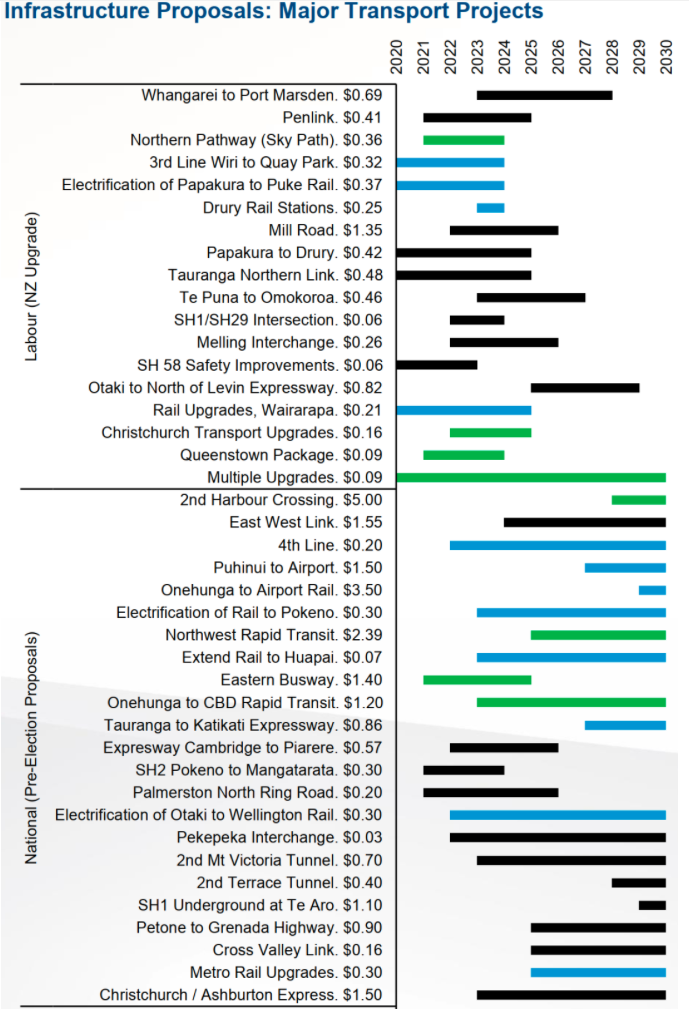
As the election campaign progressed, National announced that, if elected to government, it would invest NZ$31,000,000,000 in transport projects over the next ten years. Covering all areas of transport, this construction programme forms the main part of its plan to upgrade New Zealand. At the heart of National's policy proposal is a new second surface route across Auckland Harbour.
Which regions will benefit?
The transport infrastructure proposals put forward by both Labour and National can be expected to support future economic development across most of New Zealand. In the North Island, for example, a four-lane motorway will connect Whangārei, Auckland, Hamilton and Tauranga within 10 years, while Wellington will receive up to NZ$3,500,000,000 for various construction projects. In the South Island, NZ$90,000,000 in infrastructure investment will further enhance Queenstown's tourism hub. Canterbury will benefit from a series of urban transport upgrades in Christchurch, as well as a proposed motorway potentially linking Christchurch and Ashburton.
Far-reaching effects on property
Infrastructure construction may appear unrelated to property, but it could bring the sector numerous benefits, including:
- New road and rail networks will make travel easier and more efficient, helping open up new residential areas and accommodate future population growth. Development of these areas will, in turn, increase demand for local retail services and new entertainment, hospitality and tourism facilities.
- Demand for consultancy work will rise substantially during the initial design stages, supporting employment growth. The wide geographical spread of infrastructure construction will also increase demand for office space in regional centres.
- Improved commuting will encourage greater intensification of residential, office, mixed-use and retail space around transport hubs.
- Large infrastructure projects will create valuable opportunities for industrial property. Demand across this sector will generally increase both during development and after completion, initially from construction and gradually spreading to other industries as demand grows.
- Over the longer term, logistics will benefit significantly, as the national transport network receives the largest share of construction funding. New motorways, extensions to existing motorway networks, new railway lines and further electrification across the network will expand existing logistics networks and support new logistics hubs, inland ports and last-mile delivery facilities. Dark stores will also continue to emerge as online retail grows.
Looking at the major commercial property sectors individually, Colliers International outlined current market trends in its September report.
- Offices: vacancy rates may rise further
Office vacancy rates in Auckland's and Wellington's CBDs have gradually risen from their cyclical lows, mainly because more secondary office space has become available. The June 2020 survey put Auckland CBD's overall vacancy rate at 6.3%, above its historic low of 4.7%. Secondary building vacancies rose from 6.3% to 8.5%, while prime building vacancies increased from 2.5% to 3.5%. In Wellington, CBD vacancies rose from 7.7% to 8.1% between December 2019 and June 2020. Secondary building vacancies increased from 7.7% to 8.1%, while prime building vacancies rose from 0.4% to 0.6%.
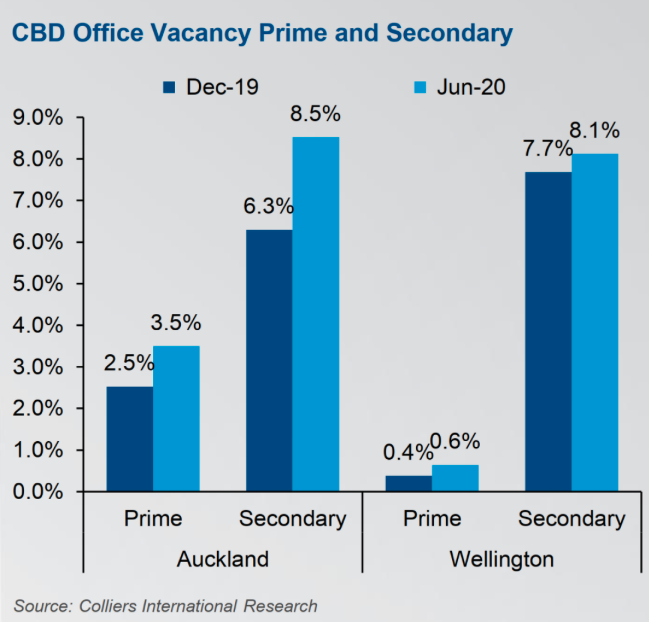
Given current economic conditions, future development plans and expected changes in occupancy, overall vacancy rates may rise further. As new developments are completed, both prime office space available for sublease and unleased space in existing prime buildings will increase. This will give tenants more opportunities to lease quality offices, potentially with more attractive rental incentives than in recent years.
- Industrial property: a strong manufacturing recovery
The July Performance of Manufacturing Index (PMI) figures show a strong V-shaped recovery in New Zealand manufacturing. The seasonally adjusted PMI was 58.8; a reading above 50.0 indicates manufacturing expansion, while one below 50.0 indicates contraction. This was the highest level since April 2018, up from the record low of 26.0 in April, when New Zealand was under Level 4 lockdown. Nationally, manufacturing contributes around 10% of New Zealand's annual GDP. In March 2020, manufacturing generated NZ$24,000,000,000 in output, accounting for around 11% of GDP in March 2020. Although manufacturing's share fell by 1.7% compared with the same period last year, output remained virtually unchanged, varying by less than 0.1%.
- Retail: major new developments alongside rising vacancies
Despite severely challenging trading conditions caused by lockdown, retail recorded the largest increase in space in the second quarter.
Auckland gained around 57,000 square metres of retail space, including the successive openings of major developments such as Commercial Bay shopping centre, furniture and homewares store Nido Furniture, and home improvement store Bunnings Westgate. However, the overall retail vacancy rate rose to 3.8%, equivalent to around 67,000 square metres, compared with 3.3% six months earlier.
In Wellington, the latest survey showed retail space declining from 112,530 to 111,618 square metres because a substantial amount of space was excluded while undergoing refurbishment. The overall vacancy rate was 6.7%, up from 4.1% in December last year. This increase was largely due to a small number of large vacant units in the Willis Street precinct.